My first woven rug came together rather fast, from six old shirts of Jeff’s (one which I made for him years ago, and five LLBean shirts) made custom for a space in our bedroom in front of an old dresser which was given to us by a weaver (hi B!). The rug was woven on my 48″ rigid heddle loom, with the Freedom Roller attached, and I used a temple but kept it back a few inches from the fell so I didn’t whack it with the Schacht weighted beater.

Its been raining steadily for a few days, and I hemmed the rug sitting at the window, in the low light of the afternoon, admiring the Autumn color outside with the black oaks that have completely turned gold.

I am really surprised I could weave an *actual* rug on a rigid heddle loom! The rug is 28×50 inches, and I figure I could have had double the length with the Freedom Roller attachment; I reckon I could warp up to 48″ wide, so in theory, I could make a monster rug of 4×8 feet. After I finished weaving it I hemmed the edges to the under side, and carefully took the labels off and chose one to sew on the hem for a little artful whimsy . . .

Juno was the warping and cutting supervisor!


♣ Weaving Notes ♣
General Notes: I had to get around the fact that the rug is not made with a proper floor loom, with a heavy swinging beating reed, and so I had to beat hard along each weft with the Schacht weighted beater, but the end result was good enough. I thought of a clever way of cutting long strips; figured since the strips of cut fabric are getting scrunched into the warp anyway, it does not matter if they are on the bias or on the grain, I cut about 2″ wide strips, starting at the bottom, between button bands, following the shape of the shirt tails, zig-zag cutting back and forth, using up as much of the shirt as possible, and very little was cut on the grain. The sleeves were mostly spiral cut. When about 1.5″ from the button band I stopped, then from beneath cut a wide turn back the other direction over of the previous cut, snipping across side seams as they come. I was not particularly neat with the cutting either. I cut all the ends angled, and overlapped the beveled ends instead of sewing edges together, which would be way more work. I wove one shirt completely before starting the next, in segments rather than stripes, so we could recognize the old beloved shirts in their sequence.
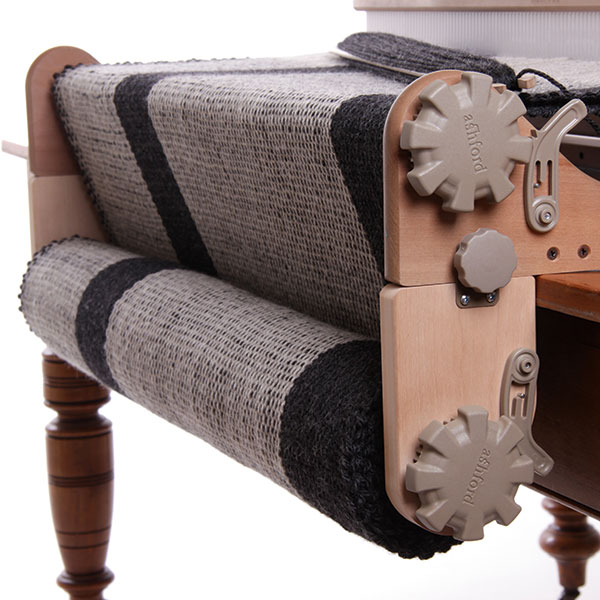
Additionally, the rug is fairly sturdy and thick and the woven “cloth” builds up fast on the cloth beam, so the Freedom Roller (Ashford’s add-on cloth beam for their rigid heddle looms) is absolutely essential in my opinion to weave a rag rug that is thick and substantial, as is the weighted beater. But perhaps the most essential thing that I overlooked (never again!) is the importance of using warping yarn that can withstand the punishment of the hard beating.
- Yarn: Maurice Brassard 8/2 cotton, double threaded (2 in hole, and 2 in slot) emulating 8/4 warp yarn. Approx 80″ from apron rod to pegs. Should have bought heavier warp yarn and waited for it to arrive before starting the rug!
- Weft: Cotton flannel strips, about 2″ wide, taken from old shirts. Beginning and end 3″ same as warp, woven wide enough to make a turned hem below the rug.
- Loom: Ashford 48″ Rigid Heddle Loom (the beast!) with Freedom Roller attachment
- Number of warp ends: 210, double threaded = 420.
- Reed: 7.5 dpi (30/10cm) dent rigid heddle reed, about 28″ width in reed.
- Finished: 1 inch turned hem, sewn against the underside of the rug. No washing/drying. Measurements finished are 28″ x 50″. I planned for 60″ length but made a mistake when measuring warp distance and somehow didn’t factor in the correct amount of loom waste! Gaw!!!
- Yardage: Who knows…. 6 shirts using as much as I possibly could.