Rug No.2

It has come. The summer in its scorching moods and light saturated glaring afternoons, where the heat is reason to be out in the early mornings just to get a breath of fresh air, to water the plants, fill the birdbaths, and take Juno for a scamper. Then it is back inside, to stay busy beneath the posts and beams of the house, sheltering in. The solstice has already long passed, the days are shortening already, at a dizzying rate, it will soon be Autumn again, and each year older I become, the pages of my calendar flip faster than I can write anything down… the days, near empty boxes on pages turning… and my blog goes quiet for weeks upon weeks now. My focus has been elsewhere, and for a long time. I feel this morning though, as I have woken not only to a new day, but a new clarity, a new trust in myself.

In the new year I put together the Brooklyn 4-shaft table loom, and I finally began to weave very fine narrow cloth, satisfying a craving that goes beyond reason, lost to its gravitational pull, I was sure it was me married to fine linen weaving for the rest of time (Cloth No.4) . Even though everything, and in all directions, is part of the creative experience, adventuring so far out in one direction, before recentering and then again drifting off in another direction, like a pendulum. I wonder, is this the way of the artist? I am longing for a mid-summer reset at center. I confess, there are times I’m just too embarrassed to post about yet another diversion, that I have become more quiet, unsure of my impulses, I seek the stillness, worried that as soon as I put it into words, the words already begin to change inwardly.

Soon we will (finally) be putting in the finish floor for our rebuilt home (but not too soon, hopes Juno), and in a bit of anticipatory celebration I have decided to weave rugs. Lots of them? Reminiscing in the archives to November of 2024, I had recently woven my first sakiori from torn cloth, and then completed my first floor rug, feeling certain these were to be the first of a huge series where I would refine my technique. But I had not woven another until now. Reconstructing worn clothes into bit of improvisational rag weaving of sakiori cloth and rugs, while at the same time weaving fine cloth requiring intense focus, should keep me on my toes for the remainder of the summer!

♣   Weaving Notes  ♣

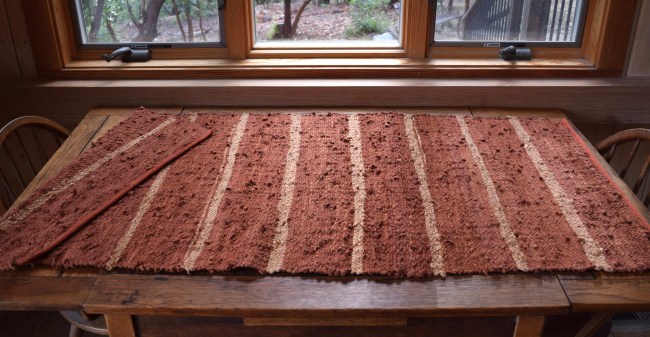
I wove a third of the rug with no particular pattern in mind but to make stripes, which I think was maybe a bit cliche. I did however, make intentional “mistakes”, laying down a few colors out of sequence, and making some stripes fatter than others, going for that folk art appearance. The effect was perfectly achieved when the faded areas of the fabrics, from drying on the clothes line inside-out in the sun, over time create a variegation of color, sought-after in folk textiles.

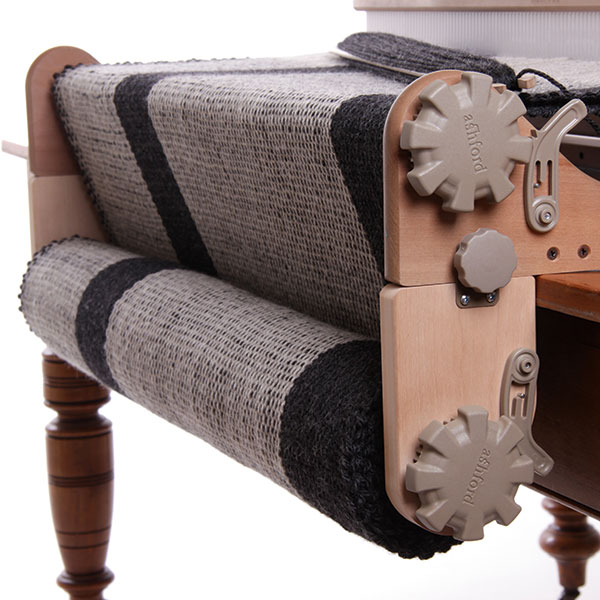
Oh, and it is definitely worth mentioning that weaving a rug on a rigid heddle loom needs a bit of specialized extras — specifically a weighted beater to really pack down the weft (the plastic reed is only to change sheds, not to beat anything) , and in my opinion the Ashford Freedom Roller is essential for the bulk that builds up in no time on the cloth beam.

The actual weaving notes are minimal for this project, as I was improvising through the whole thing, and not taking notes. Here is what I remember…

  • Yarn: Warp: 8/4 cotton warp yarn from Maurice Brassard, in color Rouille. Weft: Linen strips cut from many pairs of 100% linen pants, ranging from 1/2″ to 1-1/2″ , creating a thick-and-thin appearance, from spiral cutting up from the hem of the legs, over side seams and patches, going with the rustic nubby effect.
  • Loom: Ashford 32″ Rigid Heddle Loom with Freedom Roller attachment.
  • Warping method:  Direct warp method, double threading from back apron rod, through front to peg = 110″ , which was a rough guess to be more than long enough to use up all the terracotta linen strips. Wound on to back beam and finally threaded 1 in each hole and 1 in each slot. Tied off on to front apron rod for weaving.
  • Number of warp ends: Approx 182
  • Reed: 12.5 dent, but threaded every other hole/slot to create 6.25 dents per inch.
  • Width in reed: approx. 29″
  • Selvedges: Used a temple to keep width in reed.
  • Finished:  I didn’t want fringes, so I planned to hem. Wove the first and last 2″ woven in warp thread, packed down with weighted beater created weft-faced, stitched a rolled hem. I should have woven first 3 inches and packed down tight with weighted beater like I had at the last 2″. Measures 29″ wide by 66″ long unwashed.
  • What I will do differently next time: Cut the strips 1″ consistently, weave the warp thread header longer and pack down with fork for a tightly woven rolled hem. I will make a very minimal weavers angle when laying in the weft, for fear I was too dramatic with this one. Also, I really think for linen rags, I would like to use linen warp.

Cloth No.4

I have finally cut the linen off the loom and it is free, warp and weft married for the rest of time, and never to be unraveled. There is something sure and permanent about a well and densely woven piece of linen cloth, that it would tear before it would unravel, it would compost into soil before the weft and warp let go of each other.

My goofy mistakes presented themselves as I thought I was focused and yet I ended up at the beginning having to improvise through a lot of chaos in spite of my focus. There were a lot of things I should have done differently in this weaving; the most important being that I set up the warp very dense at 32 epi (warp threads per inch) and since the warp ends were so close together, the weft didn’t weave in a balanced way, the sure sign is that it is nearly half that. Next time when weaving this linen with 32 epi should weave twill structure I think, or if I continue to do plain weave, beat harder with the weft… looking for that sweet spot.

I learned also that it would have been great had I made a piece half this length, surely I could have a nice linen scarf, or something nice to wrap bread in out of the oven, and not invested so much time and expensive linen on a less-than-optimal sett. My new rule: Weave a small piece until I’ve got it perfect, THEN weave the yards-long cloth.

♣   Weaving Notes  ♣

I had already threaded the heddles starting at one end of the reed, planning to fill every dent, so the fact that I forgot to leave a couple of dents for the floating selvedge made it a challenge. One end had an intentional floating selvedge, threaded second, which is not wound on to the warp beam and the length of the thread winds around a bobbin and hangs off the back of the table through the weaving. The other side, as I forgot to make the floating selvedge first, I had to improvise an after-thought method, and I can’t remember what I did exactly, but may have cut off two texsolve heddles to free up two threads wound on to the warp beam with the rest of the threads, and to tension the after-thought floating selvedge threads — as they were not making the trip up and down with the rest of the threads in the harnesses — the slack would increase without the take-up, so I weighted it also with a bobbin and tied to the thread so it could move as the warp progressed forward. I also figured this was a happy mistake, for as a couple of other threads loosened along the way, well they got the bobbin trick hanging off the back too.

  • Yarn: Linen 14 from Silk City Fibers (7000 yards per pound) in Cream.
  • Loom: Ashford 16″ Brooklyn 4 shaft Table Loom, straight draw threading for plain weave, lifting pairs of odds & evens (1 & 3 , and 2 & 4)
  • Warping method:  Direct warp method, double threading from back apron rod, through front to peg. Wound on to back beam and finally sleyed through reed, threaded the heddles, and tied off on to front apron rod for weaving.
  • Number of warp ends: Again, I forgot to take these critical notes, so distracted by improvising through warp patterning.
  • Reed: 16 dent
  • Sley pattern: 2 ends in each dent
  • Threading pattern: 1 end in each heddle, but for the windowpane texture threaded 2 ends in a heddle.
  • Width in reed: approx. 15.5″
  • Sett on loom: 32epi
  • Selvedges: Floating selvedges , 2 ends each side. Used a temple to keep width in reed.
  • Sett after finishing: Warp 34 epi, and weft 18 ppi
  • Texture Pattern for Warp:  This was an exercise in making mistakes, so no need to put the pattern down as it ended up being crazy different. I had intended to have very subtle window panes, with only 2 ends in a dent. That was at least a good technique, but next time I will do four ( if I am to continue with direct warping, it must be even numbers per dent.)
  • Texture Pattern for Weft: I repeated the same measured distance between window panes as was in the warp, and because the window pane spacing in the warp was messed up badly, I repeated the sequence. In becoming a repeated mistake, in a way , makes it intentional and random at the same time! I ponder this method as something I may want to repeat, for it was at least not too repetitive.
  • Finished:  Ends woven in bamboo 8/2, makes a nice tight hold, so I could leave raw edge, with no hem. Washed and half dried in machine, then steam pressed, measuring 156″, or 4.33 yards long and 15” wide, and weighs 247g. 
  • Yardage:  Total yardage used for finished piece = approx 3812y, figured from weight of finished piece and not including loom waste. Note: it appears this project used half the 1.1 lb cone, so a single cone could in theory, weave double this yardage, probably 8 yards, or double the width, 31″ in the reed, with the same 32epi.

Seeking a Snowy Oasis

Pure, clear, and fresh. These words come to mind as I weave my white linen. My shuttle seems determined as I pass it from hand to hand through the narrow shed in my little Brooklyn table loom, each pass of the weft is necessary, and deliberate, while at the same time I operate the hand levers, the shafts changing as if the warp is inhaling and exhaling. The long warp feels like an exhausting important journey to test me, and I embrace it.

But already I am anticipating the next, which will begin after I cut this cloth off the loom. I think about how it will be… a very simple and easy warp, also fine linen, also in white, also in plain weave, but with very sparse pattern, if any, as only my own soul knows how I’ve longed to weave. I am thinking about the beauty of clarity, and newness, and the meaning behind my white fine linen threads, how it is so much like freshly fallen snow. The white linen and the white snow are nearly parallel symbolisms to me because they are untainted and honest, they are raw and pure, they are elemental.

My mind drifts back to the absolute stillness of a winter landscape I remember from not long ago. In my archives I found the post of that day when the snow fell so heavily, and silently in the night, to have woken up to such a deep white landscape I’d never before seen up here. Now to remember it, bringing out the image of that view from my loft studio window, I can almost feel and smell the frigid air in my nostrils. While my hands march through the endless second half of the warp, I’ll drift in my mind to a snowy oasis, to stay driven in the weaving towards the finish.

floating

Things are floating presently. These mornings the dense fog floats up towards the mountain from the valley, the floating selvedge weights hang suspended until the weaving is finished, and even the most subtle windowpane texture seems to float in the cloth. And I have been floating too; between resolve and distraction, between cool mornings and warm afternoons, between the first half of the warp, and now the second.

I have been making steady progress. It is a quiet kind of work as I study and admire the linen, and I find myself enjoying the rhythm of the loom, especially while things are even more quiet than usual, even more still than usual. Weaving linen requires a lot of focus, much like any important journey. I’m keeping at it, and watching my “weavers’ angle”, even in the times I’m not writing as much, it is because the work itself is a way of staying connected.

And as I have finally reached a bit of a turning point, having woven half the warp, I feel suspended and hanging a bit, like the floating selvedge weights, yet at the same time I feel things notching-up with excitement to finish, finding it interesting how focus becomes clearer once you finally sense the end ahead.

Cloth No.3

This textured plain weave cloth was mostly improvised, and I got swept up in the weaving of it, so if I hadn’t made the notes when I was planning it, I wouldn’t have had any at all. The weft windowpane motif did not look as I planned so I experimented different ways throughout the weaving (see weaving notes below). Above all, I’m so glad I tried this cotton; it is organic, and an off-white cream color, with those little dark flecks raw muslin typically has, unnoticeable in its yarn form. It happens to be the only 20/2 weight I could find that is not mercerized, it has a very soft buttery feel and is a good value as it is available in 1 or 5 lb cones. In future weaving with this cotton, I will warp the yarn at 24 epi, which would be sheer, and also at 40 epi would be crisp and dense. The cloth series is for me to understand the spectrum between sheer and dense weave and finding the ultimate balance to my personal liking.

I’m very much enjoying this simple basic Ashford Brooklyn 4 shaft table loom for weaving fine cloth, even more than the Ashford 8 shaft table loom, because it is easier to thread and sley, being the castle (the part housing the 4 shafts) is smaller, it is just easier to set up. It is Ashford’s “transition” loom, for those rigid heddle weavers to learn multi shaft weaving, but I think it is a lovely small tabletop loom that can do anything.

♣   Weaving Notes  ♣

About sleying 2 ends per dent — in managing such a high epi, the only way I am willing to weave multiple ends per dent in such fine cloth is to keep it easy and have the consistency of 2-in-1, always, and just have the right reed so that I can do that. Patterning is a lot to keep track of all on its own, without the added complication of spacing variable numbers in the reed, so an even number is essential for me to help me keep track of the threading straight draw. Probably cramming 4 ends per dent is really too many if the warp is a close sett, leaving reed marks like in Cloth #2 did, and even though it likely will even out in the wash, I don’t care to have reed marks at all.

  • Yarn: 20/2 cotton, 8400yds / 1 lb, non-mercerized  Organic Cotton Plus.
  • Loom: Ashford Brooklyn 4-shaft Table Loom, straight draw threading for plain weave, lifting pairs of odds & evens (1&3, and 2&4)
  • Warping method:  115 ” from from back apron rod to far peg. 
    • Direct warp method, from back through front to peg, while double threading from back apron rod through heddles and reed, then to peg — which creates 2 ends in a pull, at the same time sleying 2 per dent, threading 2 ends through each 1&3 shaft heddles, leaving 2&4 empty.
    • Then I wound on to back beam and finally tied off on to front for weaving, then rethreaded 1 end in every heddle 1-2-3-4, in small sections, tying off as I finished with tension, so the warp was always under tension.
  • Number of warp ends:  552 (544 + 4 extra ends per selvedge)
  • Reed: 16-dent, 256 dents total in Ashford 16″ reed.
  • Width in reed: 15.5″
  • Sett on loom: 32epi, with doubled ends for windowpane “ridges”.
  • Selvedges: 4 extra ends at each selvedge and used a temple to keep width in reed.
  • Sett after finishing: Warp 35 epi, and weft 35 ppi.
  • Pattern in Warp & Weft: For texture in warp, I threaded 2 ends per heddle, for 2 heddles next to each other, and spaced approx 2″ apart, which created a dense texture probably too wide, so in weft I did not pay too close attention but made a “crammed” weft with 2 to 6 ends, over 1 to 3 picks, basically I experimented;
    • 1. Weft passes in the same shed 4 or more times, catching the outside selvedge thread.
    • 2. Weft passes in the same shed 2 or 3 times, changing shed for a single, then repeating the shed with 2 or 3 passes. This probably most mimics the warp.
    • 3. Winding the shuttle bobbin with 4 threads, passing once , then the regular weft single once, then another pass of 4 threads, this probably looked the best but the ends had to be overlapped and ended up standing out a bit and creating difficult selvedges.
  • Finished: Raw edge not hemmed, not fringed, just cut and frayed in the wash. Washed by hand in very warm water, partially dried in machine, then steam pressed, measuring 80″ long and 14.5” wide, and weighs 117g. 
  • Yardage:  Total yardage used for finished piece = 2,167y, figured from weight of finished piece and not including loom waste.
  • Note: From my experience of sheer to heavy cottons, this feels medium weight, which is still draping quality, and soft. It was woven at 32epi, so I think weaving 24epi would give it the sheer light weight feel, but probably shrink a little more because of all the air space in the mesh. Woven at 40 would be the maximum I think.