Things that go with yellow.

I am conducting experiments in chambray. A traditional cloth of plain weave in two colors, but finding my own pairings beyond the standard blue-and-white. I have set out to test first the yellows, creating a color gamp that shifts between yellows, golds, and peachy apricots.

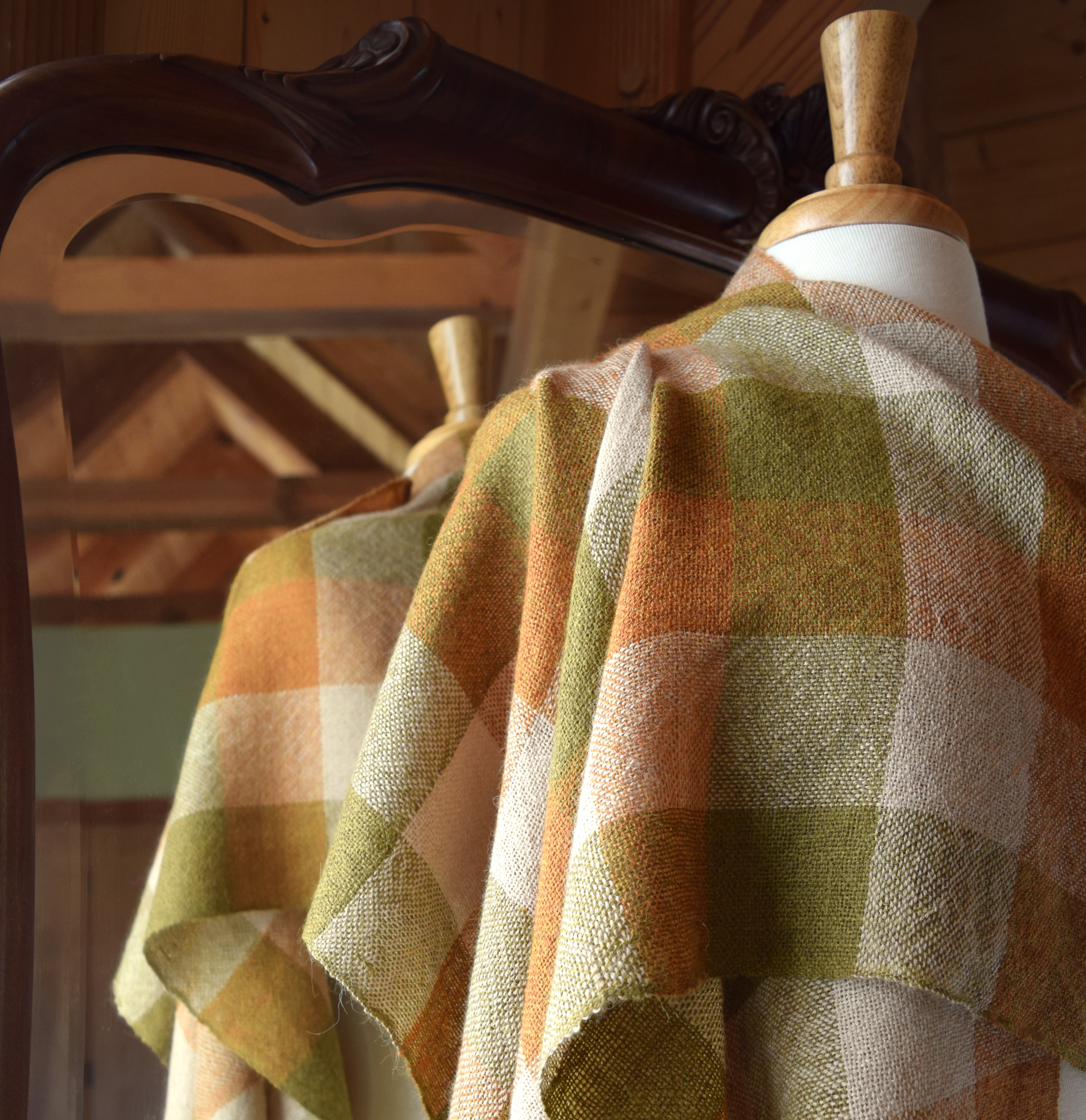
I warped my tiny sample loom in a sequence using four distinct shades of yellow. For the weft I wove the same sequence in the four yellows to see the true solid shades on the diagonal, then I introduced white — the traditional chambray partner — see how it tones down the yellows to unique pale versions? I then wove in subtle pale pink, which created a soft cross-weave that gently changed the yellow to apricot, and a deeper pink to a beautiful terracotta.

Because chambray is a plain weave, the weft and warp threads are equal, so in a balanced weave the new color should be a perfect mix of two. When the pink wefts interlock with the four shades of yellow warp, they don’t fight for dominance, instead, they melt into each other… the bright yellows soften, the pinks lose their coolness, and a rich, glowing spectrum of new colors emerge. This color gamp shows how yellow isn’t just a single note … with the right chambray pairings, it is a chameleon.

Chambray — a new category in my cloth weaving exploration where I refine color blending, and something I can easily do now thanks to my little Ashford sample loom, I am ready to pair up colors and see them come alive, so excited about my summer “gamping” trip!

♣   Weaving Notes  ♣

Although its just a sample, a color gamp, to show how the different colors look together, I need to list the exact colors I used so that I can come back to this and repeat. What is going on with the mottled appearance in the darker shades? I have learned that the term for this is “tracking” apparently, and though I will understand it one day, for now it is a mystery!

  • Yarn: 16/2 cotton from Bockens, warped in a sequence of yellows; 104, 101, 2030, 0020. I then wove the same sequence in the weft first, before weaving with natural 2000, pale pink (468) and rose (471).
  • Loom: Ashford 10″ Sample Loom
  • Warping method:  Direct warp method, threaded through two 15 dent reeds.
  • Sett on loom: 30epi

Rug No.2

It has come. The summer in its scorching moods and light saturated glaring afternoons, where the heat is reason to be out in the early mornings just to get a breath of fresh air, to water the plants, fill the birdbaths, and take Juno for a scamper. Then it is back inside, to stay busy beneath the posts and beams of the house, sheltering in. The solstice has already long passed, the days are shortening already, at a dizzying rate, it will soon be Autumn again, and each year older I become, the pages of my calendar flip faster than I can write anything down… the days, near empty boxes on pages turning… and my blog goes quiet for weeks upon weeks now. My focus has been elsewhere, and for a long time. I feel this morning though, as I have woken not only to a new day, but a new clarity, a new trust in myself.

In the new year I put together the Brooklyn 4-shaft table loom, and I finally began to weave very fine narrow cloth, satisfying a craving that goes beyond reason, lost to its gravitational pull, I was sure it was me married to fine linen weaving for the rest of time (Cloth No.4) . Even though everything, and in all directions, is part of the creative experience, adventuring so far out in one direction, before recentering and then again drifting off in another direction, like a pendulum. I wonder, is this the way of the artist? I am longing for a mid-summer reset at center. I confess, there are times I’m just too embarrassed to post about yet another diversion, that I have become more quiet, unsure of my impulses, I seek the stillness, worried that as soon as I put it into words, the words already begin to change inwardly.

Soon we will (finally) be putting in the finish floor for our rebuilt home (but not too soon, hopes Juno), and in a bit of anticipatory celebration I have decided to weave rugs. Lots of them? Reminiscing in the archives to November of 2024, I had recently woven my first sakiori from torn cloth, and then completed my first floor rug, feeling certain these were to be the first of a huge series where I would refine my technique. But I had not woven another until now. Reconstructing worn clothes into bit of improvisational rag weaving of sakiori cloth and rugs, while at the same time weaving fine cloth requiring intense focus, should keep me on my toes for the remainder of the summer!

♣   Weaving Notes  ♣

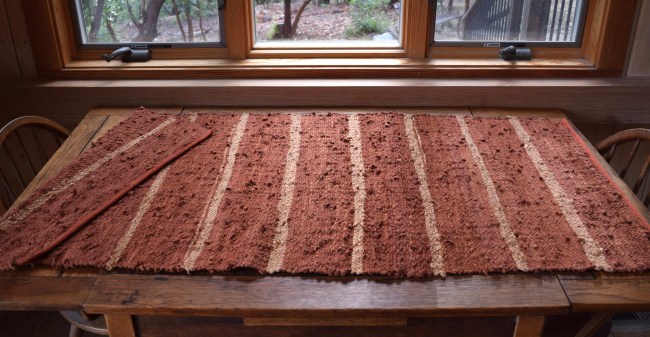
I wove a third of the rug with no particular pattern in mind but to make stripes, which I think was maybe a bit cliche. I did however, make intentional “mistakes”, laying down a few colors out of sequence, and making some stripes fatter than others, going for that folk art appearance. The effect was perfectly achieved when the faded areas of the fabrics, from drying on the clothes line inside-out in the sun, over time create a variegation of color, sought-after in folk textiles.

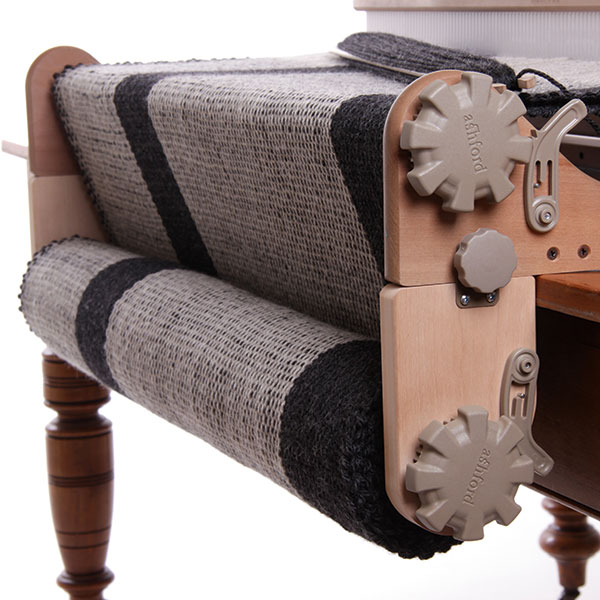
Oh, and it is definitely worth mentioning that weaving a rug on a rigid heddle loom needs a bit of specialized extras — specifically a weighted beater to really pack down the weft (the plastic reed is only to change sheds, not to beat anything) , and in my opinion the Ashford Freedom Roller is essential for the bulk that builds up in no time on the cloth beam.

The actual weaving notes are minimal for this project, as I was improvising through the whole thing, and not taking notes. Here is what I remember…

  • Yarn: Warp: 8/4 cotton warp yarn from Maurice Brassard, in color Rouille. Weft: Linen strips cut from many pairs of 100% linen pants, ranging from 1/2″ to 1-1/2″ , creating a thick-and-thin appearance, from spiral cutting up from the hem of the legs, over side seams and patches, going with the rustic nubby effect.
  • Loom: Ashford 32″ Rigid Heddle Loom with Freedom Roller attachment.
  • Warping method:  Direct warp method, double threading from back apron rod, through front to peg = 110″ , which was a rough guess to be more than long enough to use up all the terracotta linen strips. Wound on to back beam and finally threaded 1 in each hole and 1 in each slot. Tied off on to front apron rod for weaving.
  • Number of warp ends: Approx 182
  • Reed: 12.5 dent, but threaded every other hole/slot to create 6.25 dents per inch.
  • Width in reed: approx. 29″
  • Selvedges: Used a temple to keep width in reed.
  • Finished:  I didn’t want fringes, so I planned to hem. Wove the first and last 2″ woven in warp thread, packed down with weighted beater created weft-faced, stitched a rolled hem. I should have woven first 3 inches and packed down tight with weighted beater like I had at the last 2″. Measures 29″ wide by 66″ long unwashed.
  • What I will do differently next time: Cut the strips 1″ consistently, weave the warp thread header longer and pack down with fork for a tightly woven rolled hem. I will make a very minimal weavers angle when laying in the weft, for fear I was too dramatic with this one. Also, I really think for linen rags, I would like to use linen warp.

Auld Lang Syne (Scarf No.15)

A lot of the time I don’t realize the coincidences at play as I bring something to finish. For instance, the Scottish phrase “Auld Lang Syne” evoking the sentiment of “for old times’ sake” and “days gone by” . . . and my attempt at weaving to mimic an “auld Scottish tartan” design that my dear old friend and I planned the minute I got my first loom a couple of years ago (the very loom on which it is photographed) . Posted yesterday drying on the line, today here it is, fulfilling all those sentiments as it will be draped artfully over the shoulder of an old wingback chair which sits facing an old woodstove, in a very, very old cabin. For old times’ sake indeed, not to mention it is New Year’s Eve — happy 2026 everyone!

♣   Weaving Notes  ♣

This weight of alpaca is truly perfect for the rigid heddle looms, using a 15 dent reed, because the drape is spectacular and there is enough room for the alpaca to bloom in the simple plain weave. Oh, and about the missing information in the notes; I wrote everything down on a piece of paper as I was calculating the design, then later lost the piece of paper, so it was accidentally thrown away.

  • Yarn: Knit Picks Alpaca Cloud lace weight, in Carson (dark grey), Alfred (medium grey), Arabella (dark green), Elizabeth (red), and Zadie (gold). 440 y = 50g
  • Loom: Ashford 20″ Knitters Loom
  • Warping method:  Easy direct warp method for rigid heddle, 1 end in hole and 1 end in slot.
  • Number of warp ends: Not available
  • Reed: 15 dent rigid heddle reed.
  • Width in reed: 18.5″
  • Selvedges: I added 4 extra ends to each of the selvedges, as they tend to get pulled in, and I used a temple.
  • Sett after finishing: Warp 16 epi, and weft 16 ppi.
  • Color Pattern Warp & Weft: Not available
  • Finished: 3″ hand-twisted fringe, then washed and air-dried hanging, and lightly steam pressed. Measures 89″ long (not including fringe) and 18″ wide, and weighs 175g. 
  • Yardage:  Total yardage used for finished piece = 1540y, figured from weight of finished piece and not including loom waste.

Scarf No. 14

Levi came to visit, and as I was showing him my alpaca scarf series, I could tell that he admired them, and that perhaps he even wanted one, but none of the colors I had woven were appropriate for his blue & grey gentlemen’s style. So, the day before he was to leave I suggested he design one with the alpaca colors I had on hand and that I would weave it for him, and so he did, and by the time he was leaving back to Canada, I had already woven one repeat to show him. Then this last week was a determined effort to getting it done, and now it is finished and ready to send in the post. As usual, my technical weaving notes are listed below.

♣   Weaving Notes  ♣

  • Yarn: Knit Picks Alpaca Cloud lace weight, in Carson (dark grey), Alfred (medium grey), Eleanor (light grey), and Bernard (blue). 440 y = 50g
  • Loom: Ashford 16″ rigid heddle loom
  • Warping method:  Easy direct warp method for rigid heddle, 1 end in hole and 1 end in slot.
  • Number of warp ends: 228
  • Reed: 15 dent rigid heddle reed.
  • Width in reed: 14″
  • Selvedges: I added 4 extra ends to each of the selvedges, as they tend to get pulled in, and I used a temple.
  • Sett after finishing: Warp 16 epi, and weft 16 ppi.
  • Color Pattern Warp: 20 ends each of *Carson, Eleanor, Bernard, Eleanor, Carson, Alfred, Carson, Eleanor, Bernard, Eleanor*, Carson.
  • Color Pattern Weft: Same sequence as for warp *thru*, and ending in Carson.
  • Finished: 2″ hand-twisted fringe, then washed and air-dried hanging, and lightly steam pressed. Measures 76″ long (not including fringe) and 13.5″ wide, and weighs 118g. 
  • Yardage:  Total yardage used for finished piece = 1040y, figured from weight of finished piece and not including loom waste.

An Auspicious Autumn (Scarf No. 13)

Hi, its me Abelene,

Jen did not weave on her scarves at all this summer, and now suddenly another alpaca scarf to show for a very auspicious occasion of the beginning of Autumn. Jen rattled through this scarf in the very last days of summer, having left it on the loom since Spring, while frenzied all summer long with other creative textile pursuits, as designing tweed blends, formulating dye recipes, ikat resist patterning and backstrap warp-faced weaving. We (the crew of inanimate objects) came out of the closet for this finishing event, and Señor Mirando and I have come to the conclusion that Jen has got something up her sleeve, finishing this scarf for the Equinox.

Happy Autumn, from Abelene & The Crew

♣   Weaving Notes  ♣

Note from Jen: With this scarf and every scarf I have woven on the 16″ rigid heddle loom, I have been using this simple tensioning tool, and if you would like to see the technical information about it, I give more detail in the post Scarf No.12

  • Yarn: Knit Picks Alpaca Cloud lace weight, in Amos (green), Zadie (deep gold), and Molesley (beige), 440 y = 50g
  • Loom: Ashford 16″ rigid heddle loom
  • Warping method:  Easy direct warp method for rigid heddle, 1 end in hole and 1 end in slot.
  • Number of warp ends: 240
  • Reed: 15 dent rigid heddle reed.
  • Width in reed: 15″
  • Selvedges: I did not add extra ends to the selvedges, but did use a temple.
  • Sett after finishing: Warp 16 epi, and weft 16 ppi.
  • Color Pattern Warp: [40 ends Amos, 40 ends Molesley, 40 ends Zadie] x 2
  • Finished: 3″ hand-twisted fringe, then washed and air-dried hanging, and lightly steam pressed. Measures 82″ long and 14.5″ wide, and weighs 133g. 
  • Yardage:  Total yardage used for finished piece = 1170y, figured from weight of finished piece and not including loom waste.
  • Note to self, recipient was Eleanor