It is finally warming up, and all the insects are on the wing, and while the meadow grass grows higher by the hour, the days are rolling on like an enchanted pastoral scene in the mountains. Jen is weaving pensively through the afternoons, and the crew of inanimate objects and I are having our usual philosophical debates in the closet. All is in an easy and unfettered mood, the mood of warmth and days growing longer at long last, a glorious and unassailable Spring!
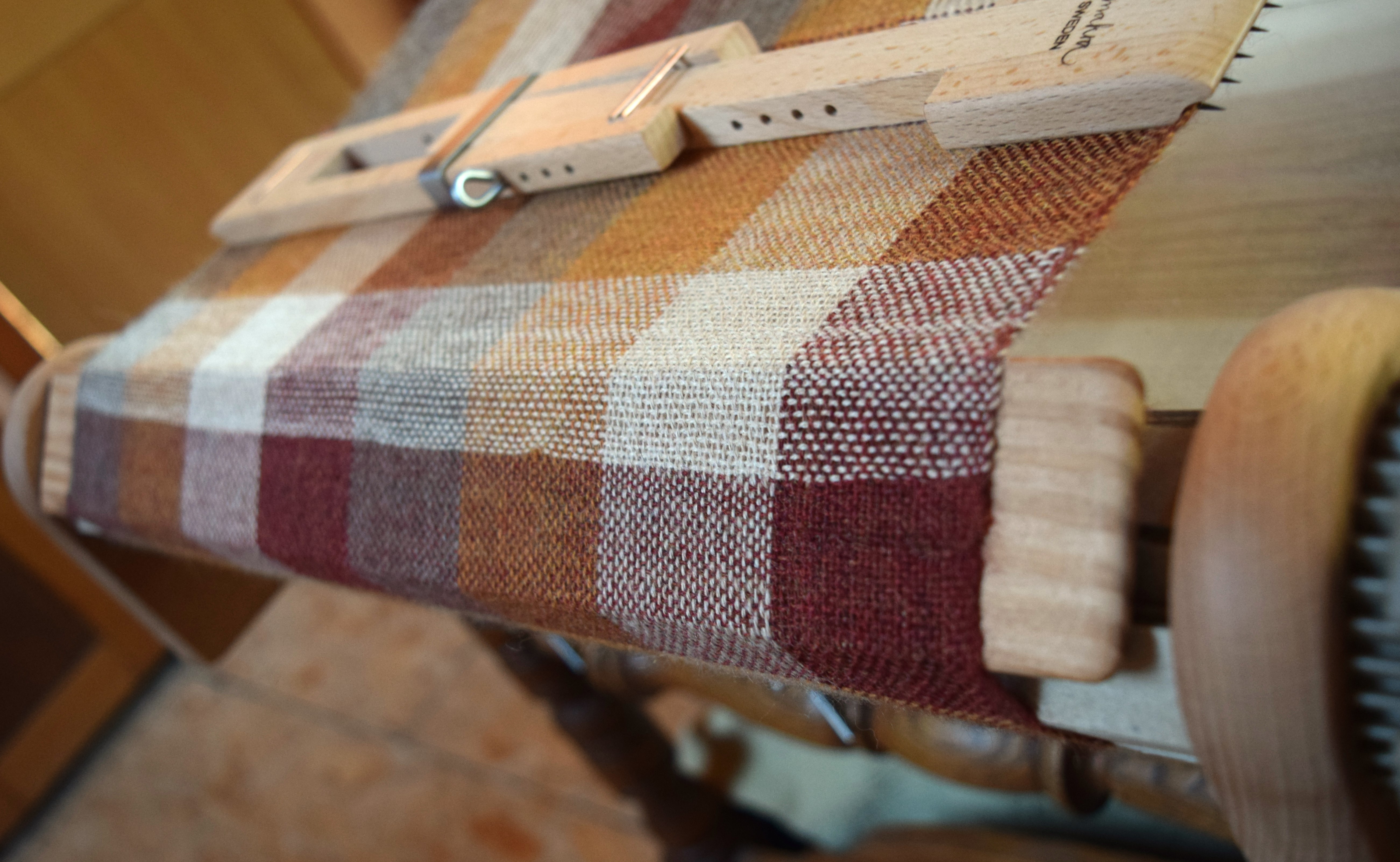
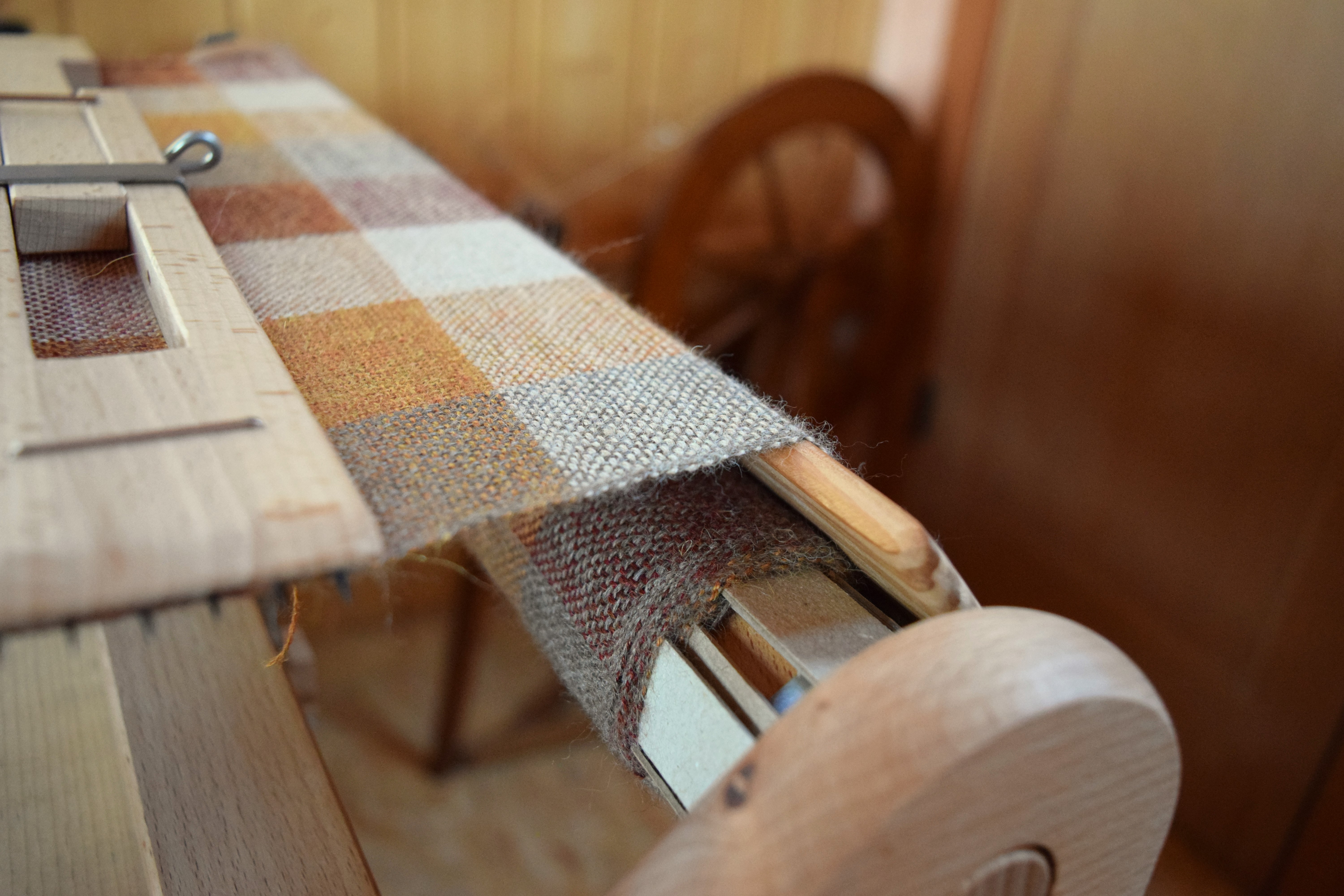
As for the alpaca scarf, it appears to be a Freudian Slip of weaving, as these colors turned out completely Autumnal, being Jen’s absolute favorite season, none the less, it is exquisite, even to be woven in Springtime.
Abelene & The Crew
Note from Jen: A few months back I made a discovery that I really want to revisit, for it has developed and I want to make sure to bring it to the fore, so that others may benefit from it. The improvised wooden piece that I came up with in the post Ikat No.1 ; I have developed its use in every weaving since, essentially becoming a loom “breast beam” as well as a fine tensioning tool. I wrote —
“When I was more than halfway through the weaving, and the front cloth beam was getting pretty packed with woven fabric and cardboard I found the cloth beam to have a certain amount of “squish”, the selvedges conforming to the curve of the cloth winding on irregularly, and not really producing a perfectly flat weave. This I assume is one of the things about rigid heddle weaving, the cloth beam builds cloth and as it does the woven cloth distorts in shape, as well as effects the stability of the tension.“
I have found several reasons why this simple fine sanded wood slat board has made a difference:
It is a fine-tuning for tension I found in rigid heddle weaving very much needed, as the tension changes in the down and up shed of the reed. The board moved forward (toward the weaving) loosens the tension – and moved back (toward the weaver) tightens it. This fine tuning of the tension allows better weaving , but also so that I can position a temple, or add cardboard warp separators, and a pulling back of the board tightens the tension, which helps open the sheds significantly.
It offers the crisp edge of a proper breast beam, such that some rigid heddle looms do not have as part of their simplistic design, Ashford being one of them. This is especially necessary if using a temple to stretch the weave the full width of the rigid reed, also I have found is necessary for a well balance weave with neat and tidy selvedges. Without a temple I find the selvedge warp threads get frayed-to-breaking, as the cloth can narrow and the selvedge threads rub against the reed, and it is a disaster when a warp thread breaks, especially the selvedge warp threads.
My tensioning board is 1/4″ thick and 2″ wide, it should be as long as the weaving width of the loom, so that it easily can support a maximum width warp. I will be making one of these for all of the rigid heddle looms I have.
♣ Weaving Notes ♣
Yarn: Knit Picks Alpaca Cloud lace weight, in Dashwood (med brown), Zadie (deep gold), Molesley (beige), and Lydia (brick red). 440 y = 50g
Loom: Ashford 16″ rigid heddle loom
Warping method: Easy direct warp method for rigid heddle, 1 end in hole and 1 end in slot.
Number of warp ends: 240
Reed: 15 dent rigid heddle reed.
Width in reed: 15″
Selvedges: I did not add extra ends to the selvedges, but did use a temple.
Sett after finishing: Warp 16 epi, and weft 16 ppi.
Color Pattern Warp: [30 ends Dashwood, 30 ends Zadie, 30 ends Molesley, 30 ends Lydia] x 2
Pattern Weft: Gold & Red dominant pattern: 2″ squares of [Zadie, Lydia, Dashwood, Zadie, Lydia, Molesley] rep length of warp.
Finished: 3″ hand-twisted fringe, then washed and air-dried hanging, and lightly steam pressed. Measures 72″ long and 14.5″ wide, and weighs 120g.
Yardage: Total yardage used for finished piece = 1056y, figured from weight of finished piece and not including loom waste.
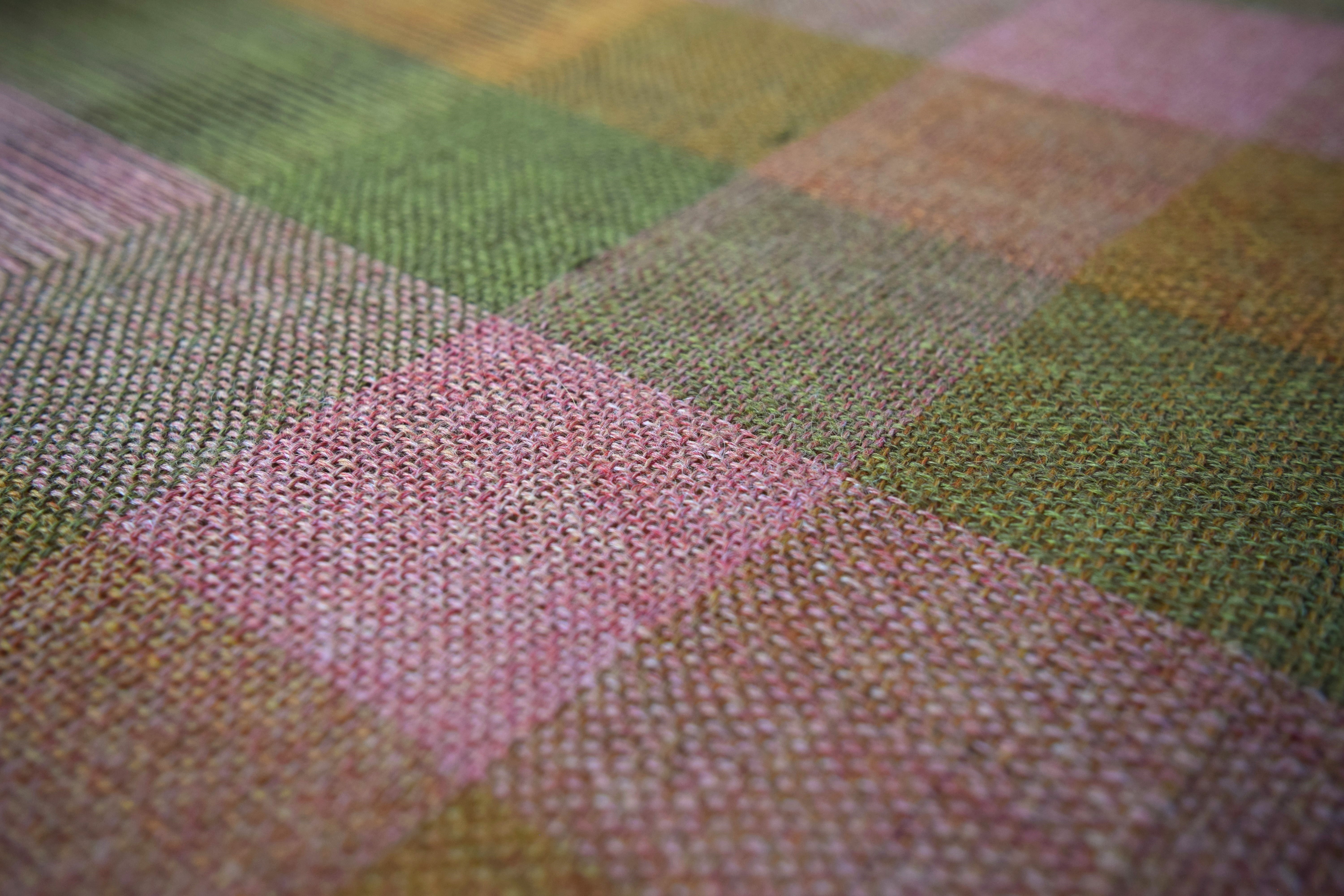
The Inescapable Spring is upon us, and breaking through the rain clouds are streaming in colors of the most vibrantly rich tones imaginable, the colors of apricots ripening on the tree, the gold sun kissed fruits soon to ripen to perfection before being plucked and bitten into. Señor Mirando and I think the Inescapable Spring weaving is definitely speaking of apricots. March has come in like a lion, and with cool breezy days full of beautiful weather still blowing through, Jen says she is going to warp another in the alpaca scarf series, because the mood is still on!
Abelene & The Crew
♣ Weaving Notes ♣
Note from Jen: What I love most about this piece is that the colors melt into each other, with low contrast on the grey scale. I want to repeat this , the colors really surprised me in the end, I thought it was going to be too much color, but it all gets toned down in the intersection of the colors. This time I was careful to set the loom up correctly for direct warping, and it was easy, and it was the perfect length. The second alpaca lace-weight I have woven on the 16″ rigid heddle loom, and I just love the balanced plain weave, the sett, the drape, and the light buoyancy to the fabric, I still absolutely am loving weaving this series.
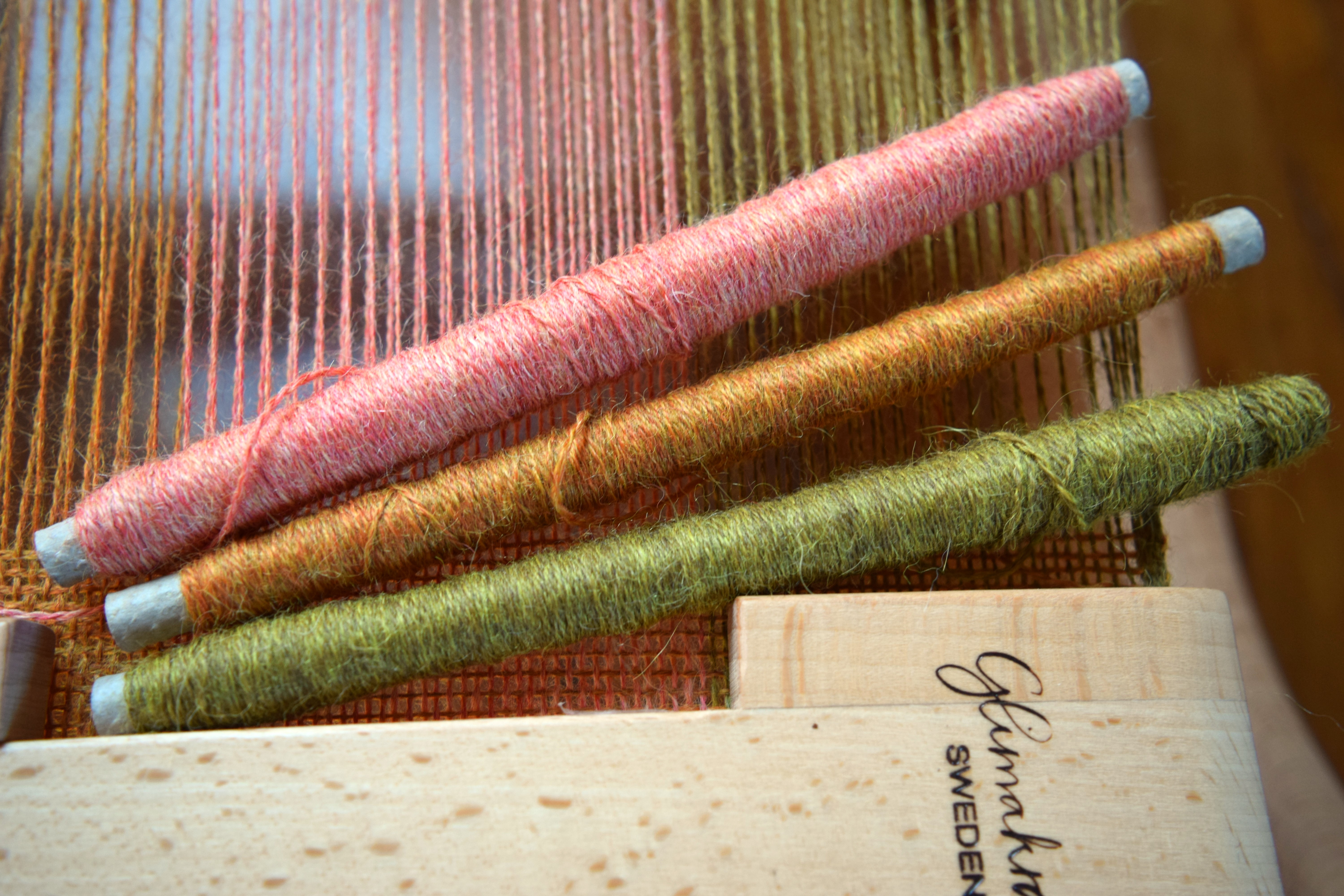
Yarn: Knit Picks Alpaca Cloud lace weight, in Zadie (deep gold), Bernice (warm pink to apricot), and Amos (moss green), 440 y = 50g
Loom: Ashford 16″ rigid heddle loom
Warping method: Easy direct warp method for rigid heddle, 1 end in hole and 1 end in slot.
Number of warp ends: 240
Reed: 15 dent rigid heddle reed.
Width in reed: 15.5″
Selvedges: I did not add extra ends to the selvedges, but did use a temple.
Sett after finishing: Warp 16 epi, and weft 16 ppi.
Color Pattern Warp: [40 ends Zadie, 40 ends Bernice, 40 ends Amos] x 2
Finished: 3″ hand-twisted fringe, then washed and air-dried hanging, and lightly steam pressed. Measures 76″ long (not including 3″ fringe) and 15″ wide, and weighs 121g.
Yardage: Total yardage used for finished piece = 1065y, figured from weight of finished piece and not including loom waste.
Number two in my alpaca scarf series, warped and started to weave the first few color changes, just enough that I could photograph the color sequence before March arrives, and obviously in a colorway that is very typical for springtime. The color choice was difficult for me; I was considering gold and green , gold and apricot (it looks pink, but it is more like apricot), or even green and apricot… but all three together? Possibly too frolicsome and feminine. I mean, where’s the calming and staid neutral in the mix? My reason is that I figured I would never improve as a weaver if I didn’t start getting outside my comfort zone and make bolder choices, and so I did. It is evident there is a vernal influence going on here, as I’ve noticed all the wild plum trees have exploded in blossoms, and the intense fragrance of it all is amazing. Weather is high drama this time of year; one day the bees come out and everything is all abuzz with temperature in the 70’s, and the next day it could snow and bring everything to a frigid halt. I absolutely love March, and the last stretch of winter.
I’m wearing the first finished weave in Jen’s latest series of alpaca scarves; she apparently got a lot of lace-weight alpaca yarn to weave a pile of them, in various colors and patterns, so obviously she’s feeling optimistic for a new adventure. Believe me when I tell you that this weave is so sheer and light and lovely to wear, the alpaca creates a depth of richness that cotton, linen, or even wool, simply cannot, and Jen thinks this is because of the natural luster of the ‘hair’ structure of alpaca, and the color saturation of dyed protein fibers. Hopefully there are still a couple of weeks left of winter in Paris, because that is where this alpaca scarf is heading next, as Jen wants to rush this off to her sister-in-law as soon as she photographs it … on moi!
Ta ta, Abelene
♣ Weaving Notes ♣
Note from Jen: This time I tried placing pegs around the table, so I didn’t have the warp taking up the whole room, which turned the table into a warping board! I believe I could improvise this way for any amount of warp length within reason. As it was, without having the reference of warping this way before, I accidentally made the warp a little too long … oh well, I’ll do better next time. The very fine lace-weight knitting yarn weaves up into a beautiful light and buoyant draping fabric, I absolutely love it!
Yarn: Knit Picks Alpaca Cloud lace weight, in Elizabeth (deep red) and Lydia (brick), 440 y = 50g
Loom: Ashford 16″ rigid heddle loom
Warping method: Easy direct warp method for rigid heddle, back to front, double threading from back apron rod through reed, then around pegs on table (a warping board). Wound on to back beam and finally tied off on to front for weaving. Rethreaded to have 1 end in hole and 1 end in slot. I forgot to measure the warp…oops!
Number of warp ends: 240
Reed: 15 dent rigid heddle reed.
Width in reed: 15.5″
Selvedges: I did not add extra ends to the selvedges, but did use a temple.
Sett after finishing: Warp 16 epi, and weft 16 ppi.
Color Pattern Warp: [40 ends red , 40 ends brick] x 3
Pattern Weft: 5″ red, 2.5″ of brick, repeated length in sequence.
Finished: 3″ hand-twisted fringe, then washed and air dried hanging, and lightly steam pressed. Measures 98″ long and 15″ wide, and weighs 140g.
Yardage: Total yardage used for finished piece = 1232y, figured from weight of finished piece and not including loom waste.