Watery

Watery is now finished, the Guatemalan backstrap loom taken apart and rolled inside the weaving, with the maguey back strap and lasso resting on top. It was a real challenge in backstrap weaving as well as in ikat preparation, and a monster of a learning curve for a beginner like me, but I am a firm believer in the best teacher being experience. Even though I did make a proper sample “gauge swatch” and posted it in Watery Sample, I had no way to know how a larger variation would weave. I made mistakes, and had to figure out how to fix them as I progressed; the heddles had to be redone, tension problems were endless, at first I could not work the shed changes correctly, nor did I beat the weft evenly, and honestly, I was not sure even how to operate the loom. But I wove a 15.5″ x 46.5″ piece of canvas weight warp-faced fabric, and to me that is astonishing and amazing! Toward the end of my much-longer warp, as room was getting tight to lift the heddle rod, I thought I’d cleverly rearrange the shed rod, and wouldn’t you know it, I accidentally rendered it un-weavable from there forward, but I only lost about 12″ of weaving length left I figure, before I couldn’t weave anymore on it. Not bad for an ardent attempt to do a large piece!

Oh, and about the llama wandering about outside the tiny house? It is a member of a grazing herd which came down from the vineyard above us to sample the greenery, perhaps to participate in the Andean inspired backstrap weaving scene?

Here is how I warped for Watery . . .

  1. I wound 10/2 mercerized weaving cotton, in a figure 8, around 2 warping pegs placed each end of the table at 72″ apart; 40 times, which is 80 ends per warp section when the loop around the loom bars is woven into a flat piece. The weave is completely warp-faced, with the weft hidden, and has 56 epi.  — If this were a balanced weave, there would be aprox. 28 epi, and the weaving would be twice as wide, at least 30″ — I did not understand this about backstrap weaving until after I learned balanced weaving!
  2. Five warp sections were tied with ikat resist tape (I did not photograph this part) without measuring, but fully improvised. Six were left untied (except for the skein ties to keep the warp sections from getting tangled in the dye bath) so all 11 warp sections could be dyed together, and be the same color.
  3. Five warp sections were tied with ikat resist tape (I did not photograph this part) without measuring, but fully improvised. Six were left untied (except for the skein ties to keep the warp sections from getting tangled in the dye bath) so all 11 warp sections could be dyed together, and be the same color.
  4. After dyeing them, I transferred the warp sections to the loom bars which I had lashed on to the pegs, alternating five resist tied sections with six solid sections.
  5. I spread out the warp to get ready to make the string heddles, and the sections all came together as one complete warp, tying ends together at the far-end loom bar, and lining up the cross in the middle of the length, ready to make heddles next.
  6. But first, on each of the five tied ikat sections I pulled some of the threads either forward or backward by pinching some threads in the section and giving a little tug; this is called “shifting”,  and the threads moved around the loom bars so that the straight undyed (white) bands skewed a little to create a design. ( I did not influence the apparent stripe of the non-ikat tied warp sections, so they just ended up as soft squiggly lines across.)
  7. I created string heddles with the same 10/2 cotton as the warp, but the warp and heddles were too close and got bound up, so later I reworked the heddles with fine nylon thread. 
  8. In the photos I show how the shifting works; on top warp threads you see the V shape , but on the bottom threads you see the opposite direction as I parted a V shape on the top shed of the warp to reveal below, because the threads change direction when they go around the loom bar. This is most obvious at the two rods which hold the cross, where the bottom half of the warp comes to the top, and the top disappears below.
  9. When at last the bottom and top of the shed is woven together, the interplay makes a lovely random design which looks like reflection of light on the surface of moving water…. thus “watery”.

Credit: I have enjoyed reading Lavern Waddington’s weaving blog Backstrap Weaving for years. Her experience is extensive, and her legacy is truly admirable as she lived for years in the Andes practicing the indigenous methods of backstrap weaving, as well as travelling the world to learn from other backstrap weaving cultures.  It is mostly from her helpful instructional videos which have brought me to this point, all which are easily navigated from her website.

Watery (sample)

I have swept up all the tweed chaos from the last months and put away in baskets, recipes written, documented all the process, and now its time for a fresh start on something new, a weaving tangent revisiting the possibility of backstrap weaving (and remembering first project two years ago). First, I needed to do a sample so I can better plan a larger project, and managed to put together some loom pieces for a small weaving of 10/2 cotton. After winding five figure-eight bundles of 30 ends 22″ long onto warping pegs, two of them with ikat resist tape, and three of them solid, then dyed all of the bundles together. By the way, when weaving, the ends double as they are wound around in a hoop. Anyway, it ended up being a tangled mess, but after I managed to put them on two loom bars lashed to warping pegs to slowly organize and re-tension the warp threads one at a time, I discovered that is what was responsible for the watery effect. The ikat backstrap weaving sample I made was to test the waters for a larger piece, and I love this idea of lashing the loom bars on to warping pegs to prepare the warp before the weaving!

It ended up being an unexpected and random ikat patterning, the resist areas shifting as I adjusted tension; two ikat bundles, and three solid bundles, dyed in a light indigo blue. After woven the fabric weight is a thick canvas, the weight of blue jeans.

When I showed my best friend the photos, she said “I love that watery pattern you made on the blue” and then it occurred to me to name this ikat design series “Watery” (thank you Sorcha!)

first backstrap weaving

I am humbled all over again, after rants of frustration, breaking warp threads, redoing the string heddles a few times, inserting a new section of warp after I was fooled by the “false cross”, tired shoulders, and to add, a bit of defiant arrogance. I was all ready to give up, but then remembering Laverne’s words in her tutorial video about backstrap weaving being such a special thing (which it very much is!) and to get frustrated and give up would be a shame. Those words hovered in my brain and made me take another look at the situation and yesterday late afternoon I put it back on the lasso and gave it another try. Well, things started to miraculously come together, finally!

The small swatch is not that much to look at, the selvedges are poor, and I have had to weave in through the back a lot of broken warp threads, but here it is at last, just what it is, my very first weaving, and an excellent test sample from the yarn that I made myself (see this post). What is the best that came out of this is overcoming frustration, seeing the finished piece, and an eagerness to warp for another weaving project. Another weaving on a backstrap loom may need to come around after I get a bit of perspective.

♣   Weaving Notes  ♣ 

  • First and foremost, credit where credit is due; I have been following Laverne’s blog on Backstrap Weaving for some time, and I believe it is her work which has given this style weaving a very deserved mark of excellence. Do see her most artful blog here:  https://backstrapweaving.wordpress.com/
  • This piece was a very stressful, and I have a new deep reverence for backstrap weavers!
  • I wanted to try my best at the Andean style, I used my hand re-spun wool, and wove very tightly, but still am learning about how the two-color-warp and false cross works, and I did end up having to warp over and insert some warp threads after bad mistakes in set up. 
  • Several times getting up and wriggling out of my backstrap, the whole weaving would flip sideways and I did not secure the shed rod or sword and so they fell out then I lost my shed, had to go back to the default cross and get it set up again. A lot of explanation for the ways I was clumsy need not be written, but I think I would like to take a break from warp-face weaving, as I really crave balanced plain weave, and not to mention, a loom that is secure in place as I like to get up and walk away for breaks a lot. 
  • This 12″ backstrap loom is the smaller of two (the other is 20″) and was the loom I ended up sending to Ro in Mexico shortly after my rigid heddle loom arrived.

Backstrap Loom

I had to seriously ask myself; do I want to just dream about one day weaving, or do I want to just weave? I suppose I was held back by fear of being a rank beginner, and for years now I have enviously read weaving blogs and watched weaving videos, and still I wasn’t ready to begin, to wheeze and strain against the learning curve, new frustrations and aches. So here is my hand-made backstrap loom, from Guatemala, one of two I bought from a charitable organization on Etsy, one for myself and one for Jeff’s daughter. I am going to sand it a little bit and condition the wood too, and then I’ll be ready to warp. I am eager to share my experience here as a rank beginner, un-confident, but like a wobbly kneed colt, I am putting one stride before me, my first step in what will hopefully become a journey.

Weaving for a Huipil

Mayan Hands – The Huipil in Danger

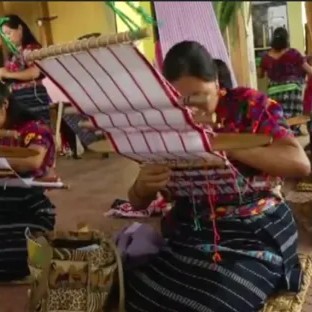
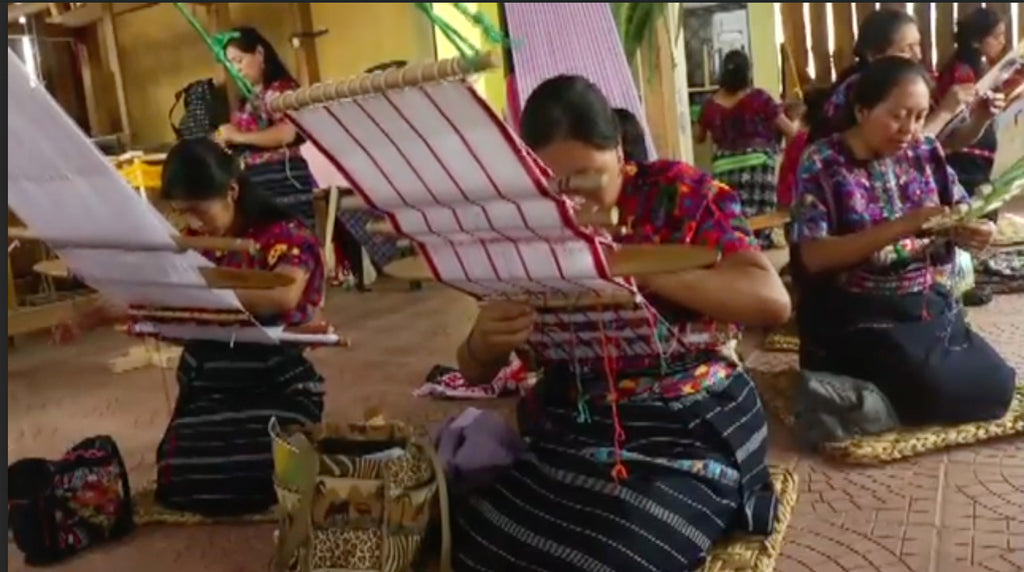
It has been a long while since I posted a weaving film, and about time I did. This is one I have been enjoying as I have been learning a little bit about the Mayan weaving and making of the women’s traditional blouse, the huipil. Just like the weavers in Peru which I have posted about a few times, these Mayan women weave on a backstrap loom, for the clothes which keep their ancestral roots alive, but in the modern age, there are concerns about losing this indigenous tradition of weaving, therefore their culture is threatened (read more about this: The Huipil in Danger) . Guatemalan Maya weaving, although on the same type of loom as the Peruvians, and the same simple loom as in many parts of the world, it is their elaborate brocade style that is so very distinctive and original. It is especially when I find these treasure nuggets of weaving films, that I just wish I had another whole lifetime to devote completely to weaving, in particular backstrap weaving ! I hope you enjoy this little weaving story as much as I do.

See all posts about weaving.