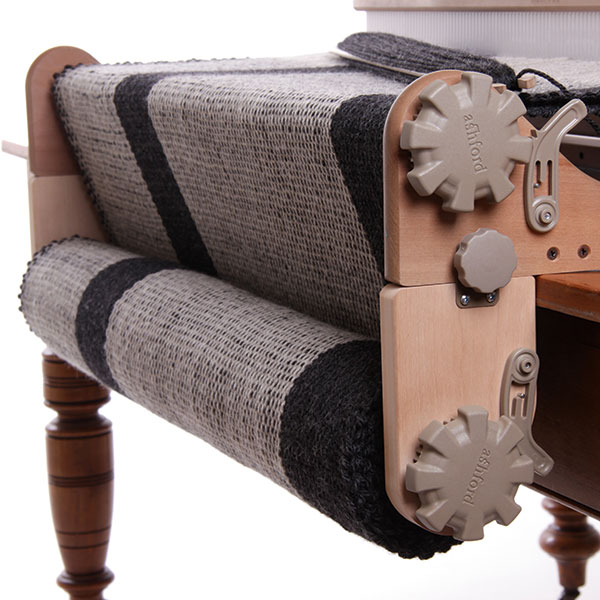
Scarf No. 14

Levi came to visit, and as I was showing him my alpaca scarf series, I could tell that he admired them, and that perhaps he even wanted one, but none of the colors I had woven were appropriate for his blue & grey gentlemen’s style. So, the day before he was to leave I suggested he design one with the alpaca colors I had on hand and that I would weave it for him, and so he did, and by the time he was leaving back to Canada, I had already woven one repeat to show him. Then this last week was a determined effort to getting it done, and now it is finished and ready to send in the post. As usual, my technical weaving notes are listed below.

♣   Weaving Notes  ♣

  • Yarn: Knit Picks Alpaca Cloud lace weight, in Carson (dark grey), Alfred (medium grey), Eleanor (light grey), and Bernard (blue). 440 y = 50g
  • Loom: Ashford 16″ rigid heddle loom
  • Warping method:  Easy direct warp method for rigid heddle, 1 end in hole and 1 end in slot.
  • Number of warp ends: 228
  • Reed: 15 dent rigid heddle reed.
  • Width in reed: 14″
  • Selvedges: I added 4 extra ends to each of the selvedges, as they tend to get pulled in, and I used a temple.
  • Sett after finishing: Warp 16 epi, and weft 16 ppi.
  • Color Pattern Warp: 20 ends each of *Carson, Eleanor, Bernard, Eleanor, Carson, Alfred, Carson, Eleanor, Bernard, Eleanor*, Carson.
  • Color Pattern Weft: Same sequence as for warp *thru*, and ending in Carson.
  • Finished: 2″ hand-twisted fringe, then washed and air-dried hanging, and lightly steam pressed. Measures 76″ long (not including fringe) and 13.5″ wide, and weighs 118g. 
  • Yardage:  Total yardage used for finished piece = 1040y, figured from weight of finished piece and not including loom waste.

An Auspicious Autumn (Scarf No. 13)

Hi, its me Abelene,

Jen did not weave on her scarves at all this summer, and now suddenly another alpaca scarf to show for a very auspicious occasion of the beginning of Autumn. Jen rattled through this scarf in the very last days of summer, having left it on the loom since Spring, while frenzied all summer long with other creative textile pursuits, as designing tweed blends, formulating dye recipes, ikat resist patterning and backstrap warp-faced weaving. We (the crew of inanimate objects) came out of the closet for this finishing event, and Señor Mirando and I have come to the conclusion that Jen has got something up her sleeve, finishing this scarf for the Equinox.

Happy Autumn, from Abelene & The Crew

♣   Weaving Notes  ♣

Note from Jen: With this scarf and every scarf I have woven on the 16″ rigid heddle loom, I have been using this simple tensioning tool, and if you would like to see the technical information about it, I give more detail in the post Scarf No.12

  • Yarn: Knit Picks Alpaca Cloud lace weight, in Amos (green), Zadie (deep gold), and Molesley (beige), 440 y = 50g
  • Loom: Ashford 16″ rigid heddle loom
  • Warping method:  Easy direct warp method for rigid heddle, 1 end in hole and 1 end in slot.
  • Number of warp ends: 240
  • Reed: 15 dent rigid heddle reed.
  • Width in reed: 15″
  • Selvedges: I did not add extra ends to the selvedges, but did use a temple.
  • Sett after finishing: Warp 16 epi, and weft 16 ppi.
  • Color Pattern Warp: [40 ends Amos, 40 ends Molesley, 40 ends Zadie] x 2
  • Finished: 3″ hand-twisted fringe, then washed and air-dried hanging, and lightly steam pressed. Measures 82″ long and 14.5″ wide, and weighs 133g. 
  • Yardage:  Total yardage used for finished piece = 1170y, figured from weight of finished piece and not including loom waste.
  • Note to self, recipient was Eleanor

vernal influences

Number two in my alpaca scarf series, warped and started to weave the first few color changes, just enough that I could photograph the color sequence before March arrives, and obviously in a colorway that is very typical for springtime. The color choice was difficult for me; I was considering gold and green , gold and apricot (it looks pink, but it is more like apricot), or even green and apricot… but all three together? Possibly too frolicsome and feminine. I mean, where’s the calming and staid neutral in the mix? My reason is that I figured I would never improve as a weaver if I didn’t start getting outside my comfort zone and make bolder choices, and so I did. It is evident there is a vernal influence going on here, as I’ve noticed all the wild plum trees have exploded in blossoms, and the intense fragrance of it all is amazing. Weather is high drama this time of year; one day the bees come out and everything is all abuzz with temperature in the 70’s, and the next day it could snow and bring everything to a frigid halt. I absolutely love March, and the last stretch of winter.

Scarf No.10

Hi, its me Abelene.

I’m wearing the first finished weave in Jen’s latest series of alpaca scarves; she apparently got a lot of lace-weight alpaca yarn to weave a pile of them, in various colors and patterns, so obviously she’s feeling optimistic for a new adventure. Believe me when I tell you that this weave is so sheer and light and lovely to wear, the alpaca creates a depth of richness that cotton, linen, or even wool, simply cannot, and Jen thinks this is because of the natural luster of the ‘hair’ structure of alpaca, and the color saturation of dyed protein fibers. Hopefully there are still a couple of weeks left of winter in Paris, because that is where this alpaca scarf is heading next, as Jen wants to rush this off to her sister-in-law as soon as she photographs it … on moi!

Ta ta, Abelene

♣   Weaving Notes  ♣

Note from Jen: This time I tried placing pegs around the table, so I didn’t have the warp taking up the whole room, which turned the table into a warping board! I believe I could improvise this way for any amount of warp length within reason. As it was, without having the reference of warping this way before, I accidentally made the warp a little too long … oh well, I’ll do better next time. The very fine lace-weight knitting yarn weaves up into a beautiful light and buoyant draping fabric, I absolutely love it!

  • Yarn: Knit Picks Alpaca Cloud lace weight, in Elizabeth (deep red) and Lydia (brick), 440 y = 50g
  • Loom: Ashford 16″ rigid heddle loom
  • Warping method:  Easy direct warp method for rigid heddle, back to front, double threading from back apron rod through reed, then around pegs on table (a warping board). Wound on to back beam and finally tied off on to front for weaving. Rethreaded to have 1 end in hole and 1 end in slot. I forgot to measure the warp…oops!
  • Number of warp ends: 240
  • Reed: 15 dent rigid heddle reed.
  • Width in reed: 15.5″
  • Selvedges: I did not add extra ends to the selvedges, but did use a temple.
  • Sett after finishing: Warp 16 epi, and weft 16 ppi.
  • Color Pattern Warp: [40 ends red , 40 ends brick] x 3
  • Pattern Weft: 5″ red, 2.5″ of brick, repeated length in sequence.
  • Finished: 3″ hand-twisted fringe, then washed and air dried hanging, and lightly steam pressed. Measures 98″ long and 15″ wide, and weighs 140g. 
  • Yardage:  Total yardage used for finished piece = 1232y, figured from weight of finished piece and not including loom waste.

Rug No.1

My first woven rug came together rather fast, from six old shirts of Jeff’s (one which I made for him years ago, and five LLBean shirts) made custom for a space in our bedroom in front of an old dresser which was given to us by a weaver (hi B!). The rug was woven on my 48″ rigid heddle loom, with the Freedom Roller attached, and I used a temple but kept it back a few inches from the fell so I didn’t whack it with the Schacht weighted beater.

Its been raining steadily for a few days, and I hemmed the rug sitting at the window, in the low light of the afternoon, admiring the Autumn color outside with the black oaks that have completely turned gold.

I am really surprised I could weave an *actual* rug on a rigid heddle loom! The rug is 28×50 inches, and I figure I could have had double the length with the Freedom Roller attachment; I reckon I could warp up to 48″ wide, so in theory, I could make a monster rug of 4×8 feet. After I finished weaving it I hemmed the edges to the under side, and carefully took the labels off and chose one to sew on the hem for a little artful whimsy . . .

Juno was the warping and cutting supervisor!

♣   Weaving Notes  ♣

General Notes: I had to get around the fact that the rug is not made with a proper floor loom, with a heavy swinging beating reed, and so I had to beat hard along each weft with the Schacht weighted beater, but the end result was good enough. I thought of a clever way of cutting long strips; figured since the strips of cut fabric are getting scrunched into the warp anyway, it does not matter if they are on the bias or on the grain, I cut about 2″ wide strips, starting at the bottom, between button bands, following the shape of the shirt tails, zig-zag cutting back and forth, using up as much of the shirt as possible, and very little was cut on the grain. The sleeves were mostly spiral cut. When about 1.5″ from the button band I stopped, then from beneath cut a wide turn back the other direction over of the previous cut, snipping across side seams as they come. I was not particularly neat with the cutting either. I cut all the ends angled, and overlapped the beveled ends instead of sewing edges together, which would be way more work.  I wove one shirt completely before starting the next, in segments rather than stripes, so we could recognize the old beloved shirts in their sequence.

Additionally, the rug is fairly sturdy and thick and the woven “cloth” builds up fast on the cloth beam, so the Freedom Roller (Ashford’s add-on cloth beam for their rigid heddle looms) is absolutely essential in my opinion to weave a rag rug that is thick and substantial, as is the weighted beater. But perhaps the most essential thing that I overlooked (never again!) is the importance of using warping yarn that can withstand the punishment of the hard beating. 

  • Yarn: Maurice Brassard 8/2 cotton, double threaded (2 in hole, and 2 in slot) emulating 8/4 warp yarn. Approx 80″ from apron rod to pegs. Should have bought heavier warp yarn and waited for it to arrive before starting the rug! 
  • Weft: Cotton flannel strips, about 2″ wide, taken from old shirts. Beginning and end 3″ same as warp, woven wide enough to make a turned hem below the rug. 
  • Loom: Ashford 48″ Rigid Heddle Loom (the beast!) with Freedom Roller attachment
  • Number of warp ends: 210, double threaded = 420.
  • Reed: 7.5 dpi (30/10cm) dent rigid heddle reed, about 28″ width in reed.
  • Finished: 1 inch turned hem, sewn against the underside of the rug. No washing/drying. Measurements finished are 28″ x 50″. I planned for 60″ length but made a mistake when measuring warp distance and somehow didn’t factor in the correct amount of loom waste! Gaw!!!  
  • Yardage: Who knows…. 6 shirts using as much as I possibly could. 

Scarf No.5

Hi, its me Abelene

Jen has brought me out of the closet where I was suffocating in debate with my new pals, the Ashford 48″ rigid heddle loom and Ashford 32″ table loom, very existential ideas, like about whether or not as inanimate objects, we really exist, and I have been by far the most optimistic among us! Anyway, Jen seems to have forgotten about me, but finally she brought me out to see the spring . . . I am wearing a very light weave that seems to be sticking to my skin all by itself, perhaps from static electricity, as it has been three days of drying wind here.

Jen wants me to say that she had some difficulty weaving this fluffy light sheer cloth, but eventually she found her way and the weaving became better balanced, eventually only a light tap of the reed to keep the structure even and open. This is the 15epi experiment in her series of weaving ultra fine cotton where she is experimenting with different threads per inch. She is super pleased that very light cloth can be woven on a simple little rigid heddle loom with one 15 dent reed, and is hoping to do more just like it. But first to finish her series she wants to weave 20 epi with this same thread, whether threading two rigid heddle reeds together on my pal the big rigid heddle loom, or to warp it up on my other pal, the table loom.  But on the other hand (um, what other hand???) she thinks she might just weave more single reed 15epi samples on the little rigid heddle loom, like this piece was.

So much fun going on here I tell you!

Ta ta, Abelene

ps. Don’t miss out on the technical weaving notes and slideshow below!

♣   Weaving Notes  ♣

  • Yarn: 20/2 mercerized perle cotton, 8400yds / 1 lb, Maurice Brassard, in colors;  Flax (P-5109), Rose Paudreux (P145), Natural (P100), and Blanchi (white) (P-101). 
  • Loom: Ashford Knitters Loom 20″.
  • Warp:   Warp length is approx 110 inches from apron rod to warping peg.  
  • Number of warp ends: 298
  • Reed: 15 dent, warp is 19.5″, full width in reed.
  • Sett on loom: Oops, I forgot to measure.
  • Sett after finishing: Warp 17 epi, and weft 19 ppi.
  • Selvedges: I did not do floating selvedges, but I did warp 3 extra ends per selvedge, which is almost necessary I am finding when using a temple.
  • Color Pattern:   
    • Warp =  [18 ends of rose, 18 of blanchi, 18 of flax, 18 of blanchi ] x 2 . 288 ends plus 3 extra selvedge ends at each side = 294.
    • Weft = wound on to a 30″ stick shuttle ; [20 wraps of rose, 20 wraps flax] repeat the sequence to end of warp.
  • Finished: 1/4 inch turned hem, then washed and dried in machine, then pressed, and weighs 83g. Measuring after finishing 76″ long and 17″ wide (before washing/drying it measured 76″ x 18″).
  • Yardage:  Total yardage used for finished piece = 1536y, figured from weight of finished piece and not including loom waste.
  • General Notes: This weave is open and fairly sheer. I am striving for balanced weave with only a light tap of the reed needed.  If I beat too hard with the reed, even just a slight bit of pressure on the reed, or too many taps, the weft easily becomes compressed and creates horizontal stripes of weft dominant color. For this reason, I had to be very careful, hoping that after a wash and dry in the machine everything would become even, with threads locked together in a firm gauze fabric. The ppi is slightly more than the epi, so not perfectly balanced. I am guessing then that 20 epi will be the magic warp spacing for ease of weaving balanced.

Wool Shawl No.3

Number three of Donegal Tweed neckwear pieces, last week I reeled off the loom , and now it is finished, and this one warped with the help of Juno who’s colorway is so similar that I’m naming the colorway “Juno” . . .

I’ve woven this one with a larger dent reed on my Ashford Knitters loom than the last two, a 12.5 dent reed, and think I’ve decided that it is the perfect size for this single ply fingering/lace weight yarn. Now three finished, no more Donegal Tweed and so on to the rest of the yarn in my drawers.

♣   Weaving Notes  ♣ 

  • Yarn: Isager Tweed made in Donegal, also known as Donegal Tweed by other brands.
  • Loom: Ashford Knitters Loom, 20″.
  • Reed: 12.5 dent reed, optimal I think, for the Donegal Tweed.
  • Sett: Warp = 12.5 epi and weft = 9 ppi, 1 thread in the heddle/hole, and 1 thread in the dent/slot.
  • Direct warp method.
  • Selvedge: Doubled up two outer most selvedge warp yarns, and used a temple.
  • Finished: Not wet finished, but steamed, tied a simple knotted fringe (knots could be taken out and twisted fringe worked, but I prefer the soft yarn strands). 
  • Measurements: 76″ long x 19″ wide, not including 4″ fringe.
  • Weight: 246 grams. Yarn has 218 y per 50 g so that is about 1090 total yards. 

just reeled off . . .

Just reeled off the loom, another plain weave check, that somehow miraculously used up the colors of the Donegal Tweed that I had left in my stash. This piece needs all of its finish work done as well as notes composed, and to “hang loose” off of tension for a while, and so I’m on to the next. This one and previous one, will return as finished and fringed pieces to properly photograph. Until then, I’m happy enough to just dive back in the yarn drawers and resurface with another warping to attend to before the end of the day. People are asking me, almost worried, what has happened to knitting? Am I finished with it? Will I return to it? The answer is simply that for now I am so happy in the weaving, knitting is only on a short sabbatical, and while attempting to convert yarn stash into cloth for a while, my long goal is to work back to spinning. Also, considering a very large rigid heddle loom for weaving wider cloth, such as throw blankets and table coverings, and what seems to me to be the natural progression of things around here. I don’t see that I will ever grow tired of simple plain weave.

just reeled off the loom . . .

This intriguing moody weaving of Donegal Tweed has been on the loom for only a few days, made entirely from yarn I had in my drawers . . . in blues, greys, and brown. Oh, but I seriously LOVE the rectangle check! I warped it on Saturday, considering it might be a nice wide scarf for a possible gift, but now pulled off the two-plus yards, and it is a bit stiff from the loom tension I suppose, thus inevitably not perfect for neckwear, possibly not soft enough. Deja vu ! Honestly, it is the same sett and same brand wool as the previous Isager Donegal Tweed piece I finished a few weeks ago, and softened up wonderfully. I bought and used a temple on this one, striving for even width with no draw-in. With this one I was a little more intentional, calculating some finished lengths, yardage, but left a lot up to guessing and assuming as the other one ended up “soft” and lovely, that this one would be too, as it is made out of the same yarn. Yet it feels like the weave is just too tight, however, I realize too that this is still stiff off the loom and has not relaxed yet, I suppose I ought to just stop worrying about it. The photo shows all the ends of the yarn wefts, which I really should learn to lay in before weaving, but I’ll weave them in with a needle soon and post again all nicely finished ~~ watch this space.

In love (with plain weave check).

I can’t get enough of the simple plain weave check pattern, and my new Ashford Knitters Loom. I found quite a bit of light grey and natural Isager Tweed in my drawer, enough to work a large two color check pattern, and wouldn’t you know it, I’m weaving it into a rather long but wide scarf, to allow for plenty of shrinkage. I happen to only have either too large or slightly too small for choices in reed (dent) sizes, but I’m going with the too-small, even though each pass of the weft requires a bit of fussing to separate the sheds, I am strumming and carefully coaxing it into a real gorgeous thing!

I think the big boxy check color pattern is an excellent way to practice the balanced plain weave, striving eventually to have the same number of warp threads horizontally as weft threads vertically, and I’ll be the first to admit how completely entertaining the check pattern is! I’m quite happy with this, my second weaving project, although I miscalculated on the size of the check pattern, the squares were supposed to be 4 inches but are not-quite 3.5 inches instead, and it isn’t quite centered in the reed, but who cares, right?

♣   Weaving Notes  ♣ 

  • The way I weaved this piece is pretty much the same as the one in the last post but with two colors,  A Very Late Introduction to A New Loom and the process will be my plain weave check standard.
  • This piece was my 2nd project on the loom, and as I had not yet understood the importance of correct reed/dent size (like knitting or crochet, you need the right “gauge” needle for each weight yarn) , and as I only had a 15 dent (smallest reed size for this loom)  the yarns are far too squished together — should have been woven in a dent size two sizes bigger, like a 10 dent reed to allow the tweed yarn to relax and bloom, therefore having more of an open weave, and creating a nice “drape”, and just be a nice wrap to wear in the cold months. 
  • When I took this piece off the loom, I was actually disappointed because it was far too densely woven to be a scarf,  and not the appropriate yarn to have made a table piece, so it is not yet finished. Maybe after I finish it and it gets some movement in it, it will soften.
  • Since this piece, as of Autumn, I have a nearly complete rigid heddle reed selection, with dent sizes 5, 7.5, 10, 12.5 and 15, and am able to weave more intentionally for the yarn I use. 

A very late introduction of a new loom…

I think it was in June, but may have been early July, a new Ashford Knitters Loom arrived, but just like a too-early guest to a party, I wasn’t quite ready for it; so I made it comfortable, expressed such happiness that it had come, and then promptly left it to attend to other things. July and August flew by and I hadn’t found the right time to warp it up, knowing very little about weaving, and even less about warping! But finally, on September 1st, I managed to warp the small loom, with the help of a very small instruction manual and warping peg that came with the loom. I found this “direct warping” method not at all difficult, quite genius in fact, but now I need to practice . . . lots of practice.

I chose this little 20″ folding rigid heddle loom because I think it is a good starting place to learn basic balanced plain weaving, and I am absolutely loving it, preferring color play to be the main focus rather than multiple shaft patterns. For that I think the rigid heddle loom is utterly perfect. Oh, and if you remember this post you’ll understand my colorway, and I’m using Venne Cottolin, and making a predictable first weaving of an Autumnal table runner… or something.

♣   Weaving Notes  ♣ 

  • After choosing the colors, I adhered to a sequence, starting with gold, then blue, then green, then rust, across the warp, ending with gold which would frame the edges in the same color.
  • In the same sequence I wove the weft upwards. If it were completely balanced weaving, there would be the same number of weft rows as warp threads, and the intersections of color would be square. But as I think it is more important to have squares than the same number of rows as threads, I wove up until the blocks were square, then changed color. 
  • It is not yet finished, when I take it off it is pretty open and draping, so I guess being cotton-linen blend (cottolin) that it will shrink and the fabric will become a little more dense. I will probably just sew a hem on each end.
  • Linen is rather stiff and scratchy until it is washed, and eventually softens, whereas cotton is instantly soft, and only gets softer, but the cottolin is a lovely blend of both, and I really love it! Linen is a very long strong fiber that is part of the “stalk” of the plant and processed from roots in the entire length,  whereas cotton is a very short and downy fiber, as it is the fluff in the seed pod of the plant, so you can understand why they are very different.
  • This size is 22/2 very fine yarn actually, and it was woven with the smallest possible 12 dent reed, and still had airspace between the weft & warp. Once washed and dried I hope it comes together and is less open. Next I will attempt to weave with 8/2 cottolin. 
  • I am learning that weaving yarns are very different from knitting yarns and especially so in the sizing standards, which I don’t know a thing about yet.Â