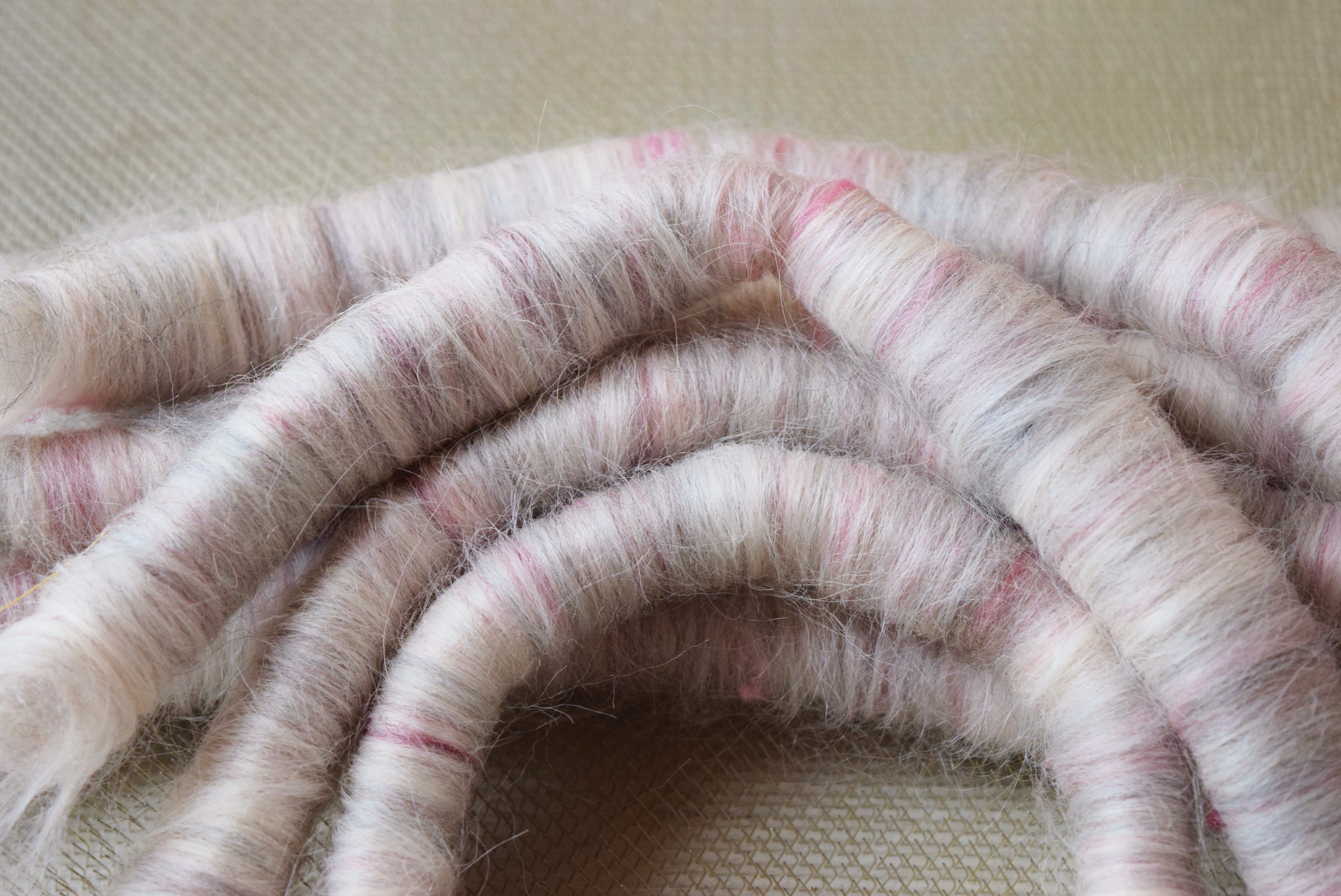
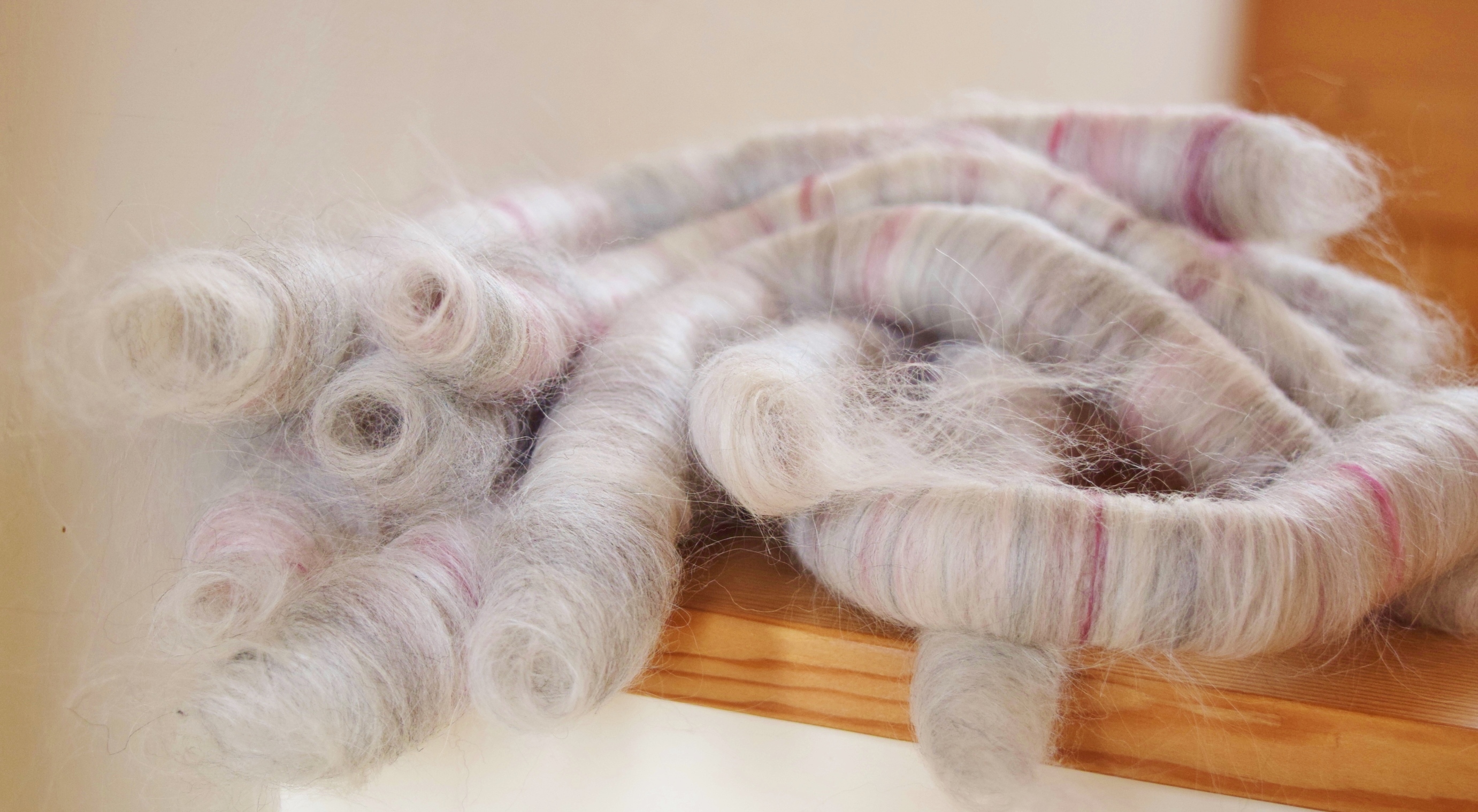
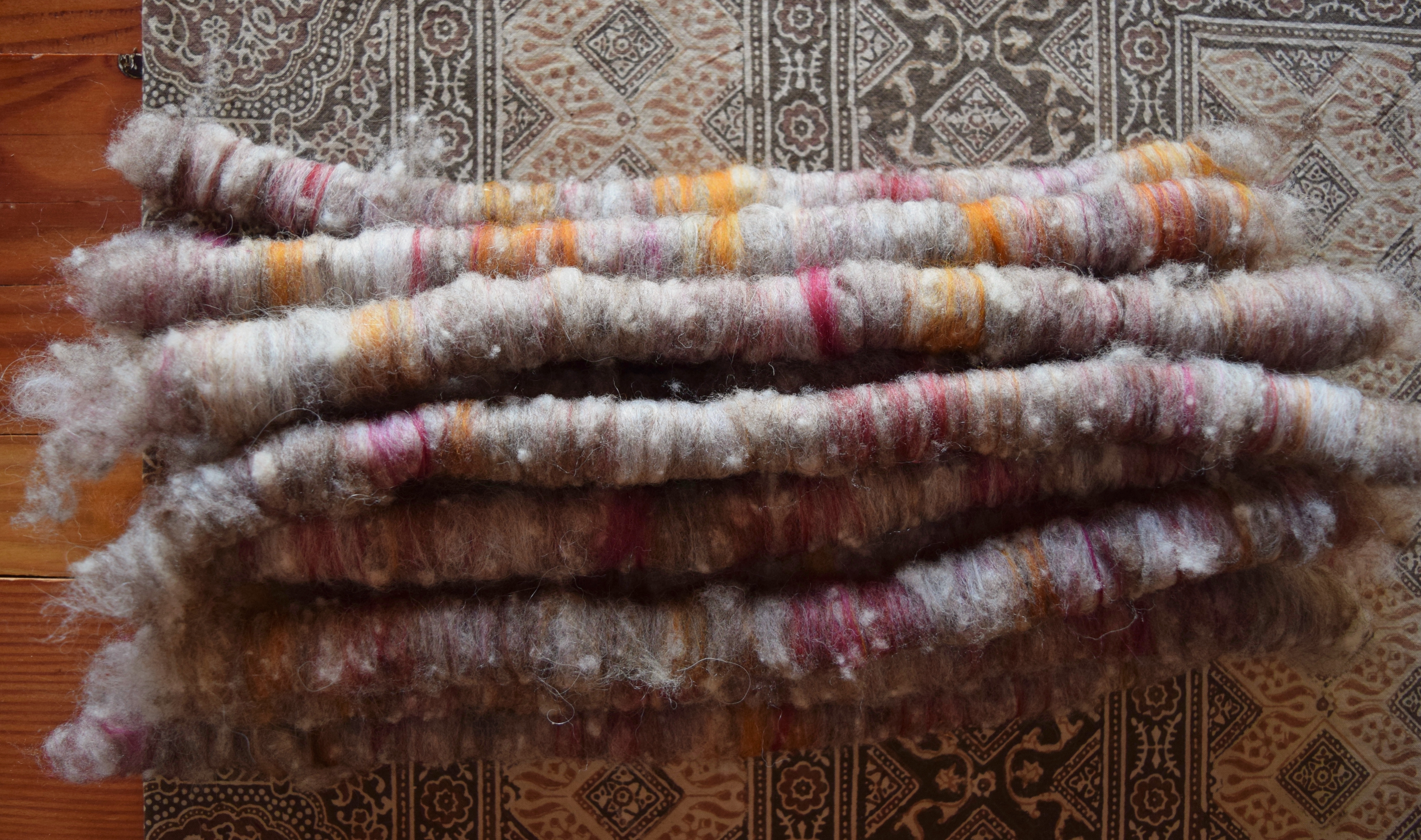
Made from nice combed top roving, so there’ll be no bumps and slubby bits in this batch, and the amazing thing is that all the color in these rolags are from combing tips of stash yarn!
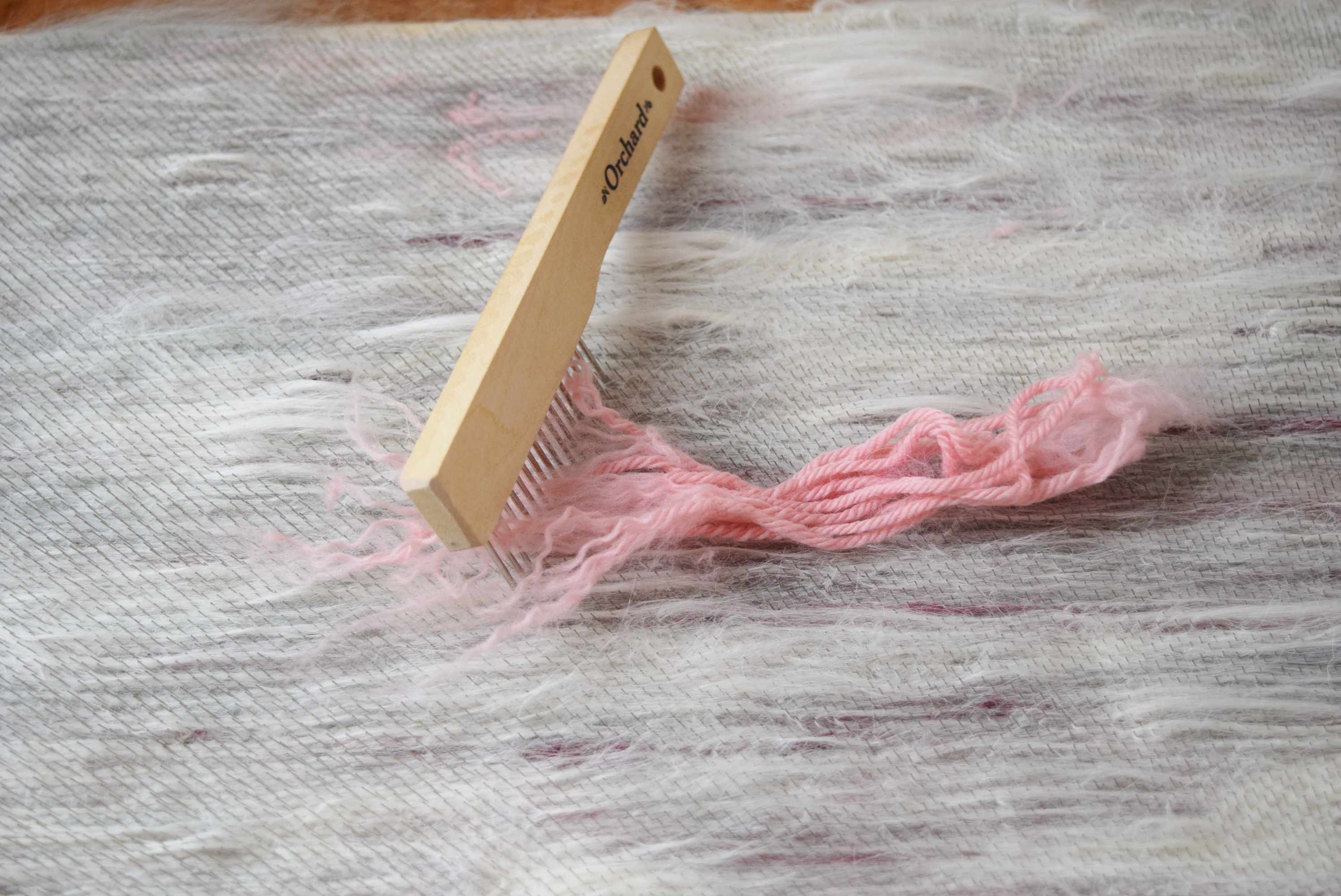
During my last blending post, I discovered a “yarn brush” technique, and having invented this for myself, I feel like I should explain how I do it. From doing a few times I think it is easiest to to cut a handful of the yarn, in lengths about 4 to 6 inches, loop around and hold the ‘brush’ firmly in the middle. I am using my paintbrush comb, but you can use hand carders or a fine tooth comb, and comb the ends of the yarn to loosen up and fray the plies, which then you can then push into the carding teeth…
I’ve found that most of the looser plied fluffy yarns, like some Berocco Inca Tweed I had handy, work best, and certainly any of the single ply yarns work beautifully without the combing the tip, they just brush off into the carding cloth easily. In the slideshow, if you hold your mouse over the images, the text will explain what I’m doing.
I am so inspired by this video about the weavers and the local culture around Harris Tweed, on the Isle of Lewis & Harris in Scotland’s outer Hebrides. I seem to be hooked on these woolen mill films these days! I am not so much infatuated with the idea of weaving the tweed yarn, but if I could be immersed into any one part of the process, it would be the blending and carding of the many colors of wool for the tweed affect in yarn spinning. This is what excites me the most, and thinking a lot about what to card next on my new blending board. I realize that I am , and always have been a colorist. Like a painter dreams of mixing pigments on palette, I am the very same, and training to see past the surface into a hidden palette of color in the fiber. Anyway, I hope you enjoy this video I’ve watched now countless times…
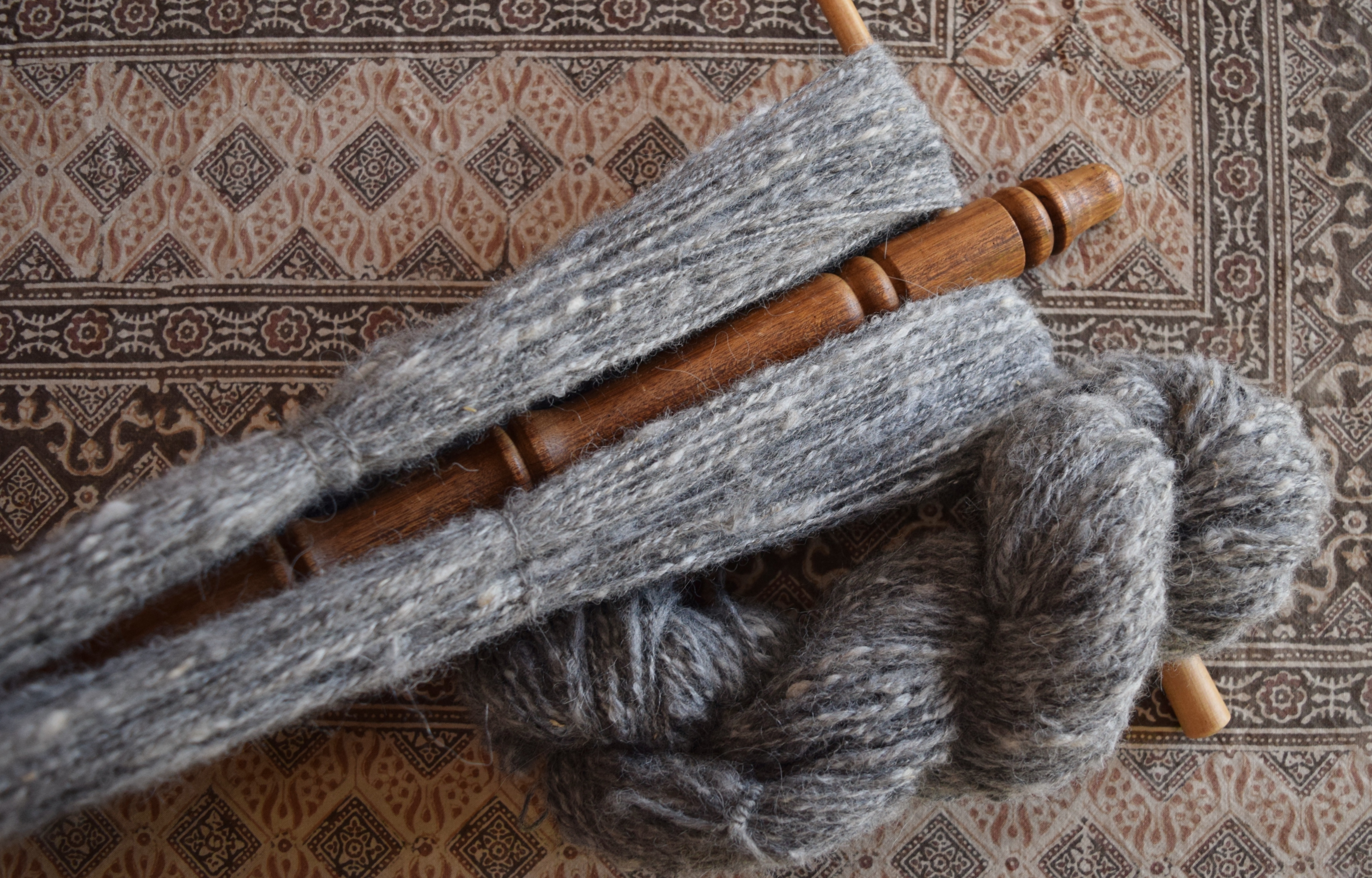
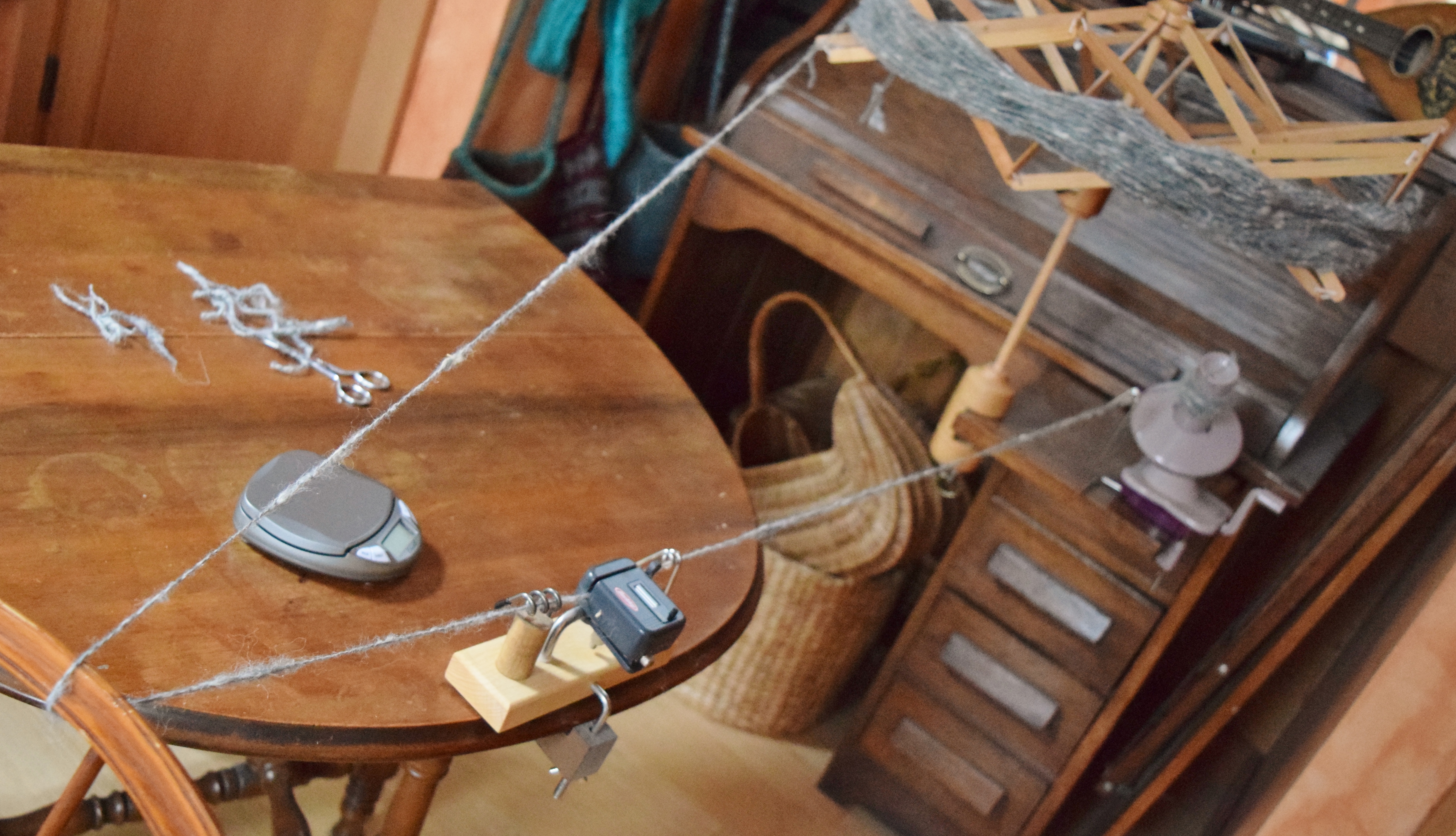
I am experiencing a bit of a renaissance in hand-spinning. I never was that much of an intentional spinner, although I am attempting to be now…. perhaps I’ve grown up a little bit? With this alpaca that I brought out of the recesses of my loft closet, I worked it from raw fleece and in this post I show the carding & blending process. After spinning it up, here I am measuring & weighing the yarn to discover what gauge it is.
Here is what I do: I run the yarn through a ‘winding station’, which measures yardage while winding off the skein on to a ball, then weigh the ball, and take notes.
This is about an aran weight. Getting more savvy in substituting hand-spun and I am itching to ‘paint’ again with fiber on my blending board. Recycled sari silk (yes, made from silk cloth of saris), bamboo, rose fiber… the works, and Oh! This was my most recent creation over the weekend, taking some very coarse Lincoln-Corriedale I’ve had for 30 years (from my sheep Hazel, plus another part fleece I have long forgotten where it came) , and blended it up together into a bat of 50/50 dark & white, which the white was extremely slubby (thats having little bits of wool puffs) I used that blend to layer with some ultra nice dyed corriedale roving I recently bought, in colors amber, mulberry, and ruby, and also a little Huacaya Alpaca , and made tasty little wool sausages….
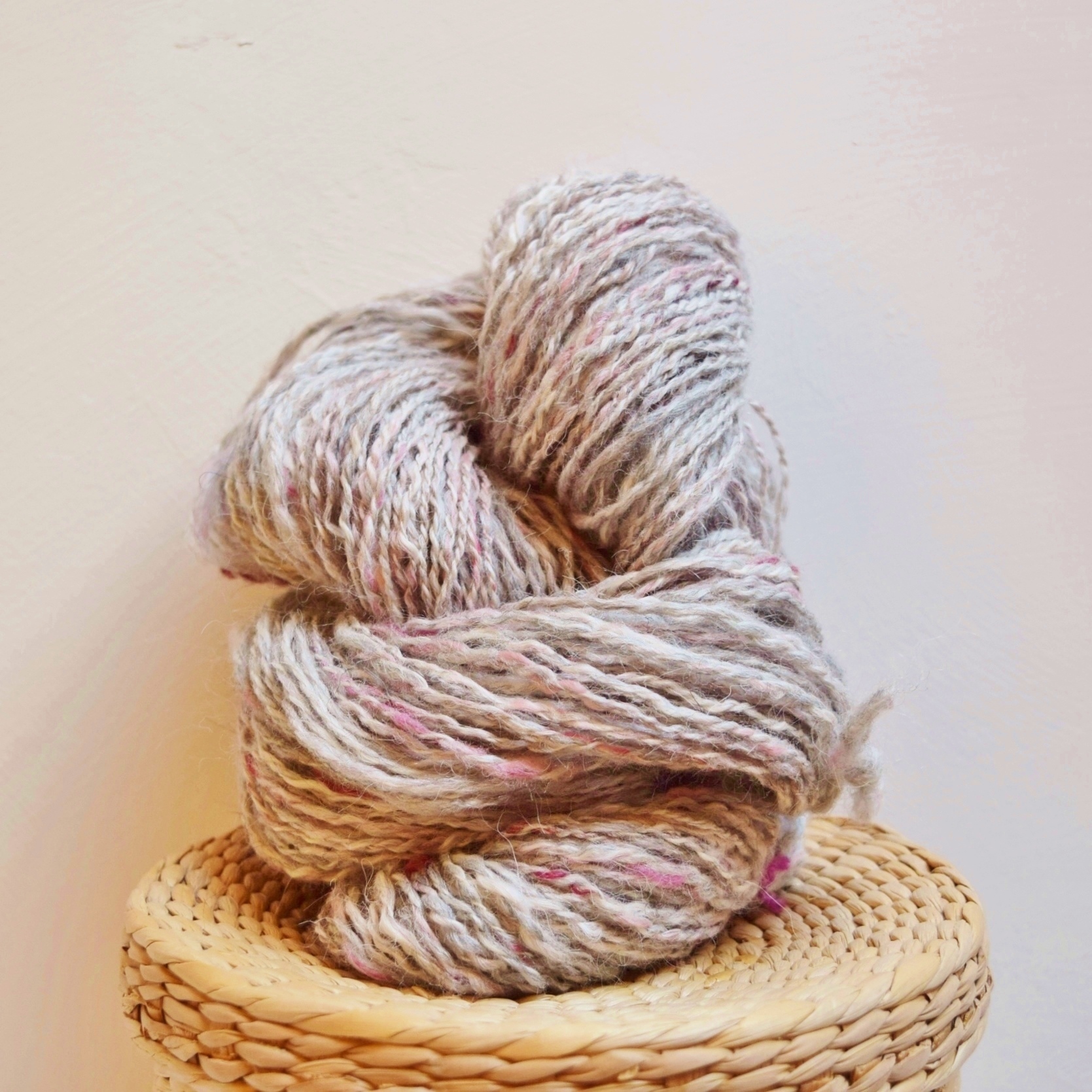
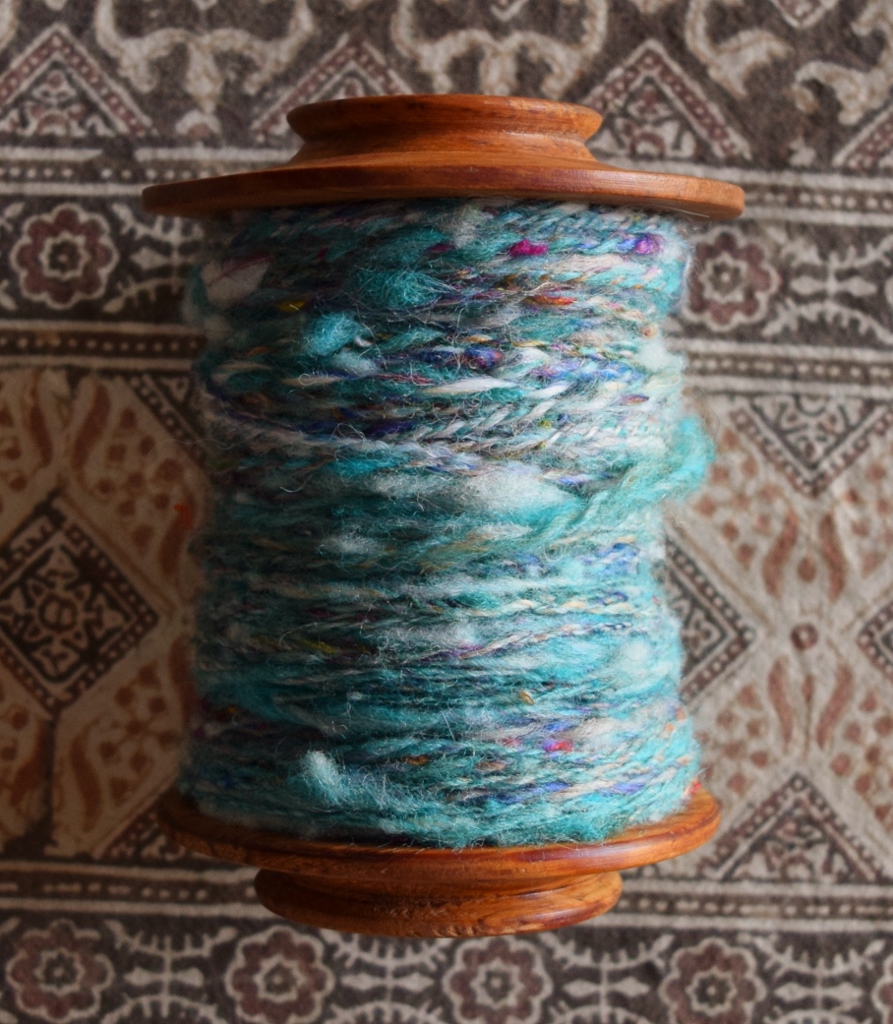
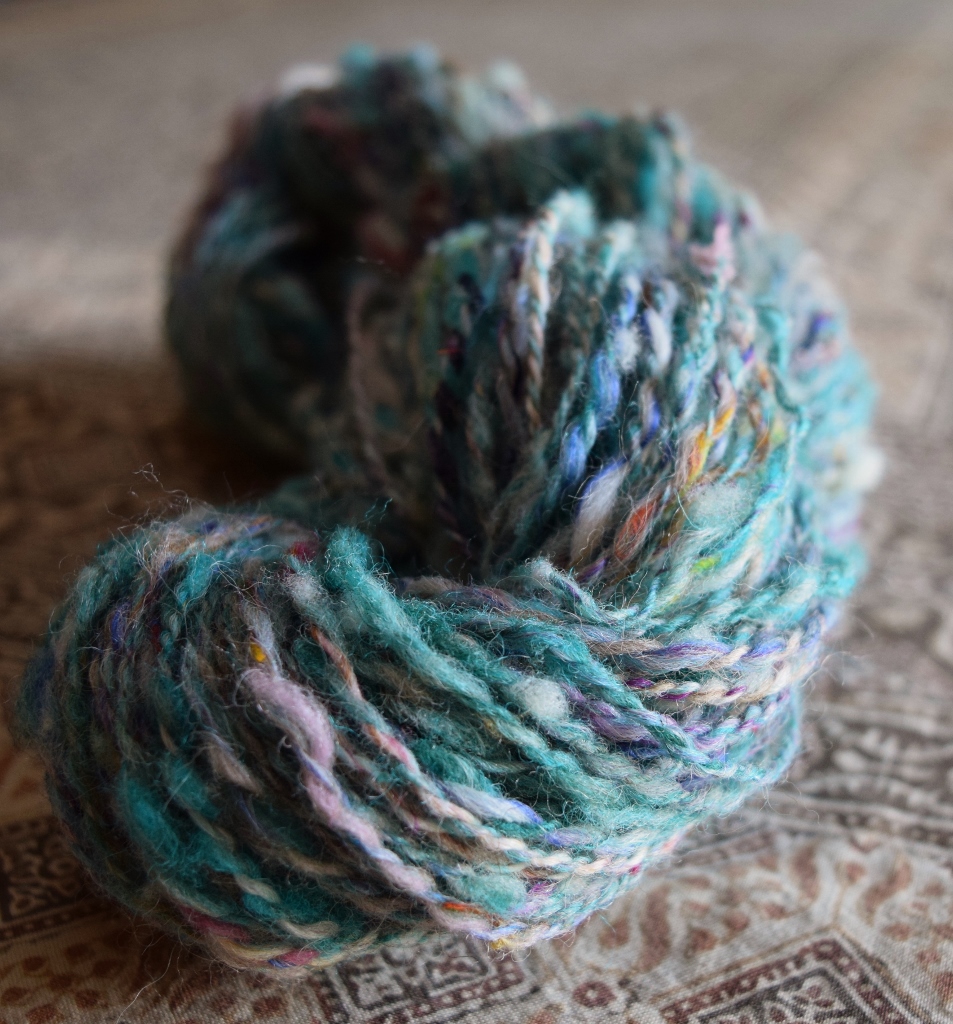
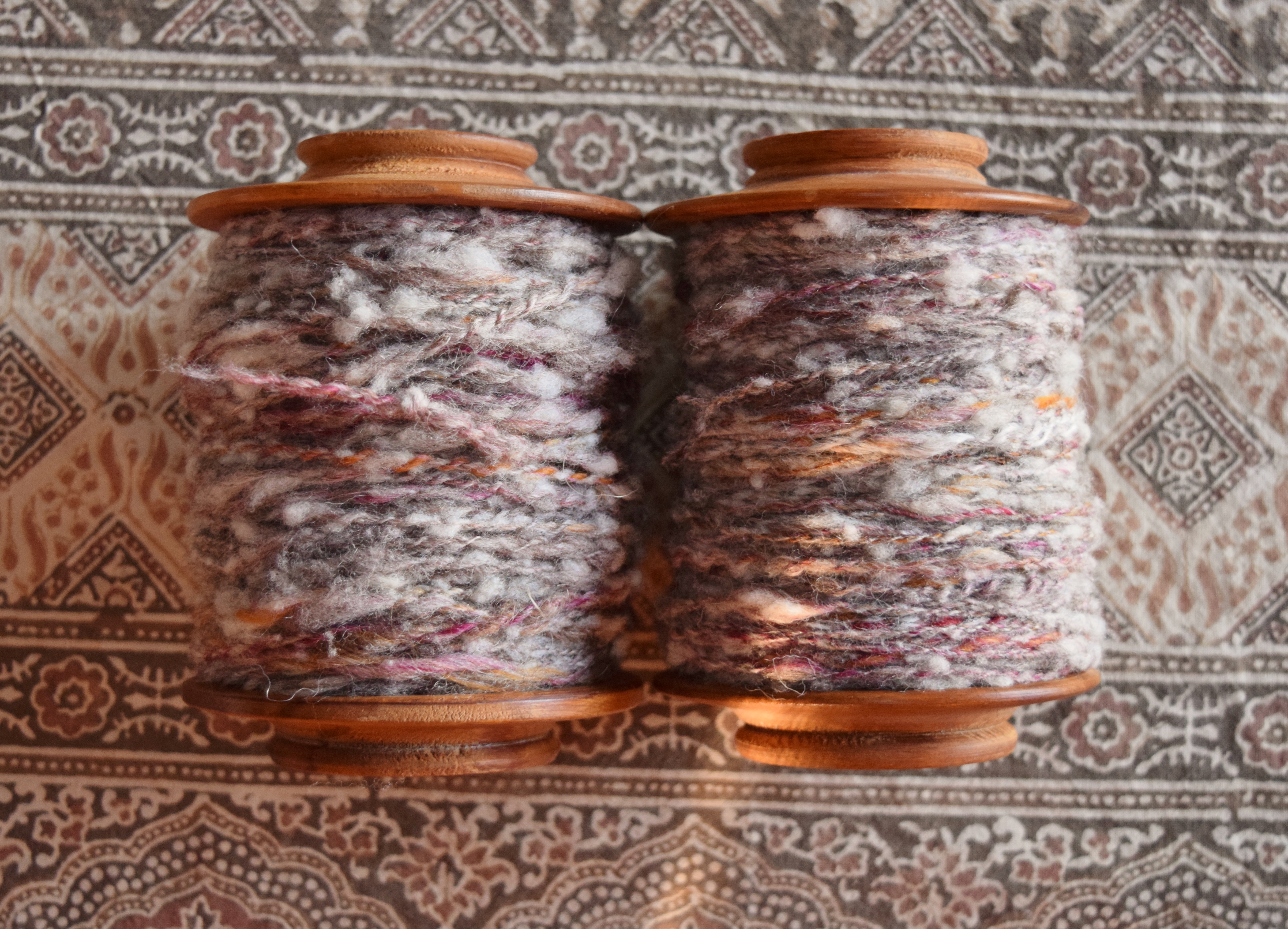
And, over the weekend, here is what I spun up…. slubby, exotic woolen spun blend
Meanwhile, the general news…
Emma is in her last days of having to endure The Cone, for the surgery she had a week ago already (to remove a low-grade sarcoma on her front leg, she will be alright, no reason to be alarmed). My nieces have started school already, Miss Seventeen is a senior this year, and Miss Fourteen is now in 9th grade! I’m very busy presently working up two patterns to be available in a double download, and prototyped in the hand-spun alpaca! And we’re having some gorgeous cool foggy mornings at last! Life is good.
Spinning from rolags is a different experience for me. Especially these tightly rolled sausage-like ones drawn off of those nifty blending boards, and from which I posted about a few weeks ago. Raw, dirty & weedy alpaca is what I’m practicing this woolen technique I am learning, from rolags. In my spinning past, I’ve spun from locks, from picked fiber ‘clouds’ , from bats, had also tried a badly produced rolag or two and gave up ~~ but mostly all the years I’ve spun its been from roving, sliver, and combed top. I am learning that although I was getting better at spinning a fine even single, the yarn I’ve been spinning has been dense, tough type of yarn. I think I was unconsciously aspiring to spin worsted (or semi-worsted) , however there is true woolen style of spinning which is done this way, from rolags I am learning, and ‘long draw’. Okay, I’m getting this…
I must say, this rolag thing is where it is at! Its fascinating, long-draw spinning method, and as yet I am far from being able to do it, and I must resist the urge to pinch the twist too much and let it compress through my fingers into tight even yarn, for that is what is to spinning, like knitting yarn with too small of a size needle I think. It creates a dense compact yarn, that squeezes the life out of the fiber. Just look how the yarn pulls out of the rolag in a line all by itself, with really very minimal fussing if you do it right…
Well, I’ve got this pile of rolags that I made from my first carding on my board, a loosely carded alpaca, and when I’m done with this, I will wash it very well as it is dirty. Hopefully it will bloom and be fluffy & beautiful.
As I’ve been ordering & collecting a bit of fancy fibers to play with and blend, and even ‘processing’ some bits of yarn I have on hand to incorporate into the tweed mixes which I am envisioning for art rolags! For now I’m glad to be taking a break from knitting as the previously posted yarn was not very nice at all, and I sent it back only to have to start all over with nicer yarn that I enjoy knitting, and more important, that my nieces will enjoy wearing! So I’m waiting for new yarn to come in. In the mean time I’m spinning! All you spinners out there, I invite you to share in the comments about your preferred spinning methods, and anything you might be able to say about woolen vs worsted spinning ~ thanks!
I’m closing with a posting of a video from 1970’s that I found about sheep & spinning in Donegal Ireland, I hope you love it as much as I do!