Just finished some twilly alpaca woven thing and rushing through photos of it so I can bring it to my dear friend, then snow started coming down, doubling the excitement . . .
Hey Juno, its snowing!
By the way, in about a week, Juno will be three, already! Where does the time go?
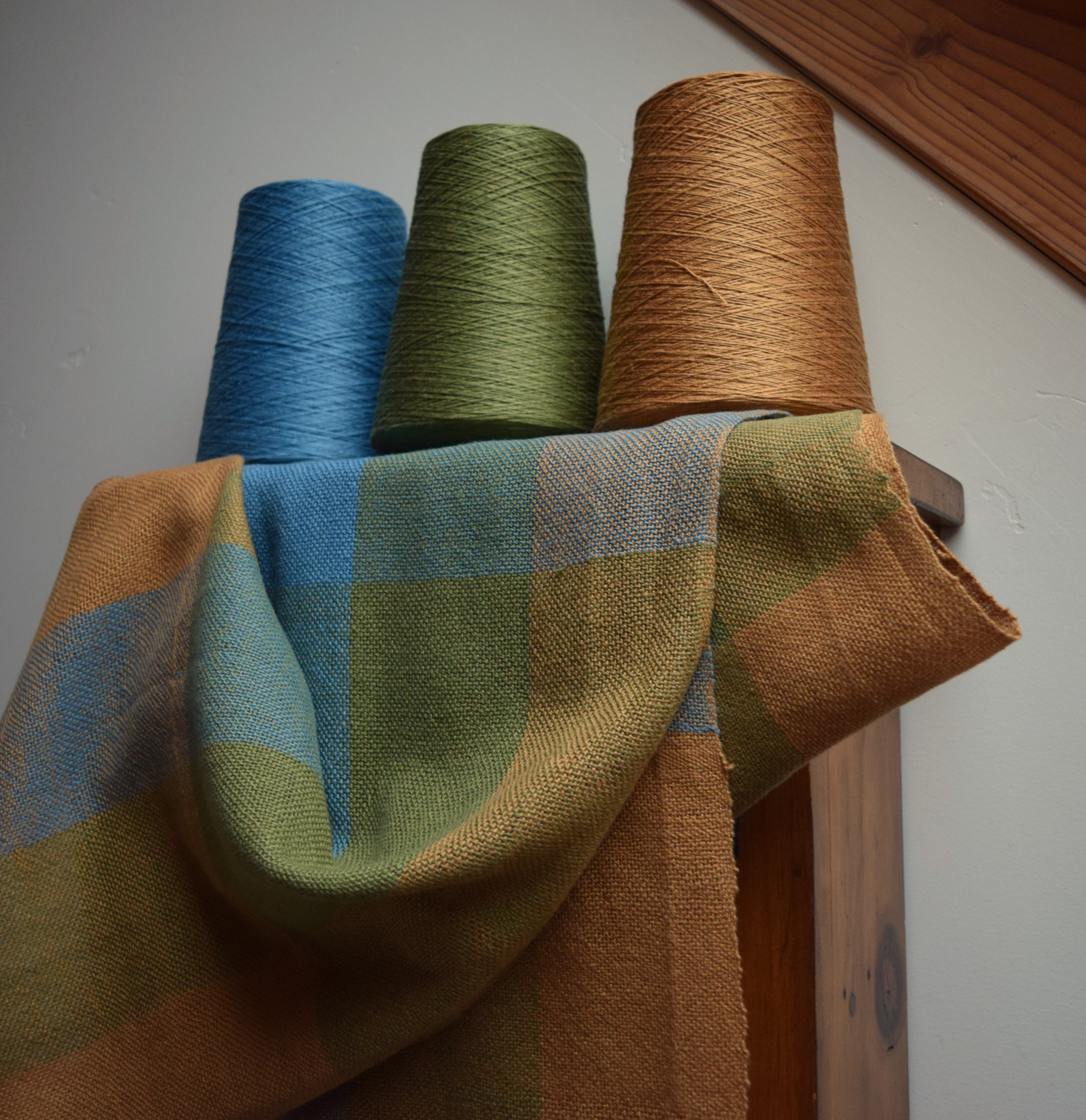
Another simple check with three big blocks of color shows so well how shades interact and colors multiply, intersections creating new colors and keeps the interest going through the arduous task of managing even edges. Something so basic as three colors can give a lot of gratification when first learning the basics of weaving. I am still a massive fan of check!
In my recent weavings I’ve been reinforcing the selvedges with extra threads and using a temple, which at this early stage of becoming a weaver, I have already come to rely upon. I think every once in a while weaving something without extra selvedge threads or temple, would give me practice keeping the selvedges from drawing inward by keeping the tension even but not too tight, and the weavers’ angle generous. There are many weaving notes and photos left below, in the event that anybody might find them useful, and I am happy to talk about the details further in the comments as well.
♣ Weaving Notes ♣
Yarn: 10/2 cotton, 4200yds / 1 lb, Valley Yarns Mercerized in colors; Golden Ochre (7129), Moss Tone (5997), and Mediterranean Blue (2448). This is the first time I used mercerized cotton, having no idea how much I would like it, I really do!
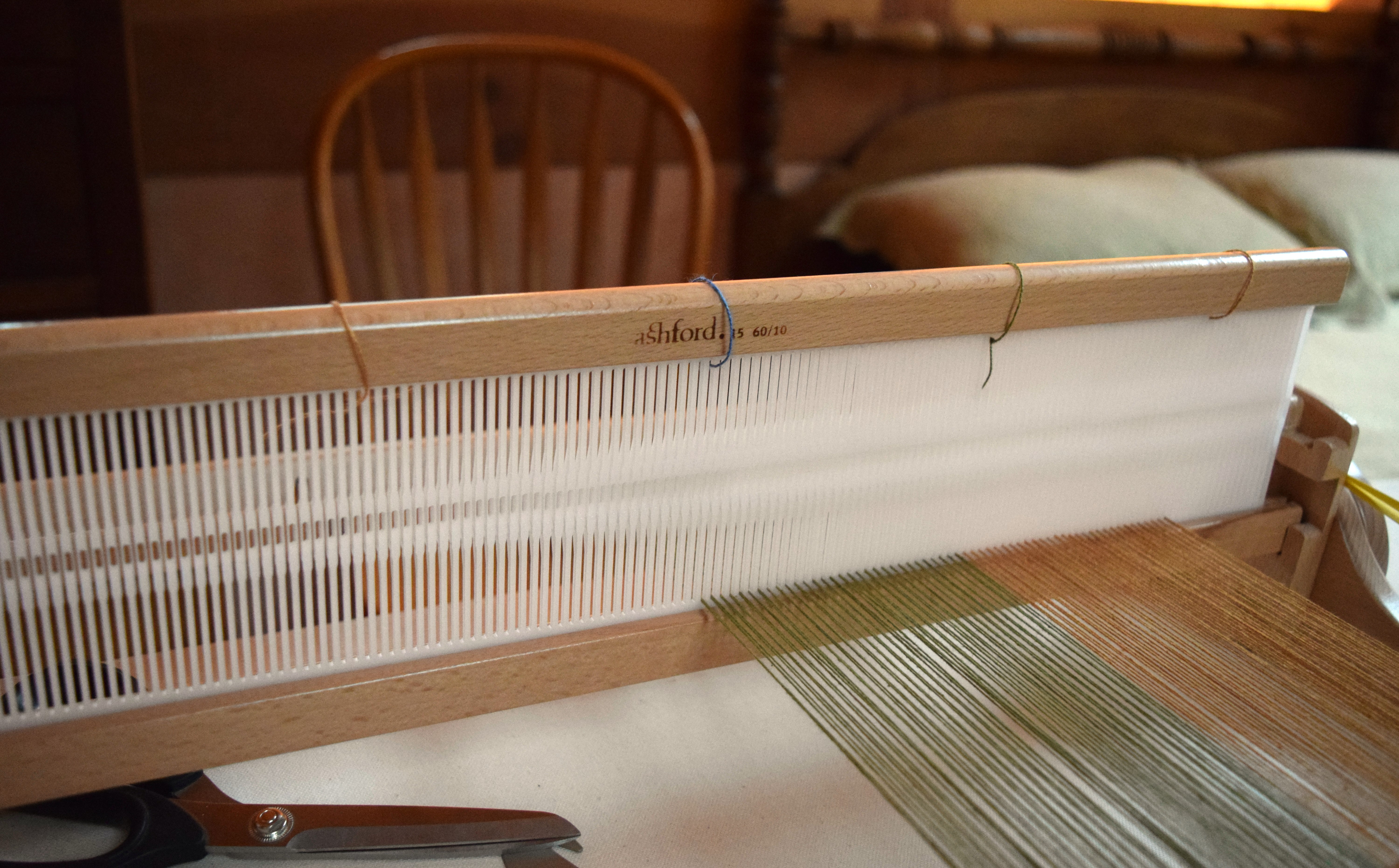
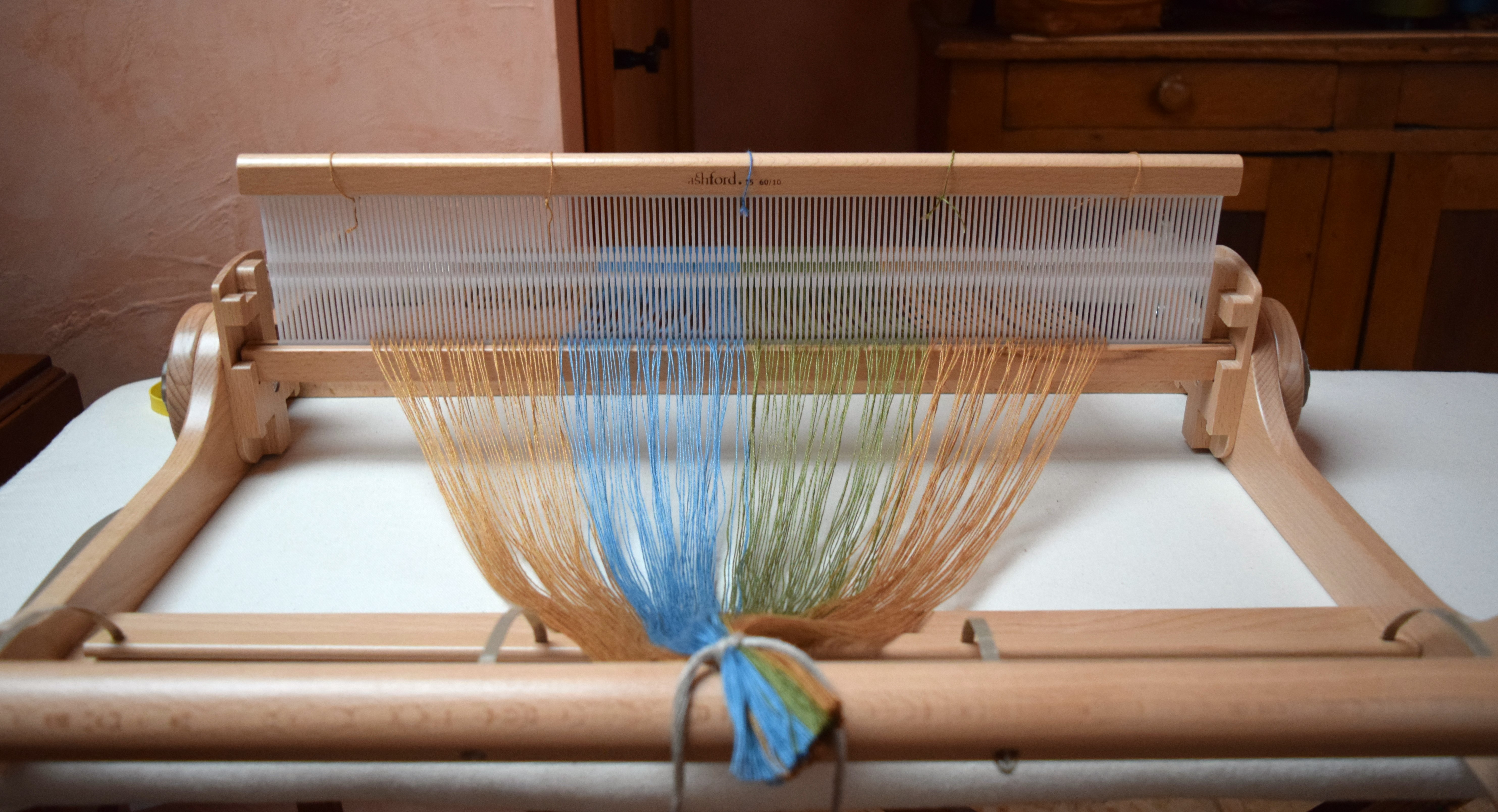
Loom: Ashford Knitters Loom 20″.
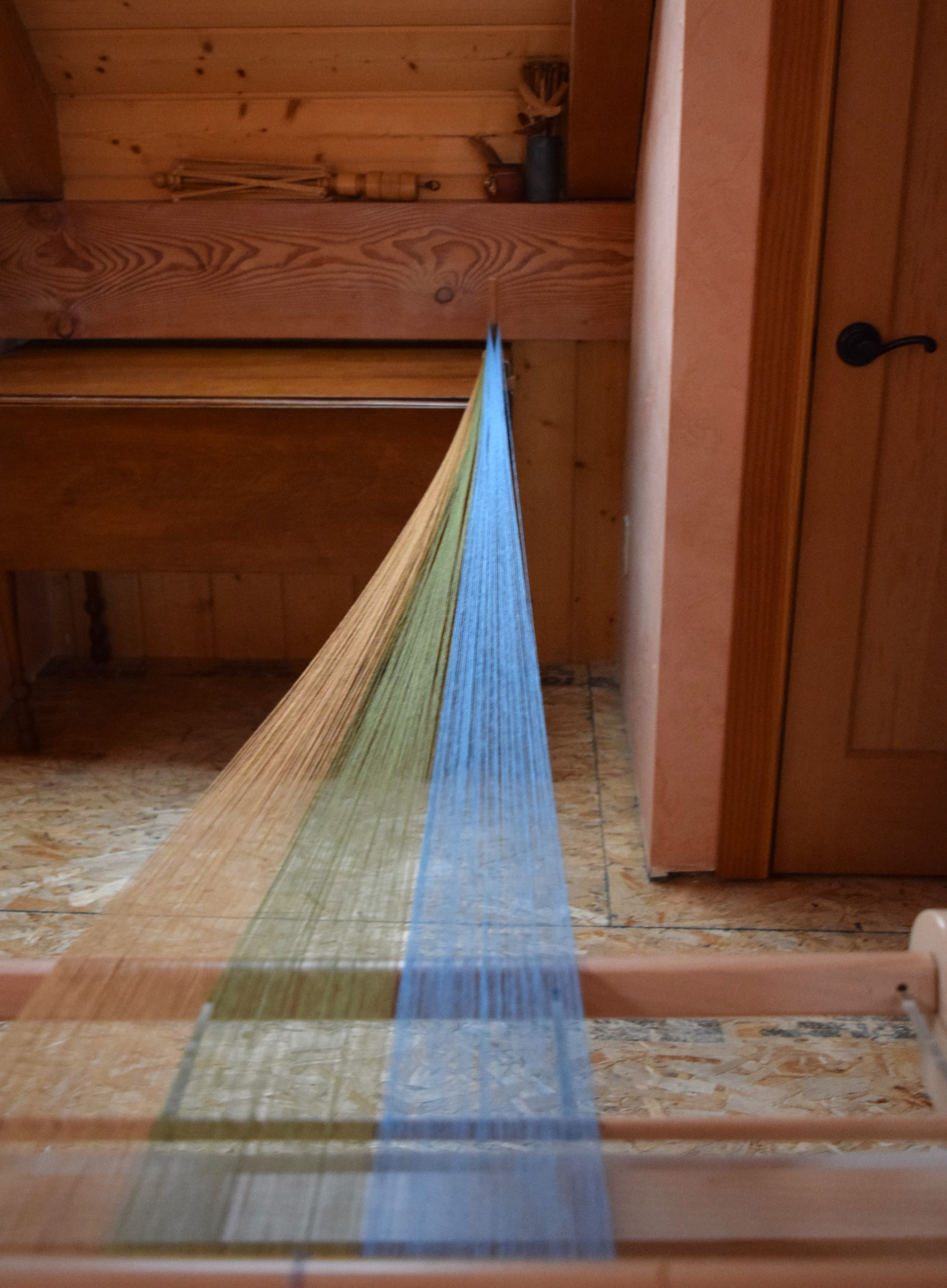
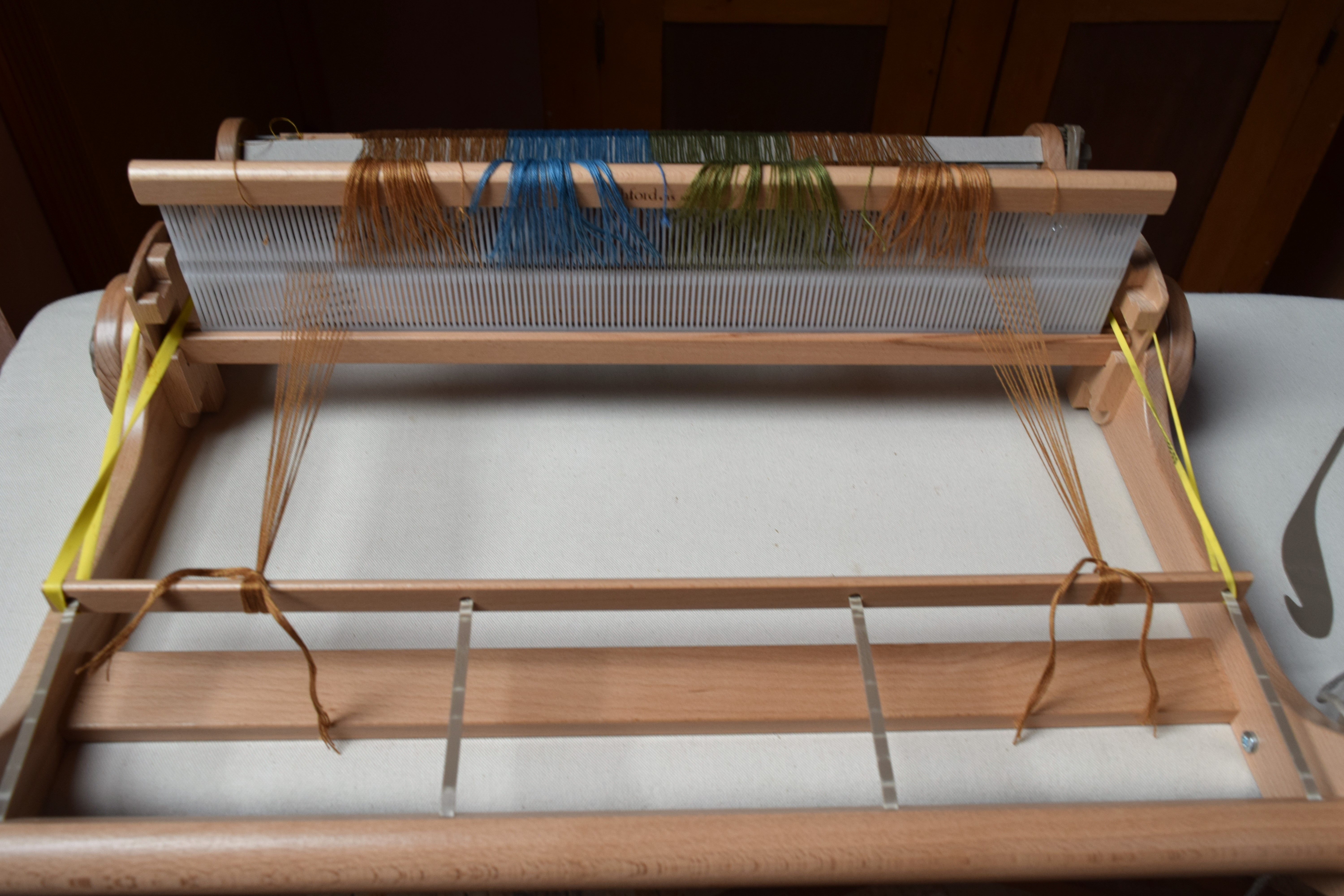
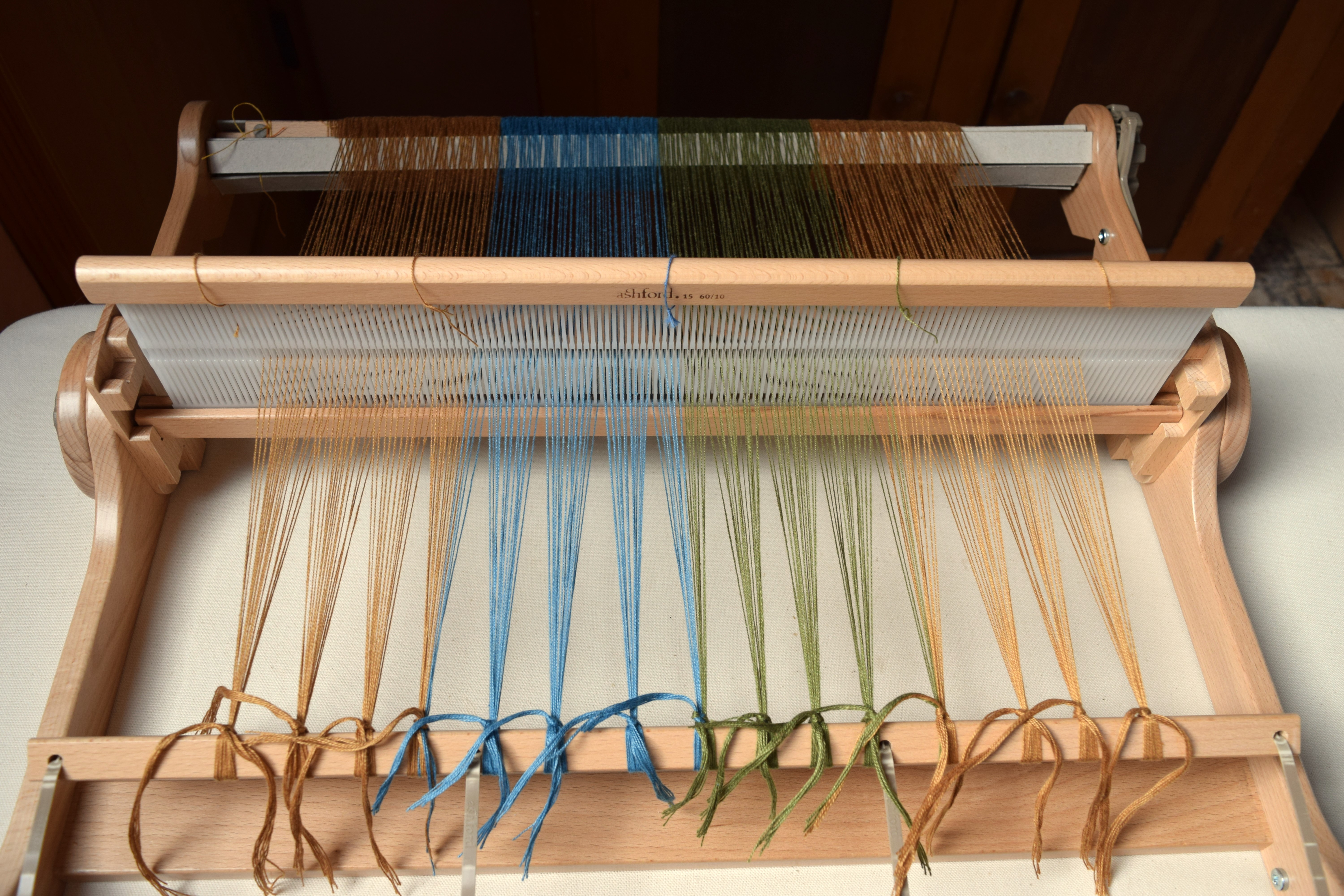
Warping method: Direct warp set-up, 1 end in every heddle/hole, and 1 in every dent/slot –drawing out from apron rod through each dent to peg is 2 ends = each color 30 dents = 60 ends. Approx 100 inches from apron rod to warping peg.
Number of warp ends: 240
Reed: 15 dent rigid heddle 20″ reed, and width in reed = 15.5″.
Sett on loom: Warp = 15 epi (threads or “ends” per inch), weft = 15 ppi (passes or “picks” per inch).
Sett after finishing: Warp 16 epi, and weft 16 ppi.
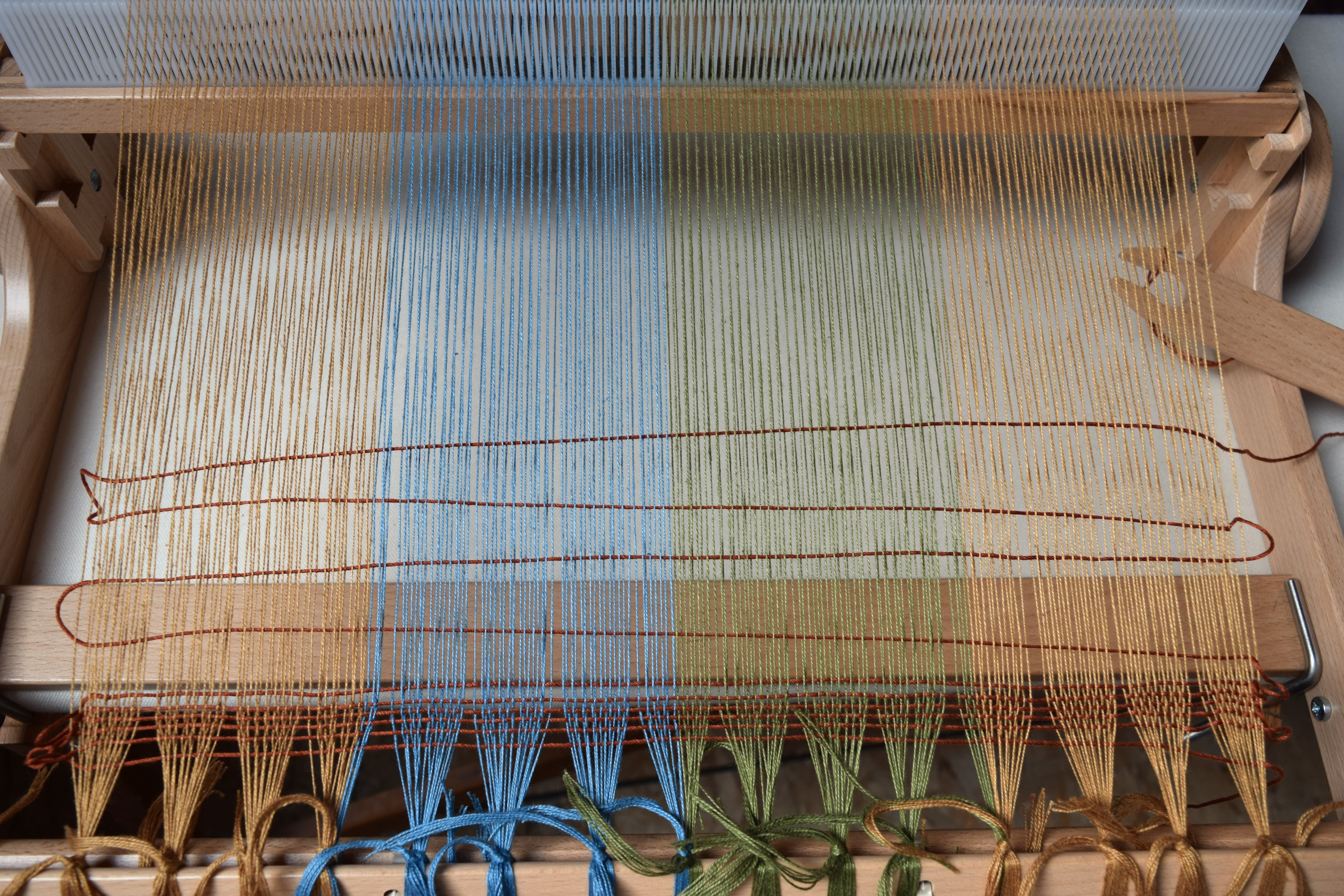
Color Pattern: Warp = 60 ends gold, 60 ends green, 60 ends blue, 60 ends gold. Weft = wound 60 full wraps on to the stick shuttle for each color, in repeating sequence gold, green, and blue.
Finished: 1/4 inch turned hem, then washed and dried in machine, then pressed, measuring 68″ long and 14″ wide, and weighs 117g.
Yardage: Total yardage used = 1083 y, figured from weight of finished piece and not including loom waste.
How could I have escaped the inevitable? The fate that I would want to operate multiple shafts was almost necessary to learn to be a weaver, and so I surrendered to fate. It took me about three days to put together, and it was not without near catastrophic moments, and in the end, it all worked out just fine. It is the largest model, with a 32″ weaving width capacity, and 8 shafts, although I don’t plan on using more than 4 for quite some time. I’ll admit to you though, I am a little afraid of it, for it surely will elevate me beyond mere simple plain weave to perhaps twill, and perhaps with a few hundred more texsolv heddles, I could weave very fine linen. We will see. For now, it is just an inanimate object that needs to have the pulse of creativity brought into it, and so today I intend to begin its very first project, I have made the calculations, with four skeins of alpaca for the warp, it is waiting for the spark of life. Wish the two of us luck.
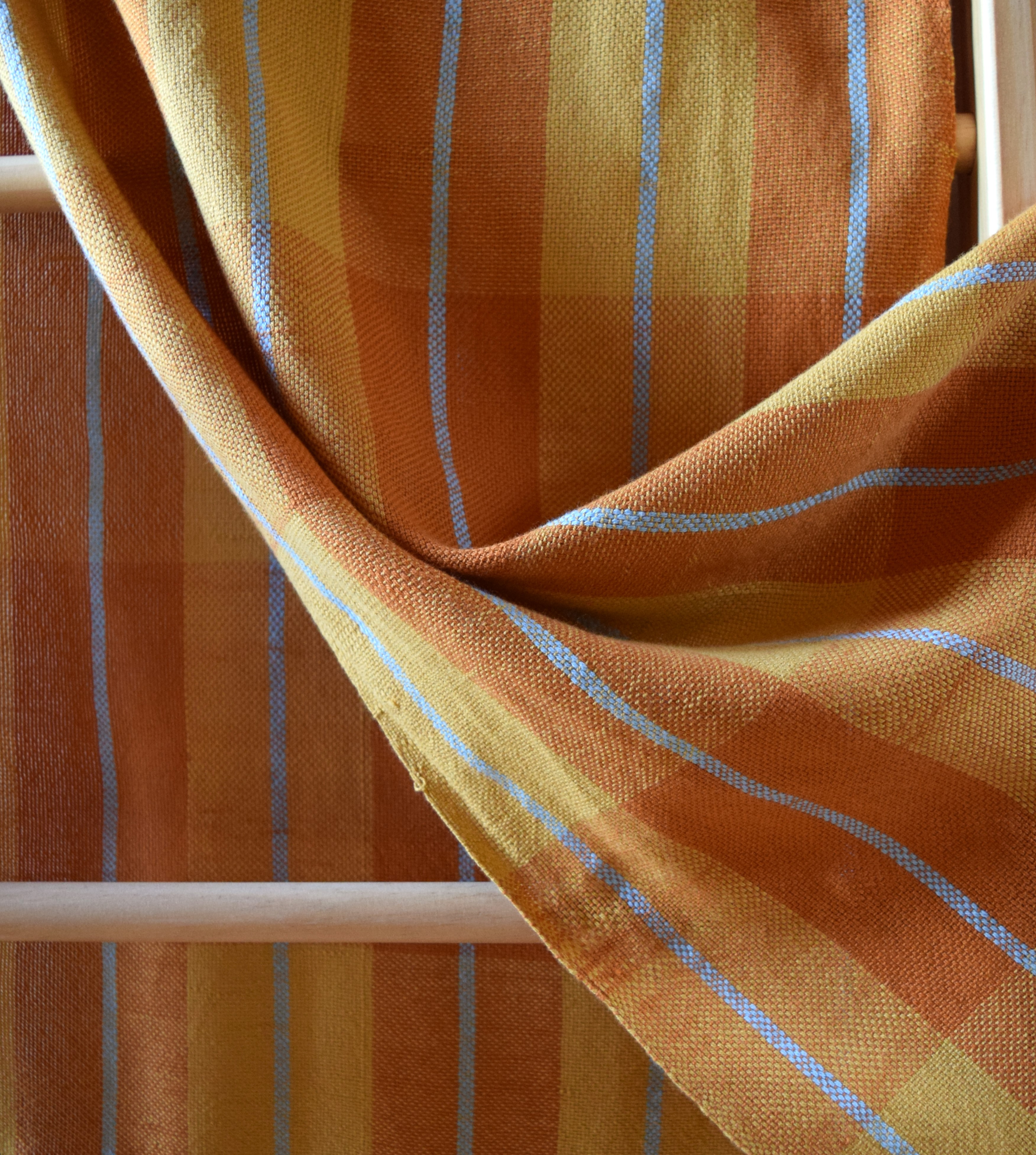
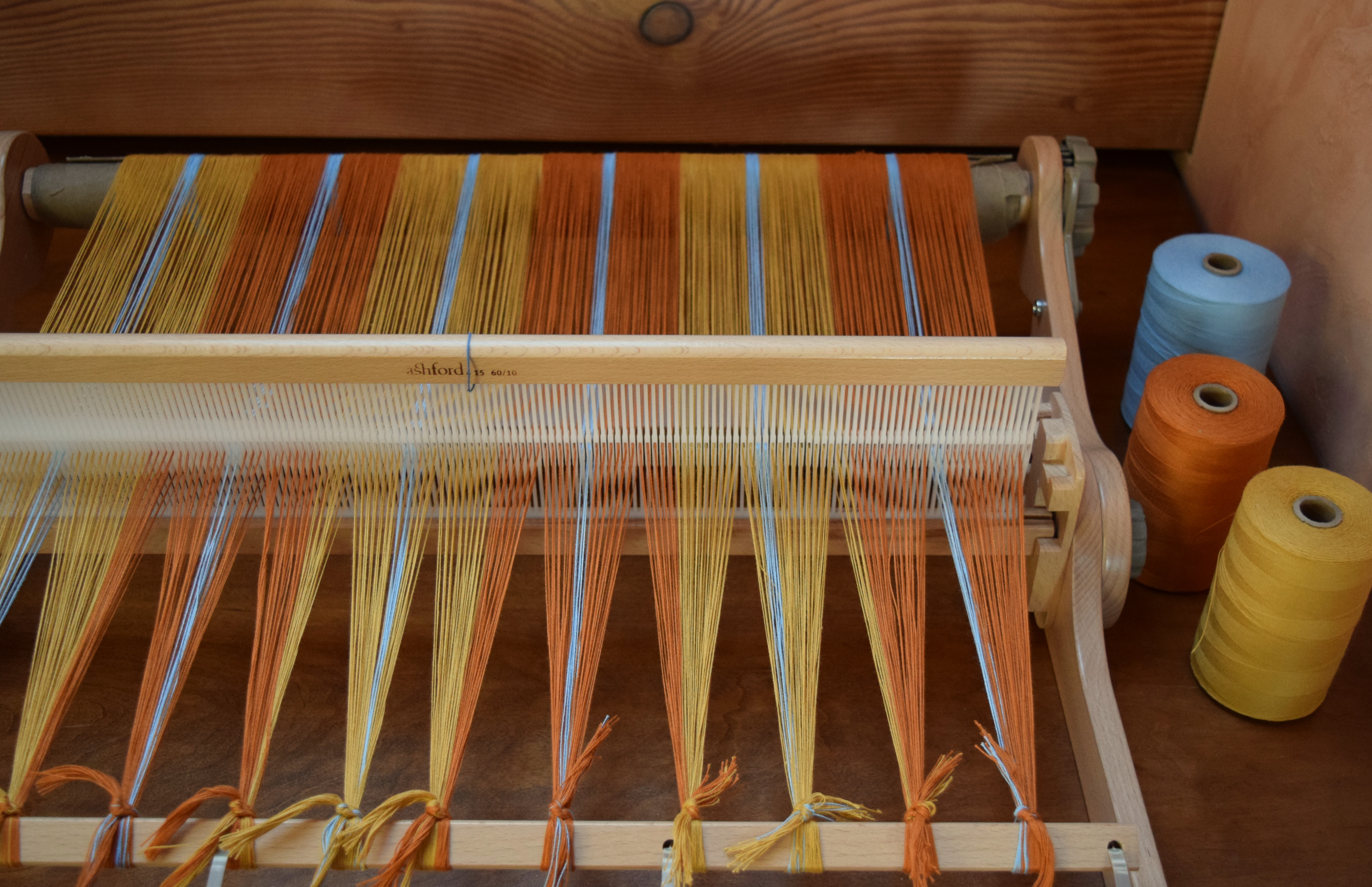
Calling this one Sunny Skies, as it radiates sun rays and with a little cool stripe of sky blue . . . to be sent off to my youngest niece who is at university in sunny Santa Barbara, a vernal emissary to cheer her up.
Warp stripes of burnt orange, golden yellow, and sky blue, against weft strips of burnt orange and golden yellow; the pattern makes an interesting, elongated check pattern with a thin strip of pale compliment color contrast. A beautiful check improvisation if I may say so, and definitely plan to explore this same pattern again per weaving notes below, the checks are so subtle as is the contrast stripe, that the possibilities are many. Exciting!
♣ Weaving Notes ♣
Yarn: Maurice Brassard 16/2 unmercerized cotton, 6720 yds / lb.
Loom: Ashford Knitters Loom 20″.
Warping method: Direct warp set-up, doubling up epi — 2 threads in every heddle/hole, and 2 in every dent/slot. Approx 100 inches from apron rod to warping peg, which is a guess as I seemed to have forgotten to take notes on that measurement.
Sett on loom: Warp = 30 epi (doubled) and weft = 15 ppi (single).
Sett after finishing: Warp 32 epi (doubled) and weft 16 ppi.
Selvedge: Doubled up two outer most selvedge warp yarns (4 ends hole & slot), and used a temple to try to keep even.
Finished: Twisted fringe by hand, then washed and dried in machine, then pressed.
Weaving edge to edge measures 72″ long x 17″ wide, including 3″ fringe.
Finished Weight: 130g. Total yardage of finished piece is 1924 yds.
Other notes: This was the first weaving in *such* fine cotton, and it proved difficult to keep weaving even. Next time I’ll go lighter on the beating. Also, even after choosing the most subdued colors available, I am feeling like the overall affect is much too bright. How to soften colors? There’s always the easy trick of simmering yarn in a dye bath of tea — before — weaving with it.
I finished weaving on Christmas eve, cut off the loom on Christmas day and in a chocolate induced moment of bravery I tossed it in the washing machine to wash, dry, and shrink. The day after Christmas I pressed, cut all the loose ends, hemmed it by hand, and am very pleased with my first tablecloth. I have been working on this cotton-linen table cloth since warping in November, at first not very often, as I had not developed a regular habit of weaving, but then as the weeks went by, and spending half hour of focused weaving several times a day in between chores. I even explored weaving spaces with the loom, having carried it up and down stairs several times, as well as back and forth from the tiny house a couple of times, and even hid it away in a closet out of sight with weaving in progress, while I cleaned up for guests on Thanksgiving Day. Sure a floor loom would be faster, but however slow this big rigid heddle loom is, slow and steady wins the race. I’ve learned how to handle the long stick shuttle while keeping the sheds relatively neat and clear, and to boast, there is less than 16″ of warp waste including tie-on and header, I think amazing given that I calculated perfectly for the fit on the table. All in all, I’m very pleased with this first serious piece of cloth. I really LOVE the simplicity of this loom, and believe its colossal 48″ weaving width is manageable because I’ve learned to weave while standing.
Direct warp method, 110 inches from apron rod to warp pegs, warping 2 threads in every heddle/hole, and dent/slot. See the post where I am warping this project.
Sett on loom: Warp = 25 epi and weft = 12.5 ppi / or, threads per inch
Sett after finishing (shrinking) : Warp 28 epi and weft 14 ppi
Reed: 12.5 dent
Color Pattern: 20 threads alternating with 4 threads = warp, 48 picks alternating with 12 picks = weft
Selvedge: Doubled up two outer most selvedge warp yarns, and used a temple to try to keep even.
Finished: Machine washed and dried, hemmed by hand, hem to hem measures 80″ long x 42″ wide.
Finished Weight: 540g, or 1.19 lbs. Total yardage of finished piece is 4000 yds.
Note about loom waste : I weighed the left over cut yarns after all finished, which weighed 55g, and that would be about 403 y, so total yardage on the loom 4400 yds, and 600g before cutting off.