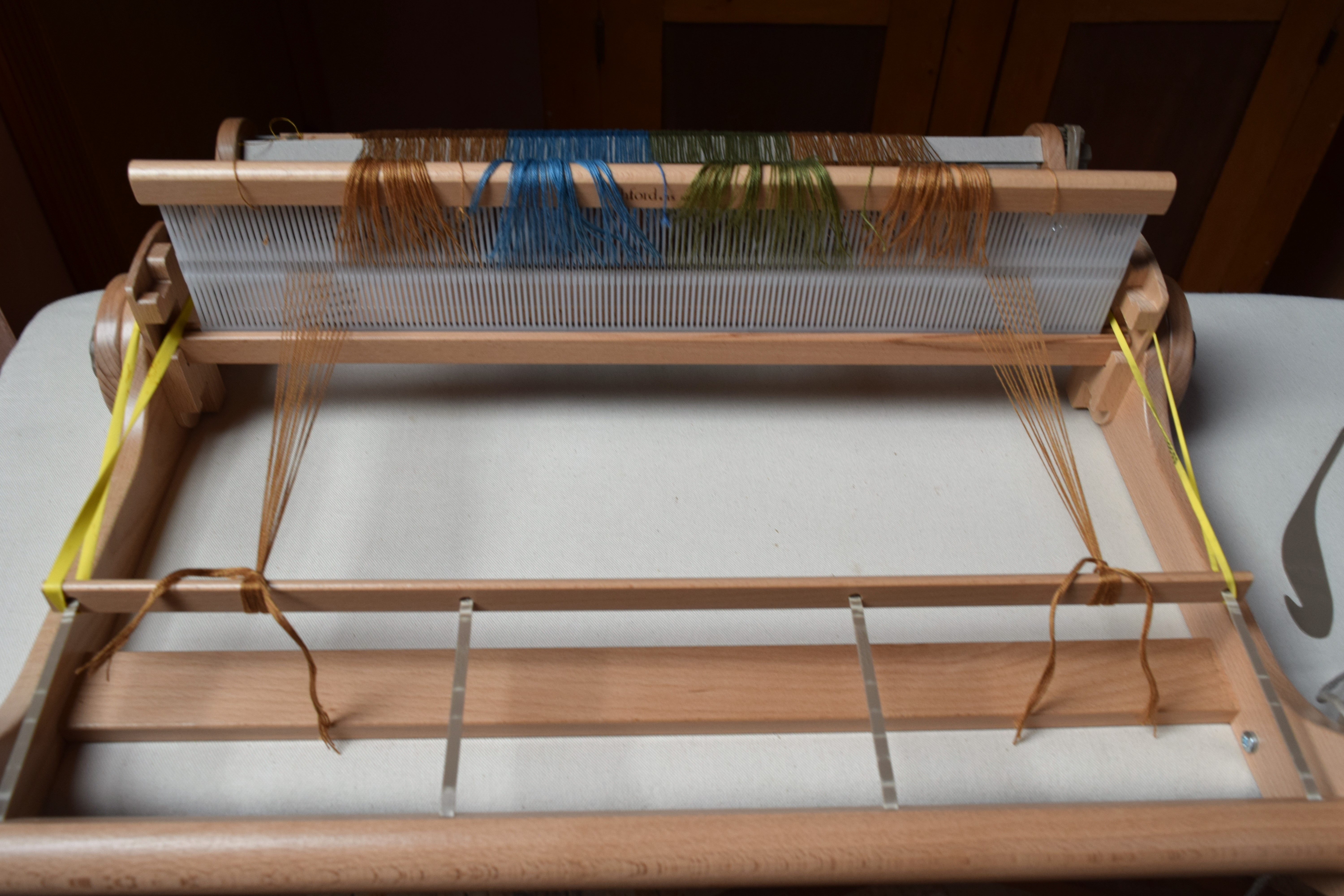
Scarf No.3

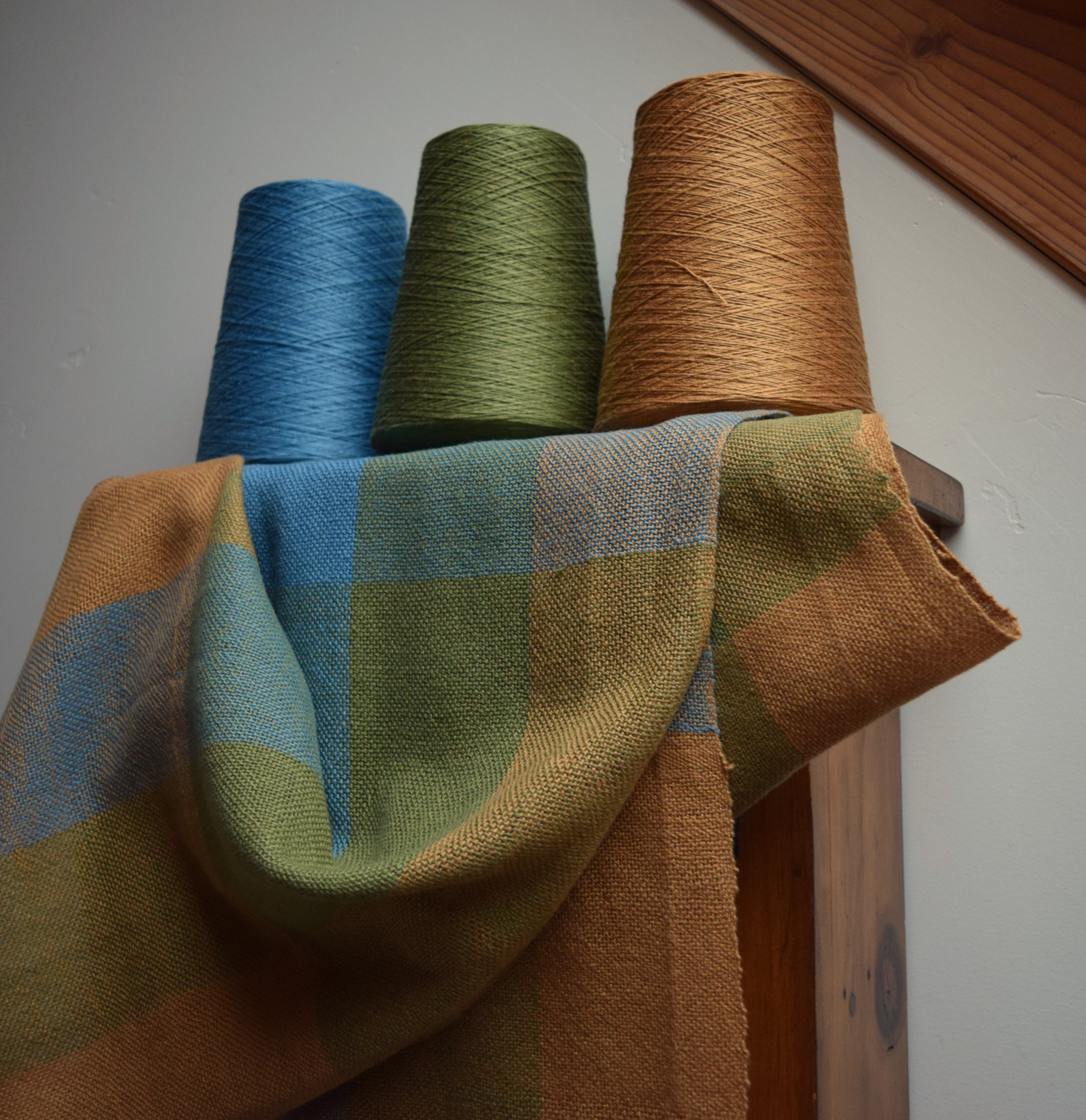
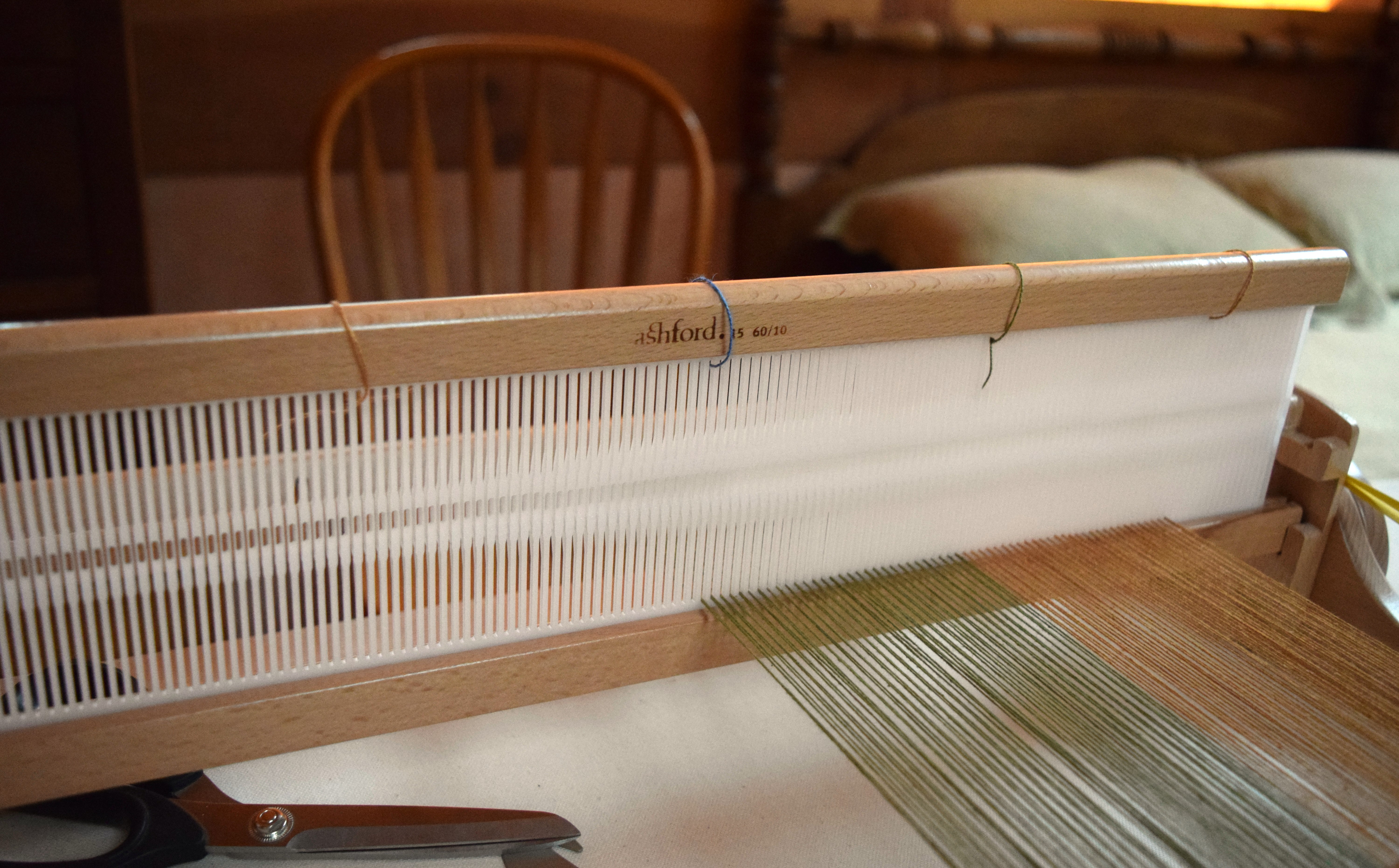
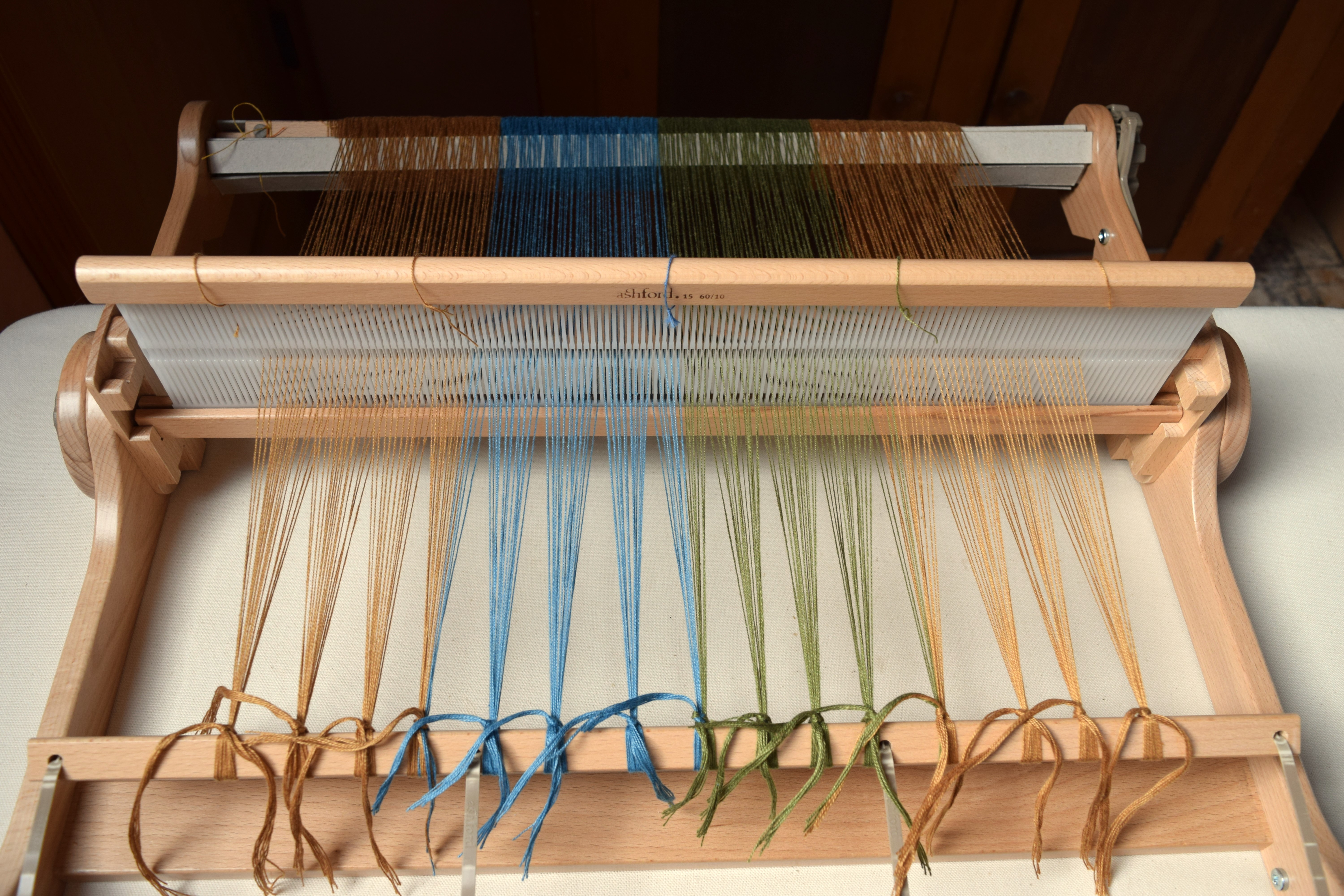
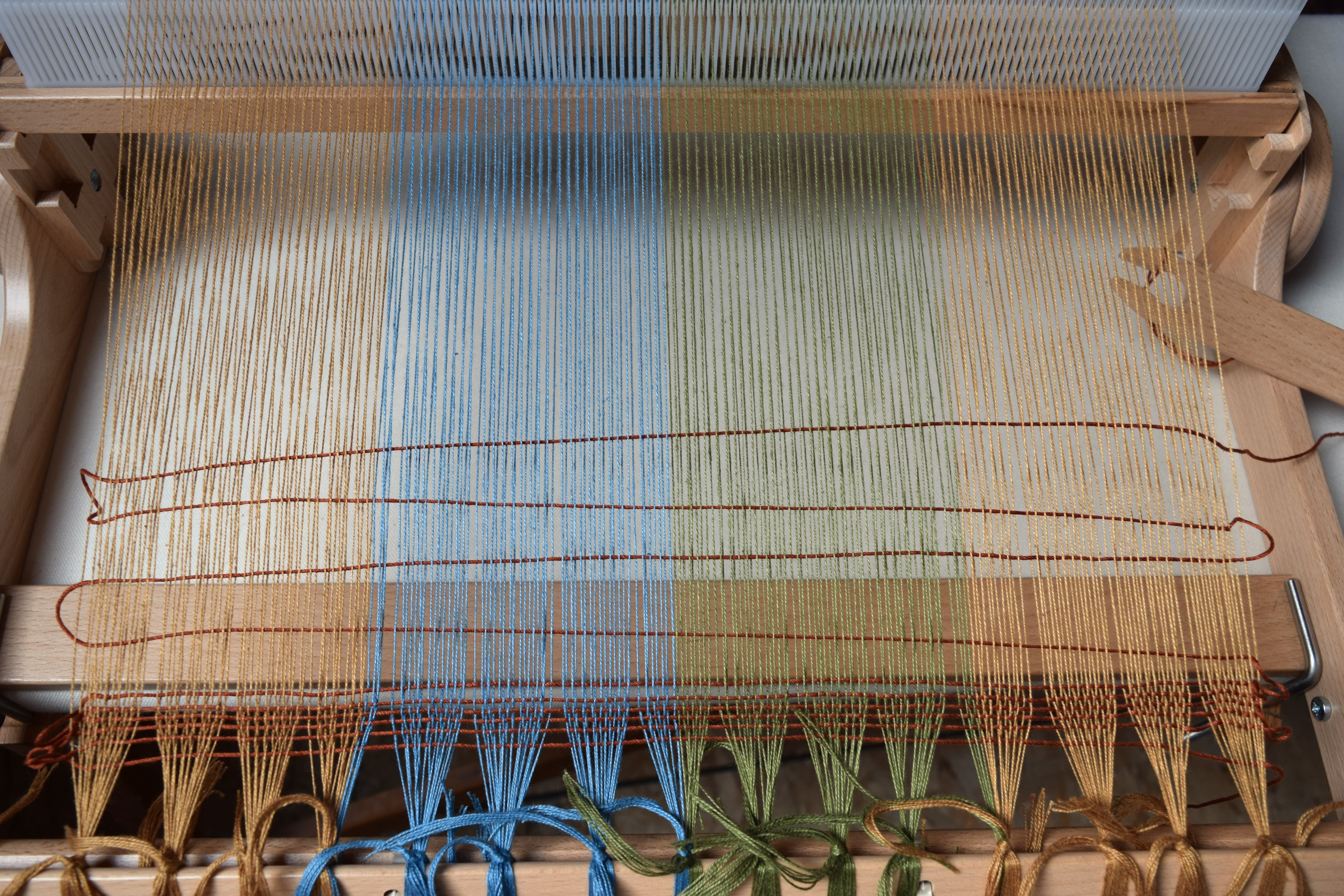
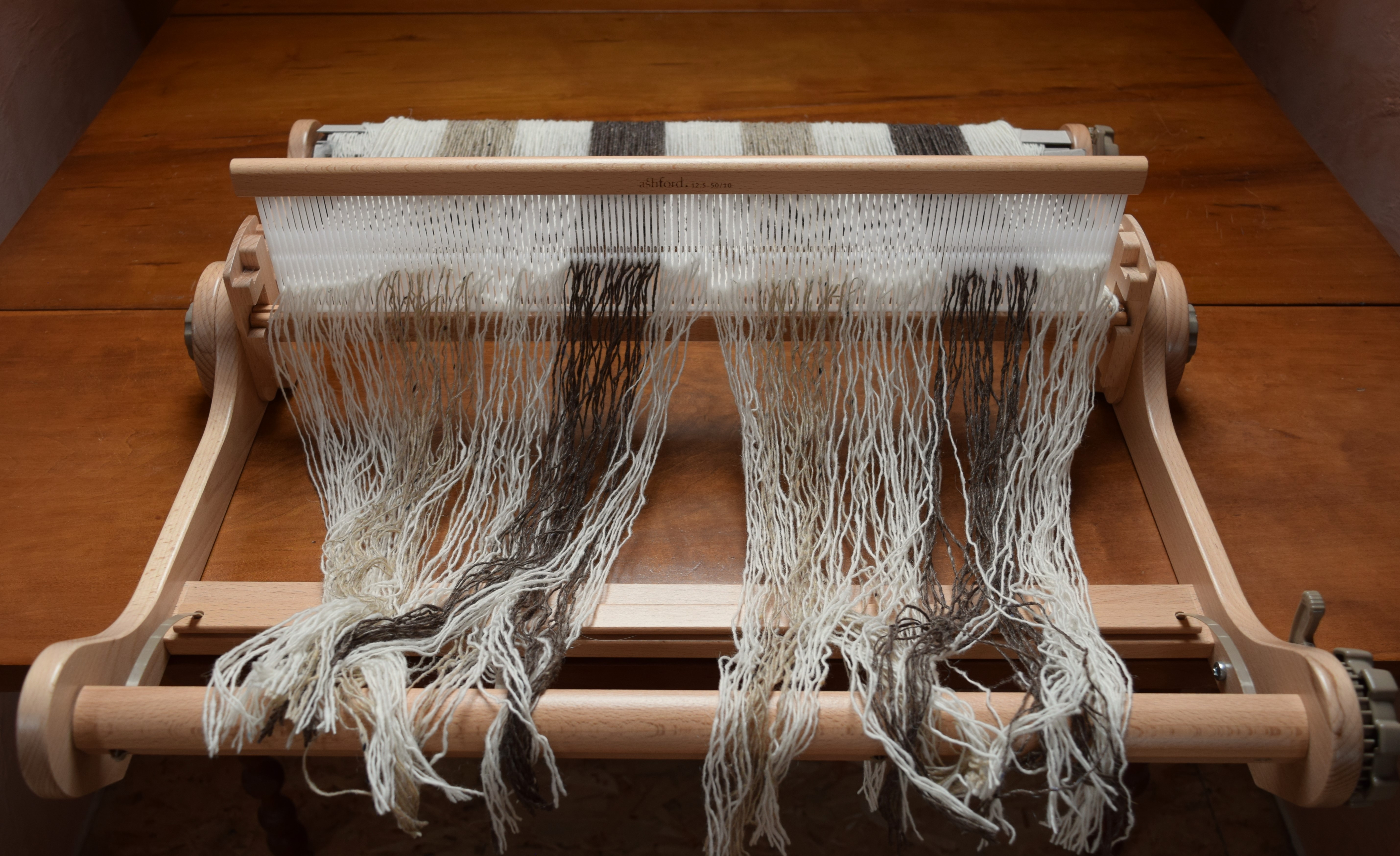
This ultra fine cloth finished has 32 threads per inch in the warp, and was woven on my 20″ Ashford Knitters (rigid heddle) Loom, which is a fabulous sample loom for all the fine weight threads I have been so curious to try. This particular project is extremely fine cotton, was threaded through two 15 dent reeds, and I have no desire to go finer, this is the limit. Famous last words, eh?
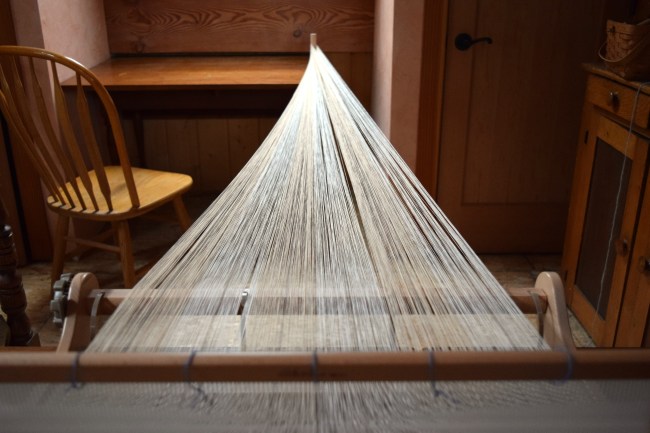
One must look and wonder how all these gazillion threads in the warp can be kept track of, and I for one, can not.  I thought all the threads were there, but as I begin to weave, there’s empty slots where warp threads are suppose to be, maybe one or two were mis-threaded, or broke, and I missed them, but as I weave further, more threads have disappeared, likely in not catching them when I was threading the reeds. I just can’t pull my hair out over it, these are sample weavings, total leaps of faith and hoping for the best, I can’t take it too seriously.
The most impressive thing to me about this piece is that it was threaded through two rigid heddle reeds; double threading is a mind bend at first, but then after my first try using these instructions the process gelled and suddenly I felt like I was born knowing how to do it. So I’m weaving on in spite of the mysteriously thinning warp, it is a thrill to be weaving such ultra fine fabric on a simple, nearly primitive loom, even though weaving 30 epi on the rigid heddle loom means I am having to do the extra work of using a stick shuttle for both passing the weft and beating down to try for a balanced weave, and still it is not. Weaving on the rigid heddle in this way slows weaving down a great deal, and there is a lot to pay attention to.

Once I am finished with this piece I may try another similar double threading sample with a different reed combination, coupling a 15 and a 12 dent together, achieving a 24 epi, and maybe then I can beat with only a tap of the rigid heddle reed instead of having to beat it down with the stick shuttle. I strive to find the sweet spot where weaving is truly balanced, not forced, and ultimately what I want to achieve with plain weave.

A bit about the design; I crave bold block design in a subtle contrast, so developing my elongated big check blocks with or without a stripe, and selecting the two very low contrast neutral colors for the background check, for this piece was an attempt to get a “barely there” colorway, yet it is still bold enough, and I really love it!

♣   Weaving Notes  ♣

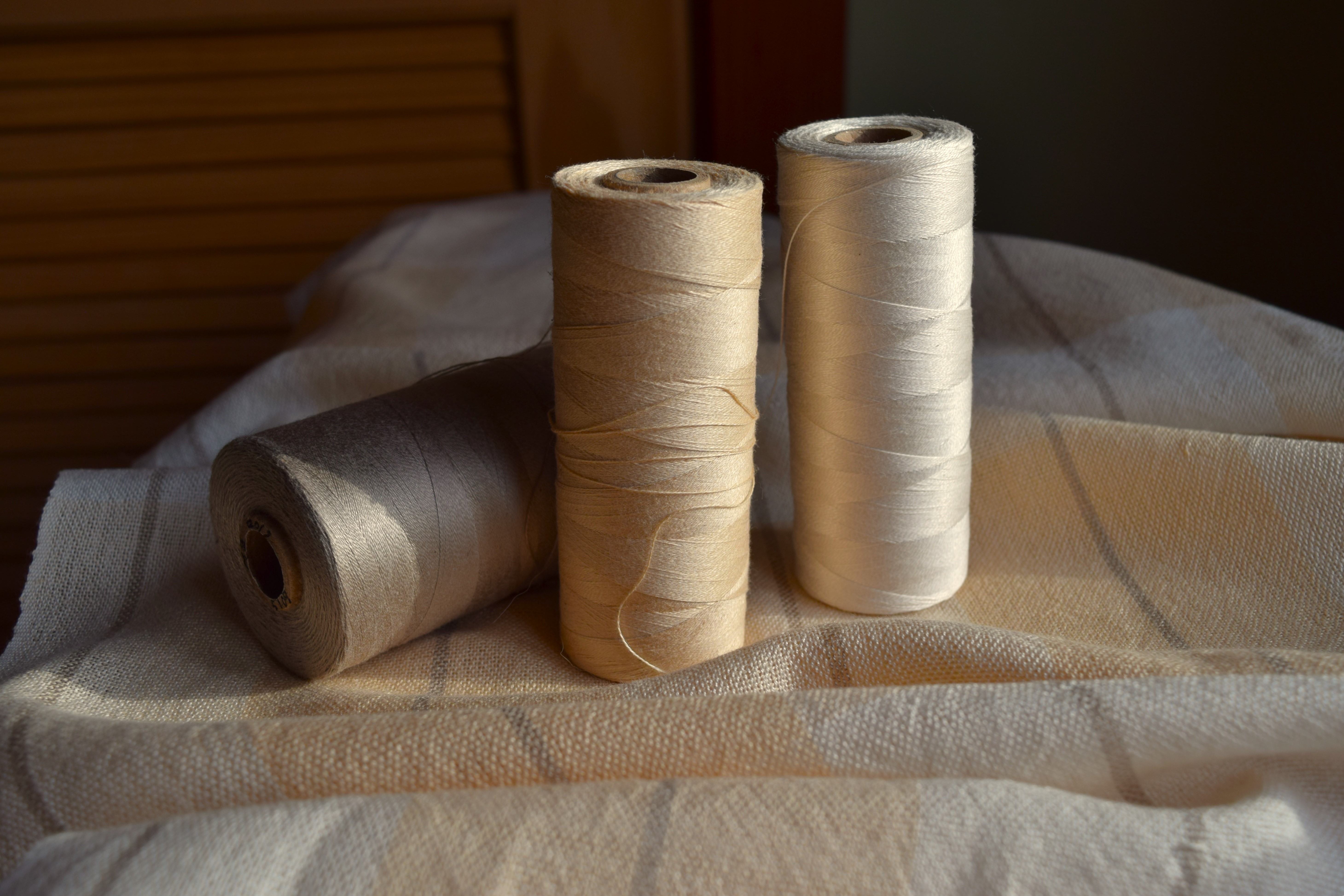
  • Yarn: 20/2 mercerized perle cotton, 8400yds / 1 lb, Maurice Brassard, in colors; Natural (P100), Light Beige (P-2), and Flax (P-5109). 
  • Loom: Ashford Knitters Loom 20″.
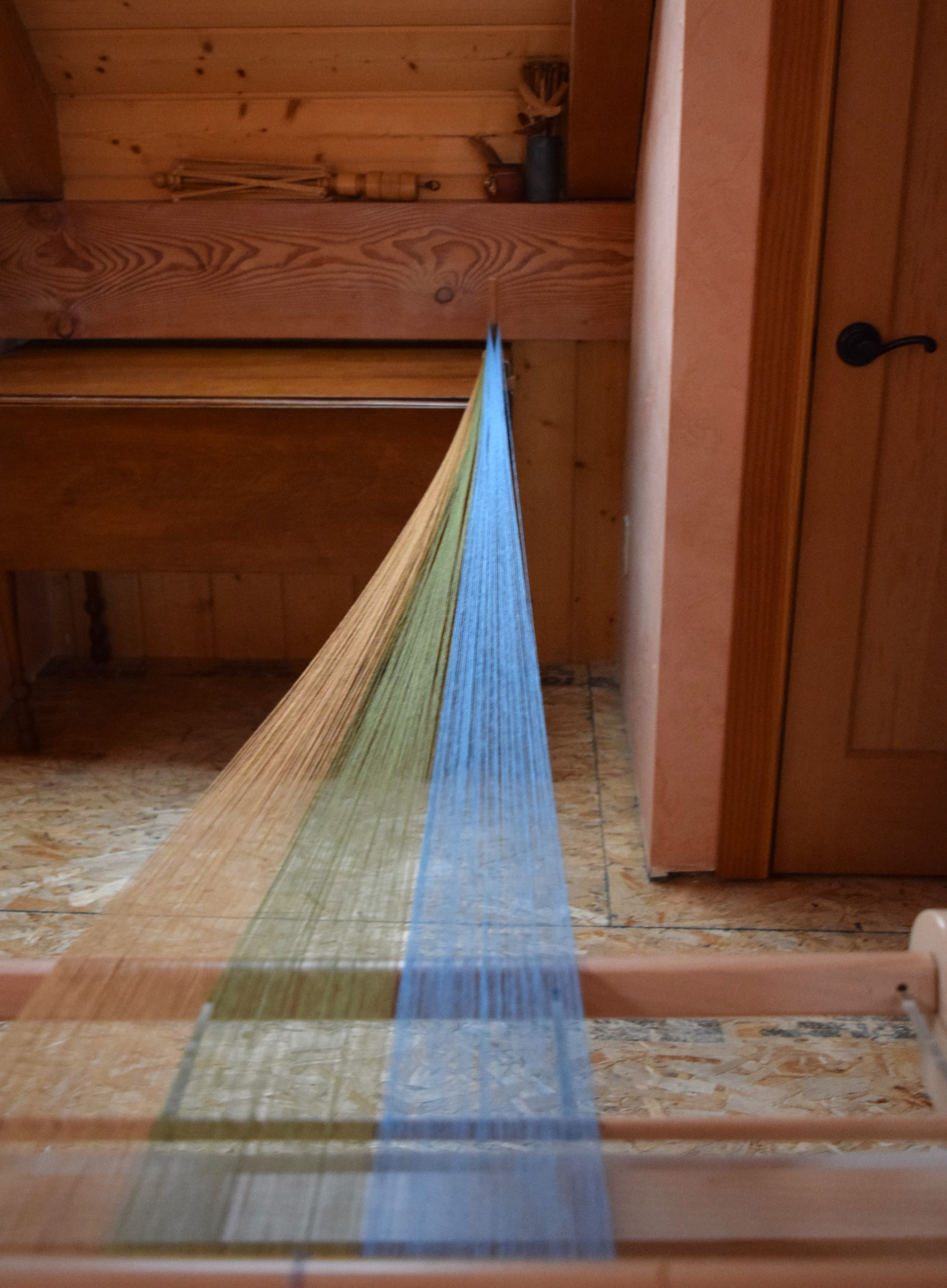
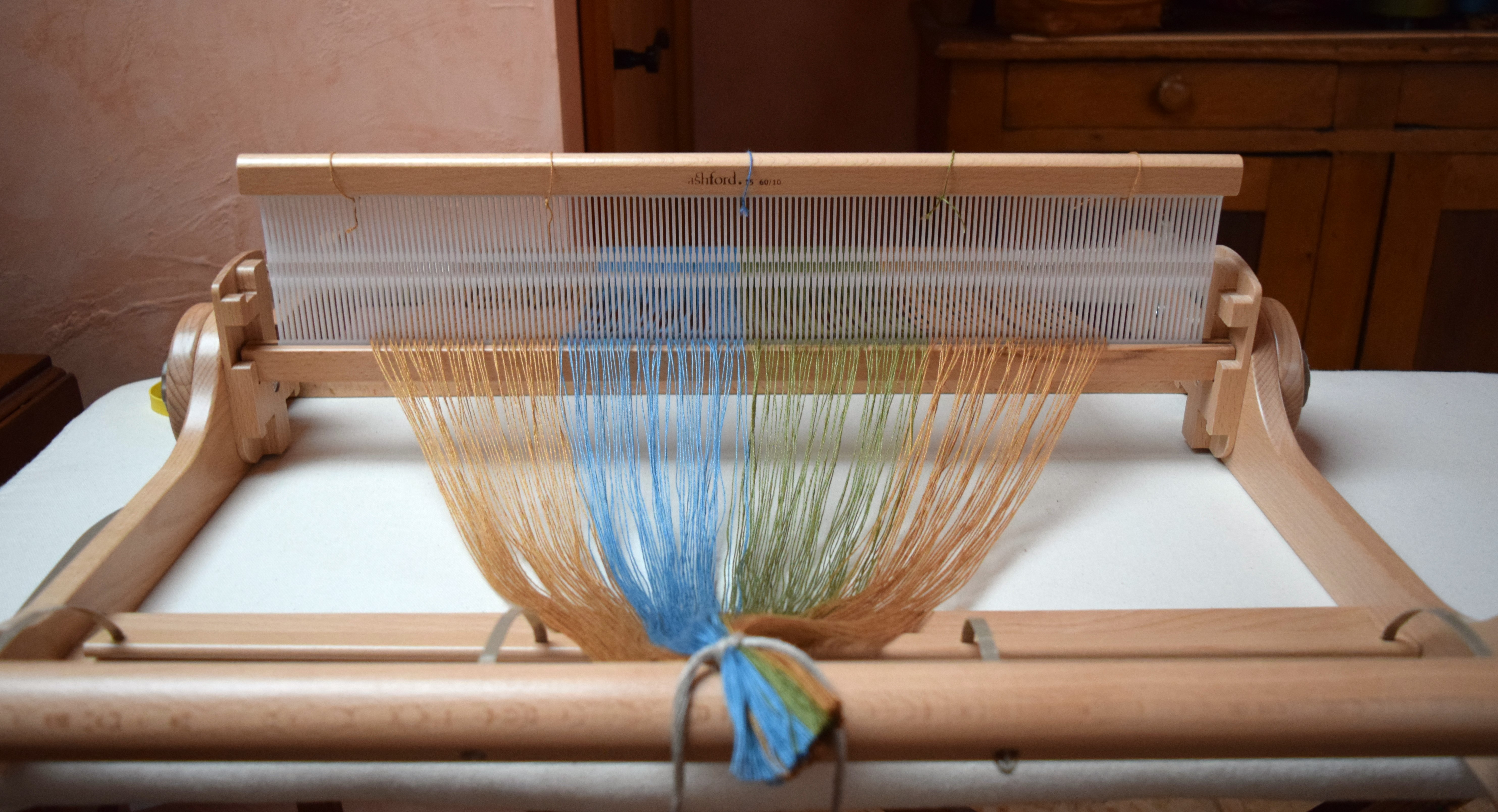
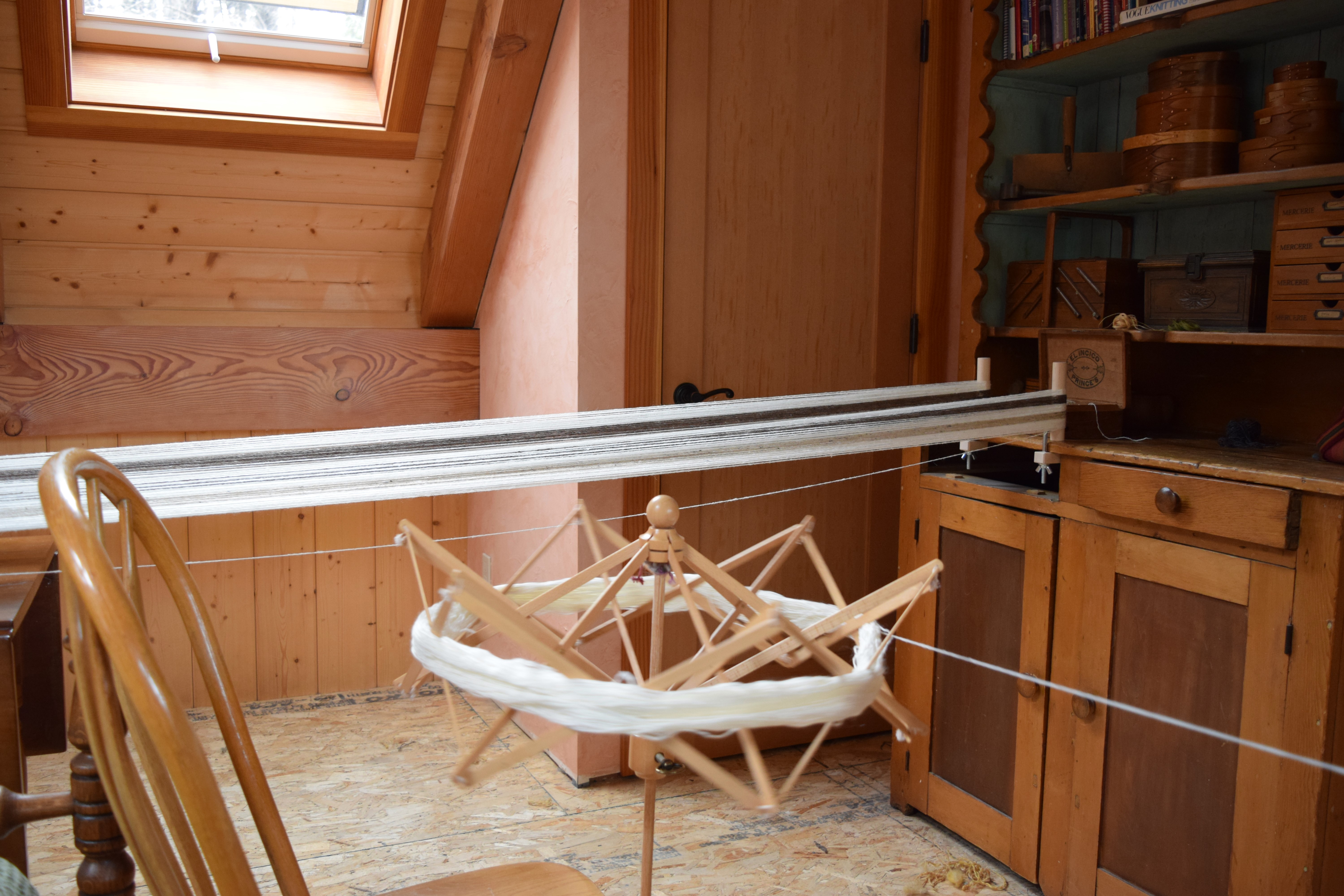
  • Warp:  Double threaded 4 ends per dent on first  reed, then through  a second reed using this method. Using a heddle stand is rather necessary, Jeff made the one I use in tech photos below.  I don’t know how to suggest an alternative, but if one has a couple of heavy objects or uses a bit of cleverness, one could rig a reed stand. Now, with the second reed forward, threading it through in a very seemingly complex manner, but it really isn’t.  Warp length is approx 110 inches from apron rod to warping peg.
  • Number of warp ends: 600 , or there about, as I lost some along the way. 
  • Reed: Two 15 dent rigid heddle reeds, about 19.5″ width in reed.
  • Sett on loom: Warp = 30 epi (ends/threads per inch),  weft =  ?? (forgot to measure).
  • Selvedges: I did not do floating selvedges, nor did I bother to double up and reinforce the selvedges, mostly because there was so much going on with threading through TWO reeds , but  a real positive thing about such a tight weave and having to beat with the stick shuttle to get the weft in place, there seems to be no draw-in on the edges. After about 12″ of weaving I noticed a little draw-in, so I started using the temple.
  • Sett after finishing: Warp 32 epi, and weft 24 ppi.
  • Color Pattern:   
    • Warp =  [12 slots with 4 ends each slot (48ends) light beige , 1 slot with 4 ends (4 ends) flax,  12 slots with 4 ends each slot (48ends) light beige.  12 slots with 4 ends each slot (48ends) natural, 1 slot with 4 ends (4 ends) flax,  12 slots with 4 ends each slot (48ends) natural, 12 slots with 4 ends each slot (48ends) natural. ] REPEAT for a total of 3 pattern reps, and 600 ends.
    • Weft = wound 60 full wraps on to a 30″ stick shuttle for each color, in repeating sequence natural and light beige. 
  • Finished: 1/4 inch turned hem, then washed and dried in machine, then pressed, measuring 81″ long and 18″ wide, and weighs 130g. 
  • Yardage:  Total yardage used for finished piece = 2405y, figured from weight of finished piece and not including loom waste.
  • What I will do differently next time:
    • Again, I ran out of room on the reed(s) while threading, and had to sacrifice the left 12 threads, but its so fine, that is like a quarter inch I am guessing. Second is I didn’t catch it, but there’s a few threads missing in the slots, and that is okay with me.
    • Glimakra slim boat shuttle actually fit in the shed!  I am so anxious to finally use it, I found I had to use the stick shuttle as a beater anyway, why not refine the movements and wind the stick shuttle with thread and omit the boat shuttle this time… but next time, with 24 epi , using 12 and 15 dent reeds double threaded, maybe it will be balanced.  

(( click 1st image to go to slideshow ))

Scarf No.2

Another simple check with three big blocks of color shows so well how shades interact and colors multiply, intersections creating new colors and keeps the interest going through the arduous task of managing even edges. Something so basic as three colors can give a lot of gratification when first learning the basics of weaving. I am still a massive fan of check!

In my recent weavings I’ve been reinforcing the selvedges with extra threads and using a temple, which at this early stage of becoming a weaver, I have already come to rely upon. I think every once in a while weaving something without extra selvedge threads or temple, would give me practice keeping the selvedges from drawing inward by keeping the tension even but not too tight, and the weavers’ angle generous. There are many weaving notes and photos left below, in the event that anybody might find them useful, and I am happy to talk about the details further in the comments as well.

♣   Weaving Notes  ♣

  • Yarn:  10/2 cotton, 4200yds / 1 lb, Valley Yarns Mercerized in colors; Golden Ochre (7129), Moss Tone (5997), and Mediterranean Blue (2448). This is the first time I used mercerized cotton, having no idea how much I would like it, I really do! 
  • Loom: Ashford Knitters Loom 20″.
  • Warping method:  Direct warp set-up, 1 end in every heddle/hole, and 1 in every dent/slot –drawing out from apron rod through each dent to peg is 2 ends = each color 30 dents = 60 ends.  Approx 100 inches from apron rod to warping peg.
  • Number of warp ends: 240
  • Reed: 15 dent rigid heddle 20″ reed, and width in reed = 15.5″.
  • Sett on loom: Warp = 15 epi (threads or “ends” per inch),  weft = 15 ppi (passes or “picks” per inch).
  • Sett after finishing: Warp 16 epi, and weft 16 ppi.
  • Color Pattern: Warp =  60 ends gold, 60 ends green, 60 ends blue, 60 ends gold.  Weft = wound 60 full wraps on to the stick shuttle for each color, in repeating sequence gold, green, and blue. 
  • Finished: 1/4 inch turned hem, then washed and dried in machine, then pressed, measuring 68″ long and 14″ wide, and weighs 117g. 
  • Yardage:  Total yardage used = 1083 y, figured from weight of finished piece and not including loom waste.

Wool Shawl No.3

Number three of Donegal Tweed neckwear pieces, last week I reeled off the loom , and now it is finished, and this one warped with the help of Juno who’s colorway is so similar that I’m naming the colorway “Juno” . . .

I’ve woven this one with a larger dent reed on my Ashford Knitters loom than the last two, a 12.5 dent reed, and think I’ve decided that it is the perfect size for this single ply fingering/lace weight yarn. Now three finished, no more Donegal Tweed and so on to the rest of the yarn in my drawers.

♣   Weaving Notes  ♣ 

  • Yarn: Isager Tweed made in Donegal, also known as Donegal Tweed by other brands.
  • Loom: Ashford Knitters Loom, 20″.
  • Reed: 12.5 dent reed, optimal I think, for the Donegal Tweed.
  • Sett: Warp = 12.5 epi and weft = 9 ppi, 1 thread in the heddle/hole, and 1 thread in the dent/slot.
  • Direct warp method.
  • Selvedge: Doubled up two outer most selvedge warp yarns, and used a temple.
  • Finished: Not wet finished, but steamed, tied a simple knotted fringe (knots could be taken out and twisted fringe worked, but I prefer the soft yarn strands). 
  • Measurements: 76″ long x 19″ wide, not including 4″ fringe.
  • Weight: 246 grams. Yarn has 218 y per 50 g so that is about 1090 total yards. 

just reeled off . . .

Just reeled off the loom, another plain weave check, that somehow miraculously used up the colors of the Donegal Tweed that I had left in my stash. This piece needs all of its finish work done as well as notes composed, and to “hang loose” off of tension for a while, and so I’m on to the next. This one and previous one, will return as finished and fringed pieces to properly photograph. Until then, I’m happy enough to just dive back in the yarn drawers and resurface with another warping to attend to before the end of the day. People are asking me, almost worried, what has happened to knitting? Am I finished with it? Will I return to it? The answer is simply that for now I am so happy in the weaving, knitting is only on a short sabbatical, and while attempting to convert yarn stash into cloth for a while, my long goal is to work back to spinning. Also, considering a very large rigid heddle loom for weaving wider cloth, such as throw blankets and table coverings, and what seems to me to be the natural progression of things around here. I don’t see that I will ever grow tired of simple plain weave.

just reeled off the loom . . .

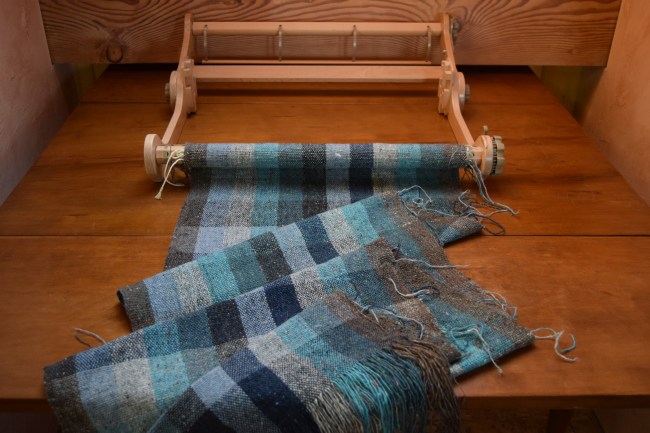
This intriguing moody weaving of Donegal Tweed has been on the loom for only a few days, made entirely from yarn I had in my drawers . . . in blues, greys, and brown. Oh, but I seriously LOVE the rectangle check! I warped it on Saturday, considering it might be a nice wide scarf for a possible gift, but now pulled off the two-plus yards, and it is a bit stiff from the loom tension I suppose, thus inevitably not perfect for neckwear, possibly not soft enough. Deja vu ! Honestly, it is the same sett and same brand wool as the previous Isager Donegal Tweed piece I finished a few weeks ago, and softened up wonderfully. I bought and used a temple on this one, striving for even width with no draw-in. With this one I was a little more intentional, calculating some finished lengths, yardage, but left a lot up to guessing and assuming as the other one ended up “soft” and lovely, that this one would be too, as it is made out of the same yarn. Yet it feels like the weave is just too tight, however, I realize too that this is still stiff off the loom and has not relaxed yet, I suppose I ought to just stop worrying about it. The photo shows all the ends of the yarn wefts, which I really should learn to lay in before weaving, but I’ll weave them in with a needle soon and post again all nicely finished ~~ watch this space.