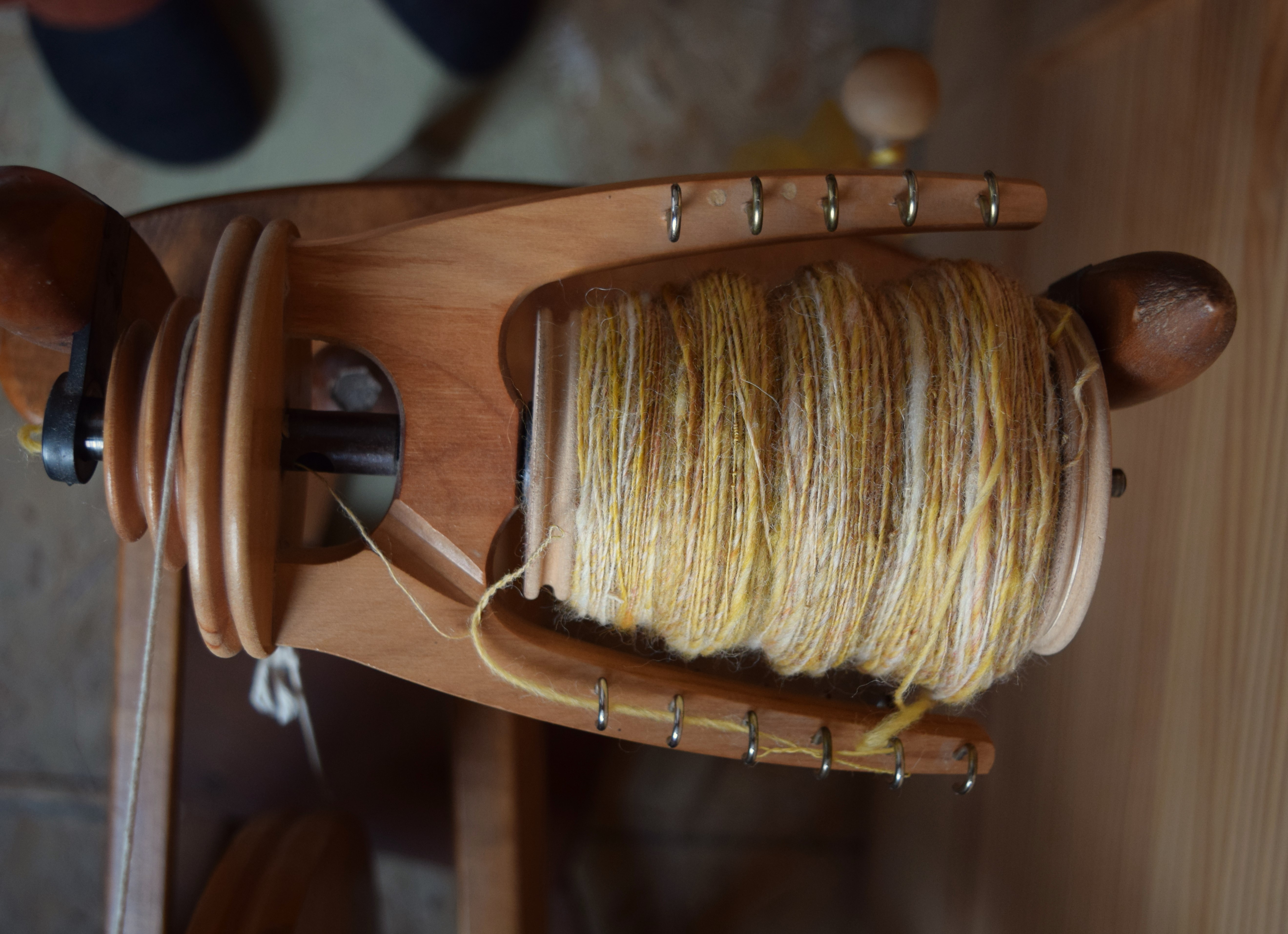
Spinning finally finished, a few weeks ago, and My Summer Fields project has thus far taken me through the summer well into autumn since the resident drum carder arrived. All that work messing with raw fleece, then giving up on it because I couldn’t get the strong smell of sheep out of it (and imbedded into my new drum carder) then changing course and instead using yards of undyed merino-corriedale Wool Of The Andes roving I had in my stash, I finally worked out the batts, and I drafted almost 600g of rolags ready to spin. On and on I spun a little here and there, then as I ended up spinning it a little too fine (my new default it seems), I decided to try a 3ply yarn. But the more one cards, drafts, spins, and plies the careful color variegations in the wool, the more the colors all diffuse! Unfortunately, a lot of work for that sad reality. However, I am pleased enough with it, but it is slow tweed for sure. I wanted to knit a sweater out of this, but am distracted by the looms in my life, and the holidays are now upon us with the new year coming just around the corner. So perhaps this would best be knit up in the calm mid-winter months. Oh, and I’ve had a chance to gauge the weight: 135y = 100g. I am thinking a bulky weight which will probably be 14-16 sts = 4 inches with US9-10 [5.5-6mm] needles.
The carded wool from Speed Tweed #1 has been spun and I have some observations. In this experiment I chose the ” layered batt ” for my first speed tweed experiment, as the colors & fibers will be least blended of all, and yet one can at the point of lifting the batt off the carder, begin spinning. These skeins were spun single ply, aran-worsted weight, short draw, soaked in super hot water, and hang dried, completely relaxing the twist. I’m finding that it really doesn’t get much speedier than that!
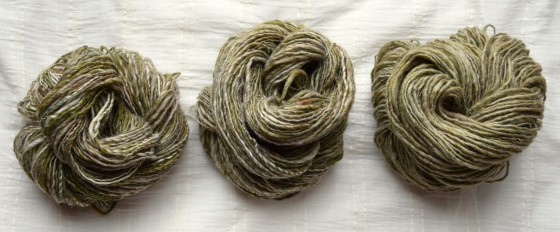
Above are samples of the first run through the carder (left), the second run through (middle), and the third (right), each time the colors homogenizing more. The most dramatic tweedy splashes of color happen in the first sample . . .
In summary, this fiber preparation was very easy, laying the layers down in one go, no hand-mix, just one trip through the carder. However, I think the process I’ve prepared the wool in Speed Tweed #2 may be the speediest preparation of all, requiring least number of steps, and in one carding its done, ready to spin. Got to spin that up and wrap up the speed tweed series.
I am experimenting on simplifying spinning the carding process as much as possible, so that eventually I may have a recipe, so to speak, to spin in the tweed style much like the Donegal mills spin that I love so much. Since my last big spinning project I have wanted to liberate myself from so many tedious steps, and so speeding up the process is what I’m after in “speed tweed” series.
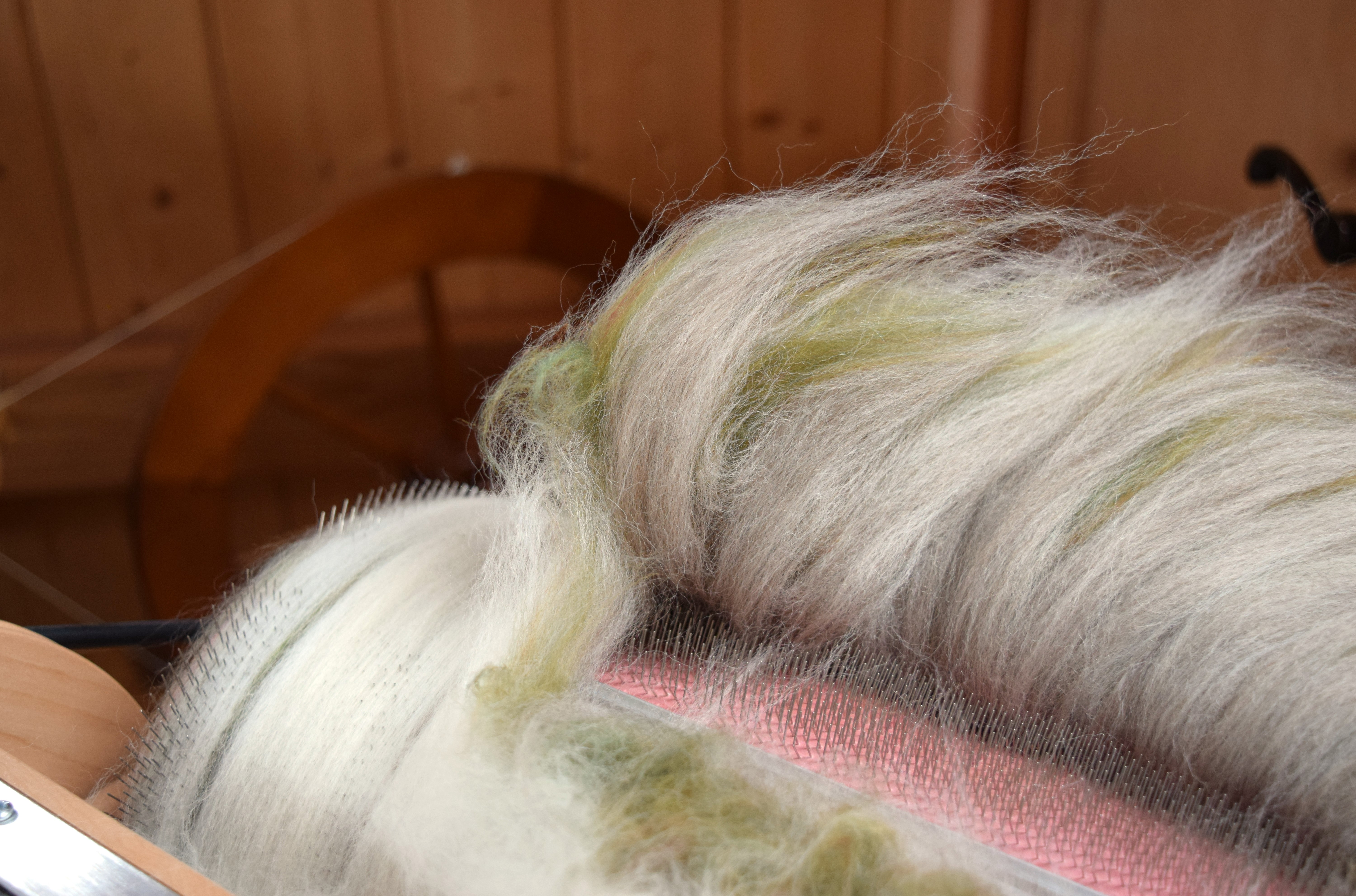
This experiment starts with a very simple layered batt of a colored hand-dyed braid and one or two solids, then spun quickly to an aran weight single ply. I am working on my drum carder this time, however blending boards or even hand carders are going to be the same process, just on a smaller scale. The drum carder of course, now that I have one, offers the most fiber volume with fewer steps, a blending board a few more, and hand carders will take many.
I chose a multi-colored combed top braid from my small collection of indie dyer braids, and I admit, this is the most significant shortcut, for to take advantage of so many beautifully hand-dyed and multi-colored rovings available these days — so many — having the colors already blended is the biggest time-saver, and so very easy to find them too! I usually prefer subdued color, so for this experiment I have sandwiched the colored roving in-between two neutral solids.
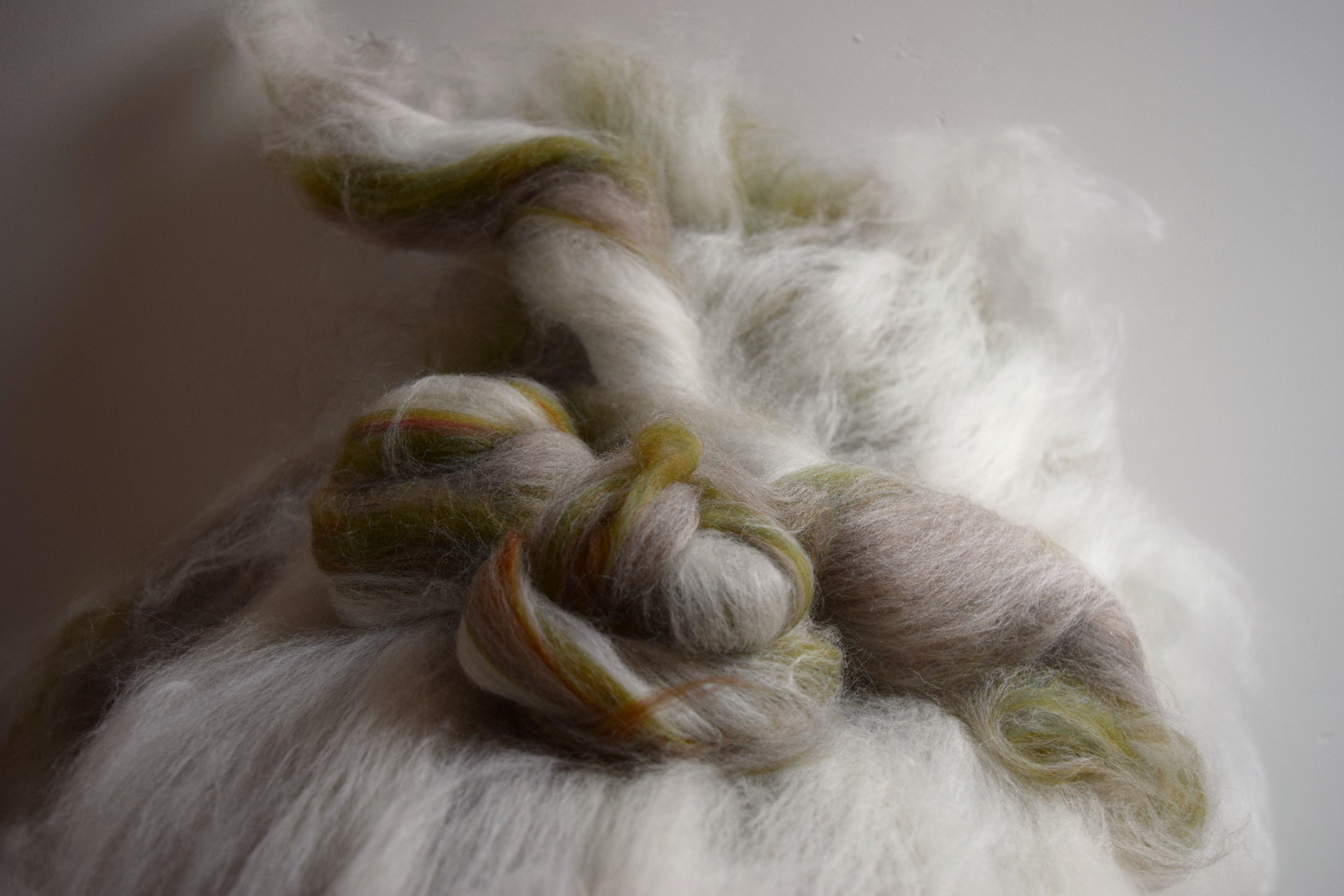
Here is one batt split and coiled into little nests.
Additionally, I plan to spin in a very simple time-saving way, in a short draw worsted technique. That is, working with the combed top, trying to keep the fibers aligned, then keeping the alignment of the wool as much as possible by splitting strips off of the batt — no rolags, no dizzing, no further prep, just loosely put into little nests to photograph them — okay, so now its time to lose myself in some spinning.
♣ ♣ ♣
Techy stuff for Speed Tweed #1:
Fibers . . .
1 part hand-dyed colored roving (100g multi-colored combed top braid from Jakira Farms)
1 part solid roving (100g Wool Of The Andes Roving in Bare )
1 part solid roving (100g Wool Of The Andes Roving in Mink Heather )
I divided each color into thirds (approx 33g each) and layered on the carder as follows:
First layer = 33g layer in mink
Second layer = 33g layer in featured colored braid
Third layer = 33g layer in natural white.
Pull batt off, divide into 6 to 8 strips, and coil strips into little nests to spin. Repeat remaining two thirds.
Approx 300g of wool to spin.
Notes for improvement: As I layered the whole 100g rovings in one layer, I had to run it through the carder again to homogenize enough to my liking. Next time I will apply the wool into the carder differently, refining my speed tweed technique!
See ALL color blending experiments & recipes archived in Tweed Chronicles
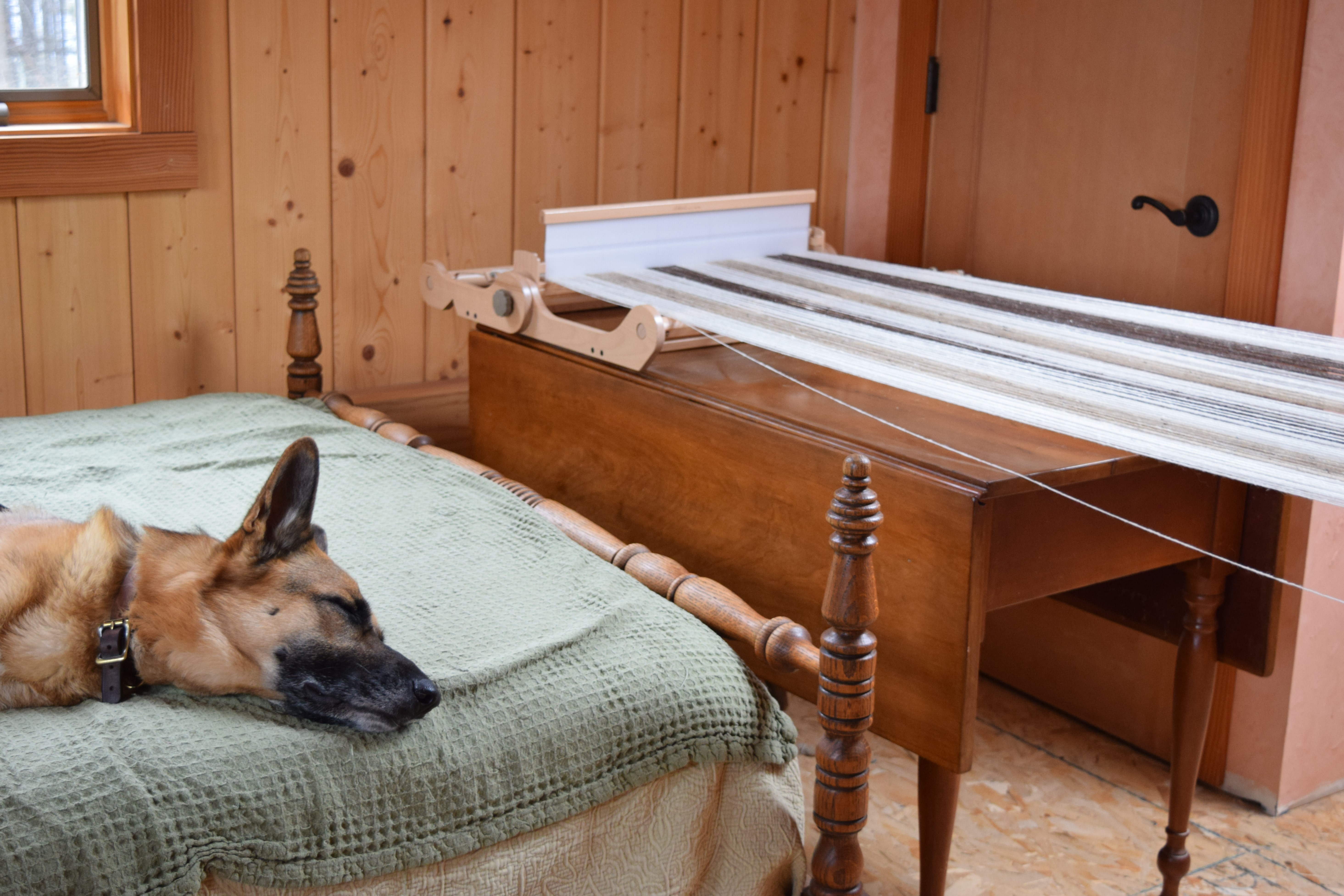
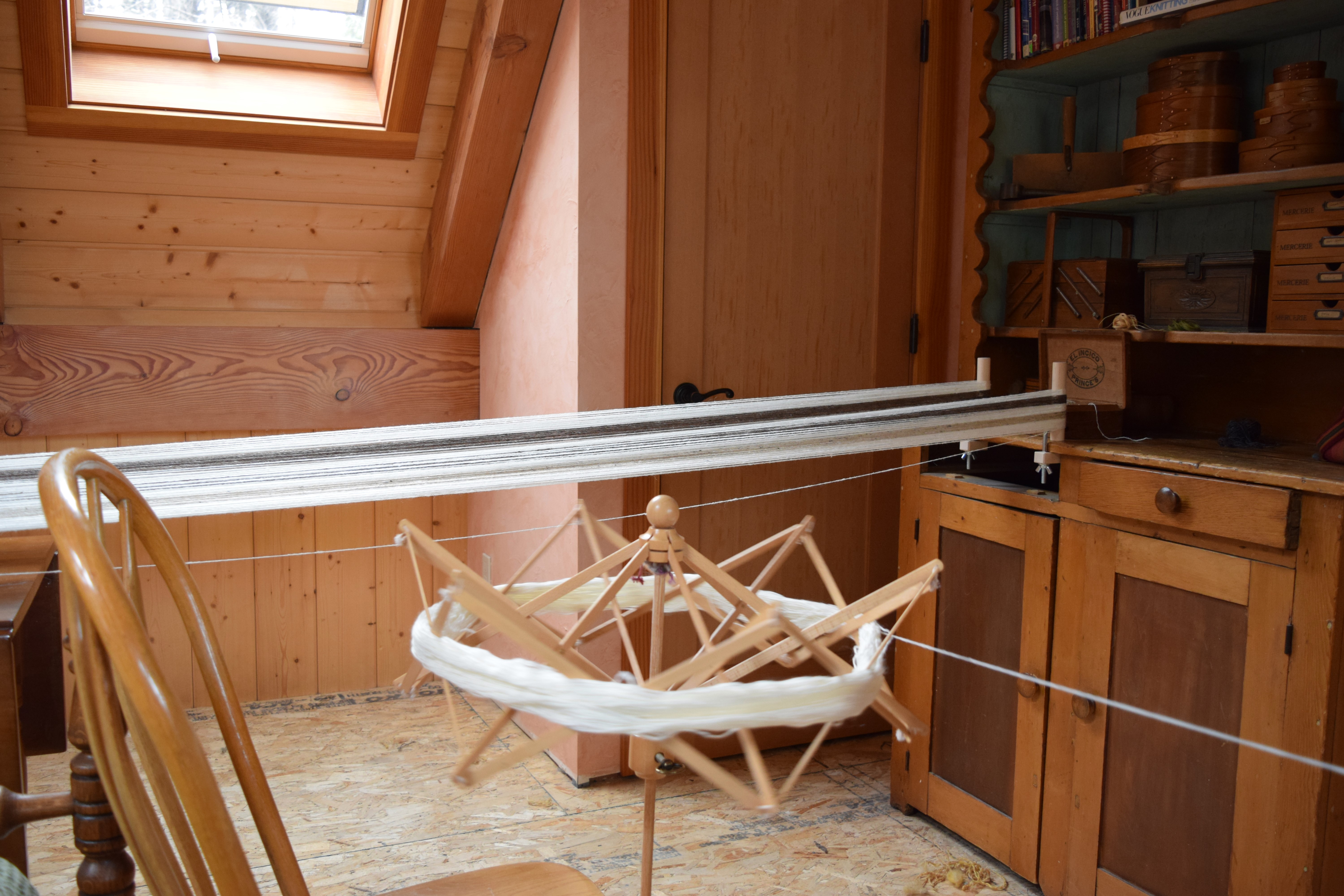
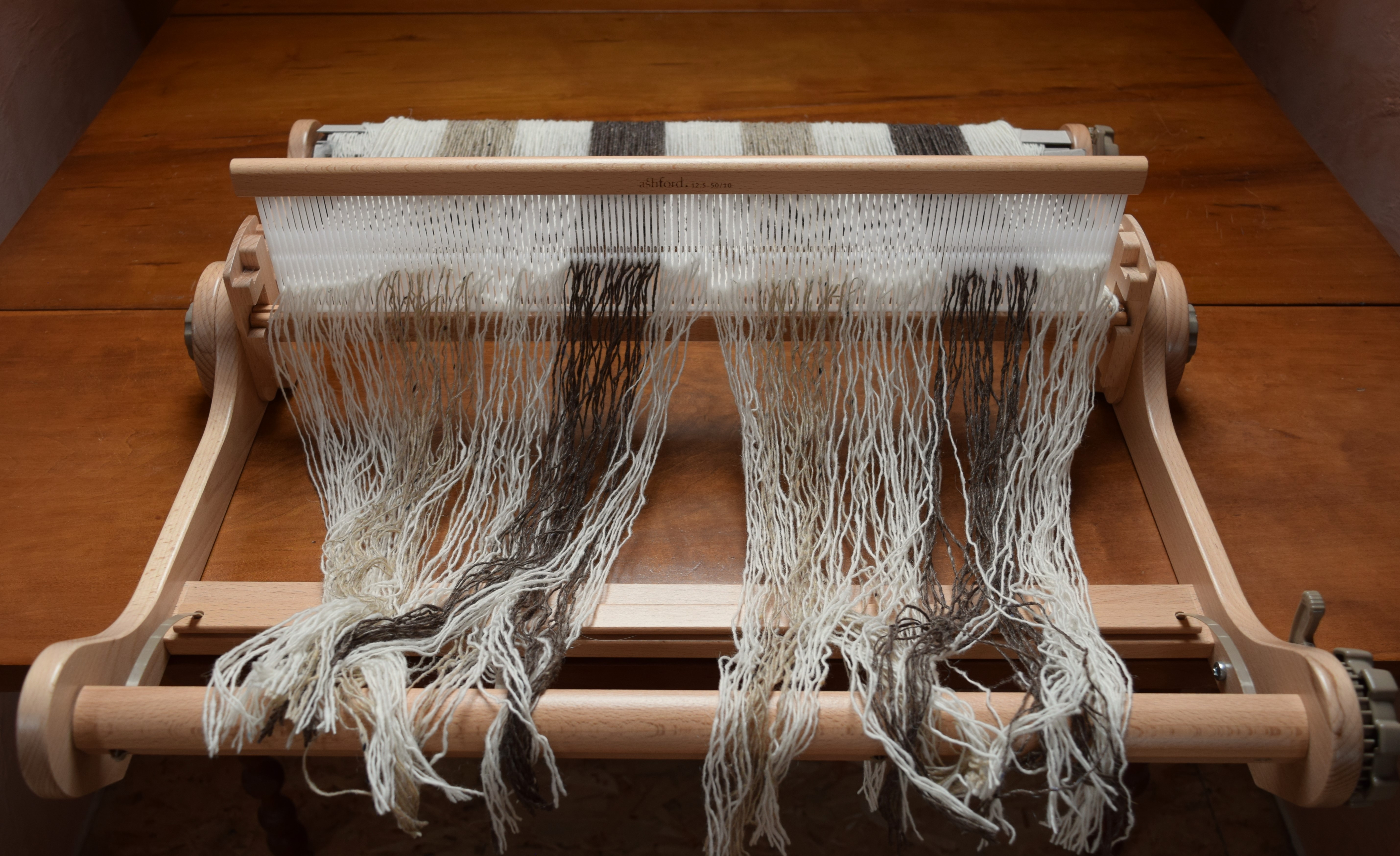
An Ashford 48-inch rigid heddle loom has shown up here, and I am broadening my weaving experience. I waxed it and put it together some time ago, and it happens to fit excellently in my closet squirrelled away when not in use, because it is actually a very simplistic streamline idea in loom design. But now I’ve set it up here for its first test weave, sacrificing all the cottolin thread I had on hand in order to learn the scope of it, and have worked only about a third of the warp through the reed, all to show for about three hours of set up; calculating basics, measuring and placing the tables for the pegs, which I’ve got spread out to section the warp, and actual warping, all which is so uncomplicated and easy compared to conventional warping. The direct warping method is brilliant, a loop thread is drawn from the spool, through the dent slot in the reed and around the pegs, which creates two threads, one which is often rethreaded later through the heddle hole, creating one thread in the slot, and one in the hole. However on this project I’m doubling up on threads which makes it even easier, although twice the initial threading through the reed to the peg, for then all the threading will be finished as soon as I make it across the full forty-eight inch reed (12.5 dent), with no additional threading after I reel the warp on to the back beam. Honestly, this is the method of methods, and I’m going to explore it extensively (a conversation with Bea comes to mind, about doubling up the threads in the reed.) : waves to Bea : Oh, and obviously the colors are much too bright for the room, and now that I photograph the set up in the house I realize now that I am going to need to get shade cards and be much more subdued with my color choices, but I am weaving this test run with all that I have on hand, and it is going to apparently consume a lot more yarn/thread than my Ashford Knitters Loom, which I fully expected proportionally. Its going to be so wonderful to have it around when I want to weave larger things, like table cloths, small blankets, curtains, etc . . . and besides, it is just the natural progression of things around here, pushing for new perspectives and experiences. In closing I’ll say that I have learned to weave standing, so working the stick shuttle through the shed, although going to take some wrestling with the reed, will be taken in stride, literally.
Number three of Donegal Tweed neckwear pieces, last week I reeled off the loom , and now it is finished, and this one warped with the help of Juno who’s colorway is so similar that I’m naming the colorway “Juno” . . .
I’ve woven this one with a larger dent reed on my Ashford Knitters loom than the last two, a 12.5 dent reed, and think I’ve decided that it is the perfect size for this single ply fingering/lace weight yarn. Now three finished, no more Donegal Tweed and so on to the rest of the yarn in my drawers.
♣ Weaving Notes ♣
Yarn: Isager Tweed made in Donegal, also known as Donegal Tweed by other brands.
Reed: 12.5 dent reed, optimal I think, for the Donegal Tweed.
Sett: Warp = 12.5 epi and weft = 9 ppi, 1 thread in the heddle/hole, and 1 thread in the dent/slot.
Direct warp method.
Selvedge: Doubled up two outer most selvedge warp yarns, and used a temple.
Finished: Not wet finished, but steamed, tied a simple knotted fringe (knots could be taken out and twisted fringe worked, but I prefer the soft yarn strands).
Measurements: 76″ long x 19″ wide, not including 4″ fringe.
Weight: 246 grams. Yarn has 218 y per 50 g so that is about 1090 total yards.