New World & Old World

This summer I embrace being a fiber arts dilettante, I am allowing myself time to explore new facets I never before took the time to, finding myself returning to my hand spindles and hand carders, noticing a theme of sorts, blending exotic New World fibers with rustic Old World fibers. In this sample I’ve discovered the odd couple thrives together with slick silken white Seacell, a fiber derived from seaweed, and very rough and tough dyed flax tow which is the short and often shredded fibers left over when refining the longer sought-after flax fibers, is frankly quite an ancient fiber to spin. Let me put it this way ; the seacell is far too slick and the flax tow is far too rough for each of them to be spun well by themselves, but carded together 50/50 they bring harmony and create a surprisingly beautiful yarn, which is both silken and soft, but strong and still a little rustic. The long strong fibers of the Seacell hold the short flax pieces together, and the flax adds bulk and loft from the stiff fibers. Who would have thought? My plan for July-into-August is to delve into unlikely combinations like this, spinning on my spindles the small samples of different, as I happen to have collected a lot of heavy rustic flax tow dyed in different colors as well as silk and the man-made silk-like fibers — just look at them all available these days. In closing, this yarn spun with the seacell and flax is one I will be experimenting with.

♣ Blending Notes ♣ 

Watery (sample)

I have swept up all the tweed chaos from the last months and put away in baskets, recipes written, documented all the process, and now its time for a fresh start on something new, a weaving tangent revisiting the possibility of backstrap weaving (and remembering first project two years ago). First, I needed to do a sample so I can better plan a larger project, and managed to put together some loom pieces for a small weaving of 10/2 cotton. After winding five figure-eight bundles of 30 ends 22″ long onto warping pegs, two of them with ikat resist tape, and three of them solid, then dyed all of the bundles together. By the way, when weaving, the ends double as they are wound around in a hoop. Anyway, it ended up being a tangled mess, but after I managed to put them on two loom bars lashed to warping pegs to slowly organize and re-tension the warp threads one at a time, I discovered that is what was responsible for the watery effect. The ikat backstrap weaving sample I made was to test the waters for a larger piece, and I love this idea of lashing the loom bars on to warping pegs to prepare the warp before the weaving!

It ended up being an unexpected and random ikat patterning, the resist areas shifting as I adjusted tension; two ikat bundles, and three solid bundles, dyed in a light indigo blue. After woven the fabric weight is a thick canvas, the weight of blue jeans.

When I showed my best friend the photos, she said “I love that watery pattern you made on the blue” and then it occurred to me to name this ikat design series “Watery” (thank you Sorcha!)

woodshedding

This summer I decided to wood-shed in the tiny (wool) house, which is a little walk into the woods (beyond Juno), and spend the days in the company of some primitive hand tools like drop spindle, hand carders, and a dye pot. I have been dyeing up a lot of wool in the tiny dye kitchen, experimenting with colors to call my own, re-inventing the wheel in so many ways. Most of all I think that I love this space for what I can achieve with short light photography.

At times I am exhausted of my obsessions, and I worry that I am just a dilettante. But heading into the dog days of summer I dive deeper into refining my creative pursuits, as I try to convince myself that textiles are not just a hobby, but a way of life. I am relishing the isolation, the hours of silence, the palpable feel of time, as I keep walking down to the tiny wool house, two or three times a day, sometimes just to think.

June is almost over and even if I haven’t made any significant finishes to show for the last couple of months, at least I’ve put together a hodgepodge post about some of the tweed tests I’ve been working on.

Tweed Test: Ajrakh

Ajrakh cloth, a timeless textile art originating from the Sindh region, is one of those artful things that I love. I brought it down to make a beautiful & cozy space to spend a lot of time in, a place I am now calling The Tweed House ( previously known as the tiny house , repurposed for a place to dye and card wool ), but I wasn’t expecting it to be such a beautiful backdrop with the afternoon light streaming in, making short light for a photographic effect I love most. Just sitting on the Ajrakh covered futon, with drop spindle and carders in hand, listening to the dye pot rattle, and sipping a tasty cup of coffee, in the woods … well, it just doesn’t get any cozier than that!

This particular blend is inspired by the traditional madder red and blue of Ajrakh, but also rich browns and golds too, a blend of three colors in equal amounts, which when combined together create more beautiful depth of colors, attempting to blend together the colors of the block prints I love. The trick I am finding is not to blend too much, so that the individual colors are still present and not too fused into each other, so the little bumps of color show in the spinning. I kept track of the dye amounts to get the deep madder red wool, and surprised myself, and the deep gold color does just seem to belong, then finally the turquoise is the gem color that pops, tones it all down and brings all the colors together, and this one is so far my favorite. But there needs to be some refinements before I write the recipe, and you can see Tweed Notes below.

♣   Tweed Notes  ♣

  • Fiber: Dyed Merino wool (dye recipes are not yet decided).
  • Measured: 1g my own “Madder Red”, 1g my own “Ajrakh Gold” (in Sindh region is achieved from pomegranate peel and/or turmeric), 1g Turquoise Blue.
  • What I will do differently next time: I will experiment on achieving a truer yet still bright indigo blue mixing different powdered dyes, but the red and the gold are spot on, because although the individual colors are maybe too bright and not exactly the same as the natural dye used in block printing ajrakh , the combination creates a perfect mixture which, in my opinion, tones all the colors down and gives the feel of the ajrakh.

Unassailable Spring (Scarf No.12)

Hi, its me Abelene.

It is finally warming up, and all the insects are on the wing, and while the meadow grass grows higher by the hour, the days are rolling on like an enchanted pastoral scene in the mountains. Jen is weaving pensively through the afternoons, and the crew of inanimate objects and I are having our usual philosophical debates in the closet. All is in an easy and unfettered mood, the mood of warmth and days growing longer at long last, a glorious and unassailable Spring!

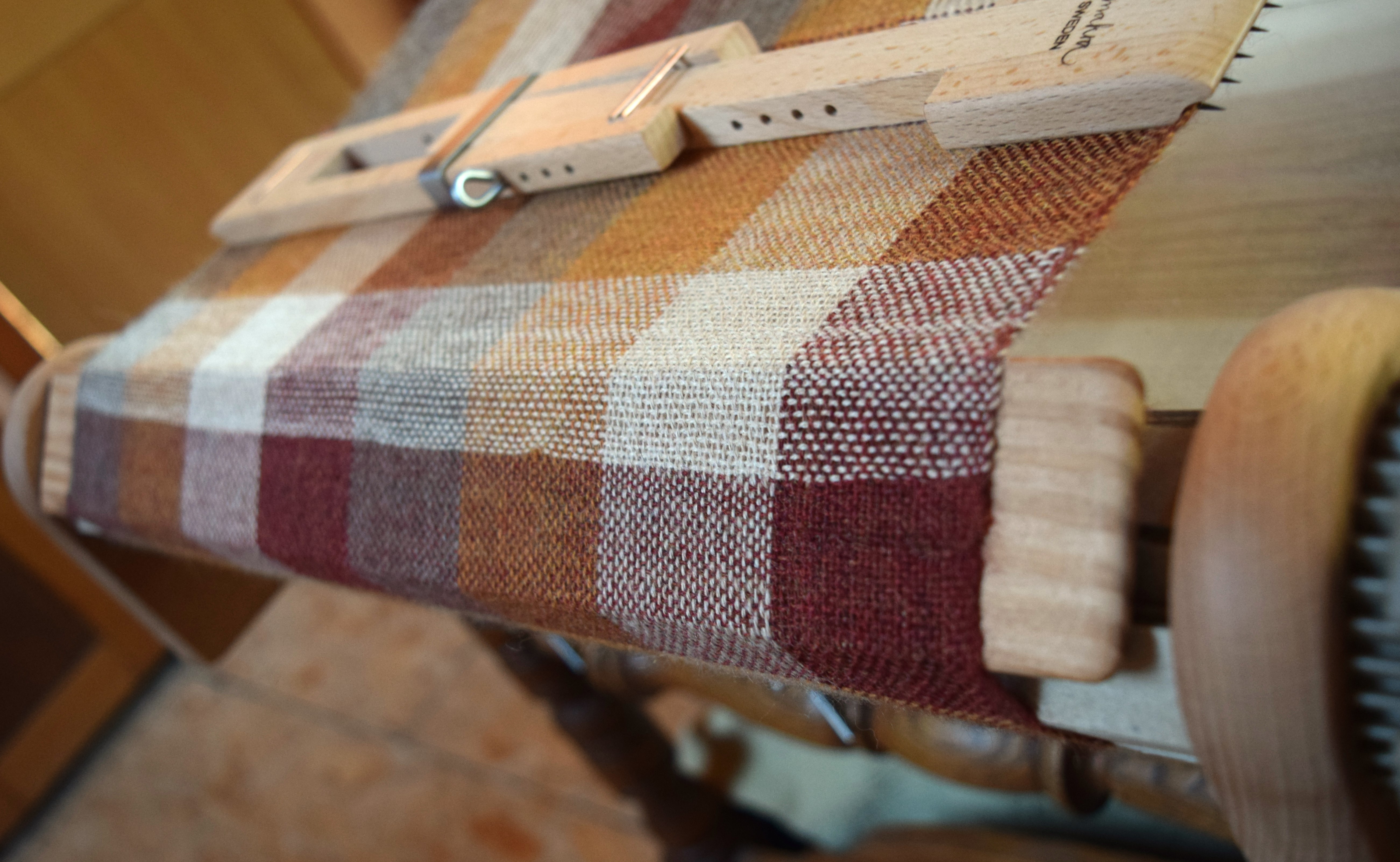
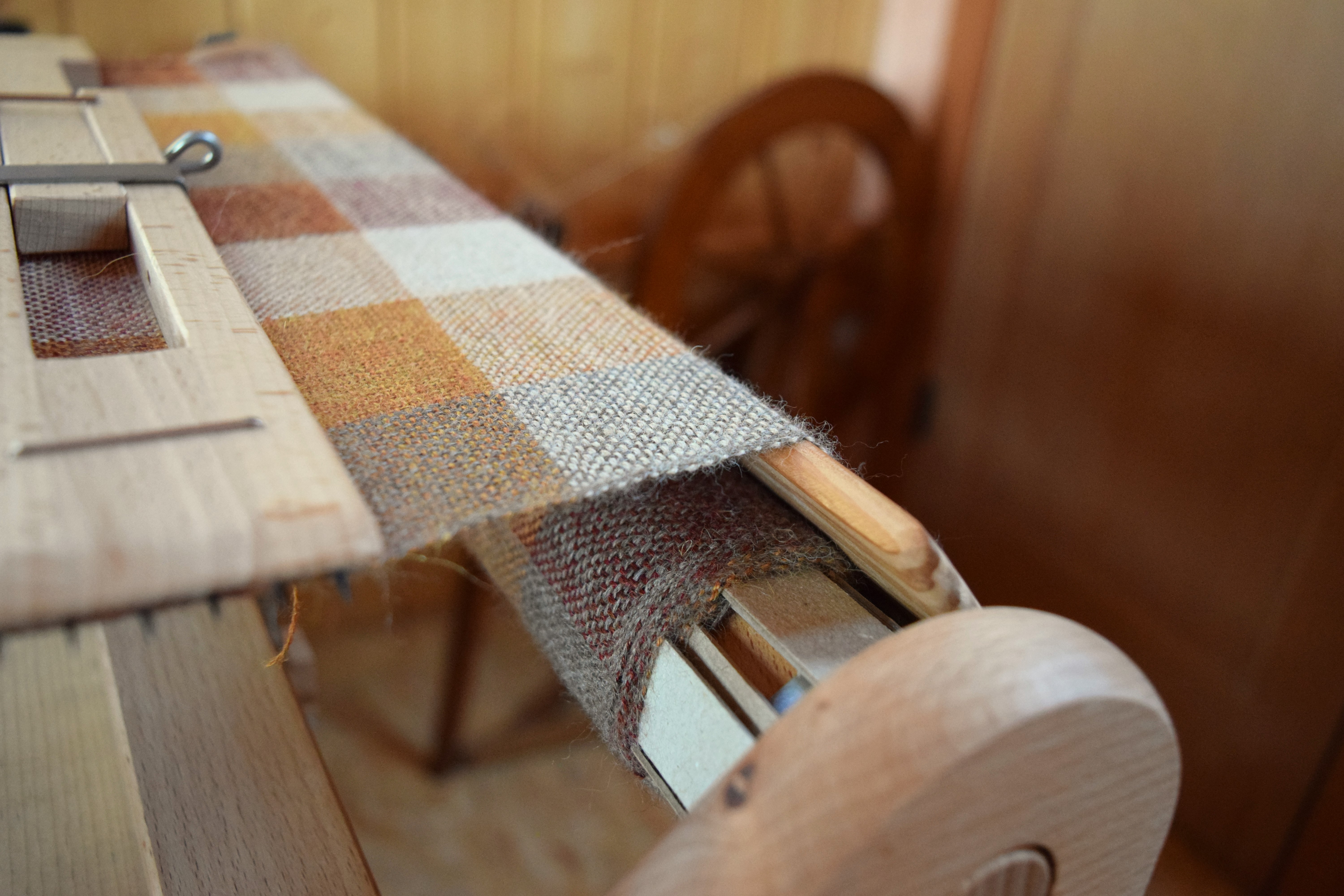
As for the alpaca scarf, it appears to be a Freudian Slip of weaving, as these colors turned out completely Autumnal, being Jen’s absolute favorite season, none the less, it is exquisite, even to be woven in Springtime.

Abelene & The Crew

Note from Jen: A few months back I made a discovery that I really want to revisit, for it has developed and I want to make sure to bring it to the fore, so that others may benefit from it. The improvised wooden piece that I came up with in the post Ikat No.1 ; I have developed its use in every weaving since, essentially becoming a loom “breast beam” as well as a fine tensioning tool. I wrote —

“When I was more than halfway through the weaving, and the front cloth beam was getting pretty packed with woven fabric and cardboard I found the cloth beam to have a certain amount of “squish”, the selvedges conforming to the curve of the cloth winding on irregularly, and not really producing a perfectly flat weave. This I assume is one of the things about rigid heddle weaving, the cloth beam builds cloth and as it does the woven cloth distorts in shape, as well as effects the stability of the tension.“

I have found several reasons why this simple fine sanded wood slat board has made a difference:

  • It is a fine-tuning for tension I found in rigid heddle weaving very much needed, as the tension changes in the down and up shed of the reed. The board moved forward (toward the weaving) loosens the tension – and moved back (toward the weaver) tightens it. This fine tuning of the tension allows better weaving , but also so that I can position a temple, or add cardboard warp separators, and a pulling back of the board tightens the tension, which helps open the sheds significantly.
  • It offers the crisp edge of a proper breast beam, such that some rigid heddle looms do not have as part of their simplistic design, Ashford being one of them. This is especially necessary if using a temple to stretch the weave the full width of the rigid reed, also I have found is necessary for a well balance weave with neat and tidy selvedges. Without a temple I find the selvedge warp threads get frayed-to-breaking, as the cloth can narrow and the selvedge threads rub against the reed, and it is a disaster when a warp thread breaks, especially the selvedge warp threads.
  • My tensioning board is 1/4″ thick and 2″ wide, it should be as long as the weaving width of the loom, so that it easily can support a maximum width warp. I will be making one of these for all of the rigid heddle looms I have.

♣   Weaving Notes  ♣

  • Yarn: Knit Picks Alpaca Cloud lace weight, in Dashwood (med brown), Zadie (deep gold), Molesley (beige), and Lydia (brick red). 440 y = 50g
  • Loom: Ashford 16″ rigid heddle loom
  • Warping method:  Easy direct warp method for rigid heddle, 1 end in hole and 1 end in slot.
  • Number of warp ends: 240
  • Reed: 15 dent rigid heddle reed.
  • Width in reed: 15″
  • Selvedges: I did not add extra ends to the selvedges, but did use a temple.
  • Sett after finishing: Warp 16 epi, and weft 16 ppi.
  • Color Pattern Warp: [30 ends Dashwood, 30 ends Zadie, 30 ends Molesley, 30 ends Lydia] x 2
  • Pattern Weft: Gold & Red dominant pattern: 2″ squares of [Zadie, Lydia, Dashwood, Zadie, Lydia, Molesley] rep length of warp.
  • Finished: 3″ hand-twisted fringe, then washed and air-dried hanging, and lightly steam pressed. Measures 72″ long and 14.5″ wide, and weighs 120g. 
  • Yardage:  Total yardage used for finished piece = 1056y, figured from weight of finished piece and not including loom waste.