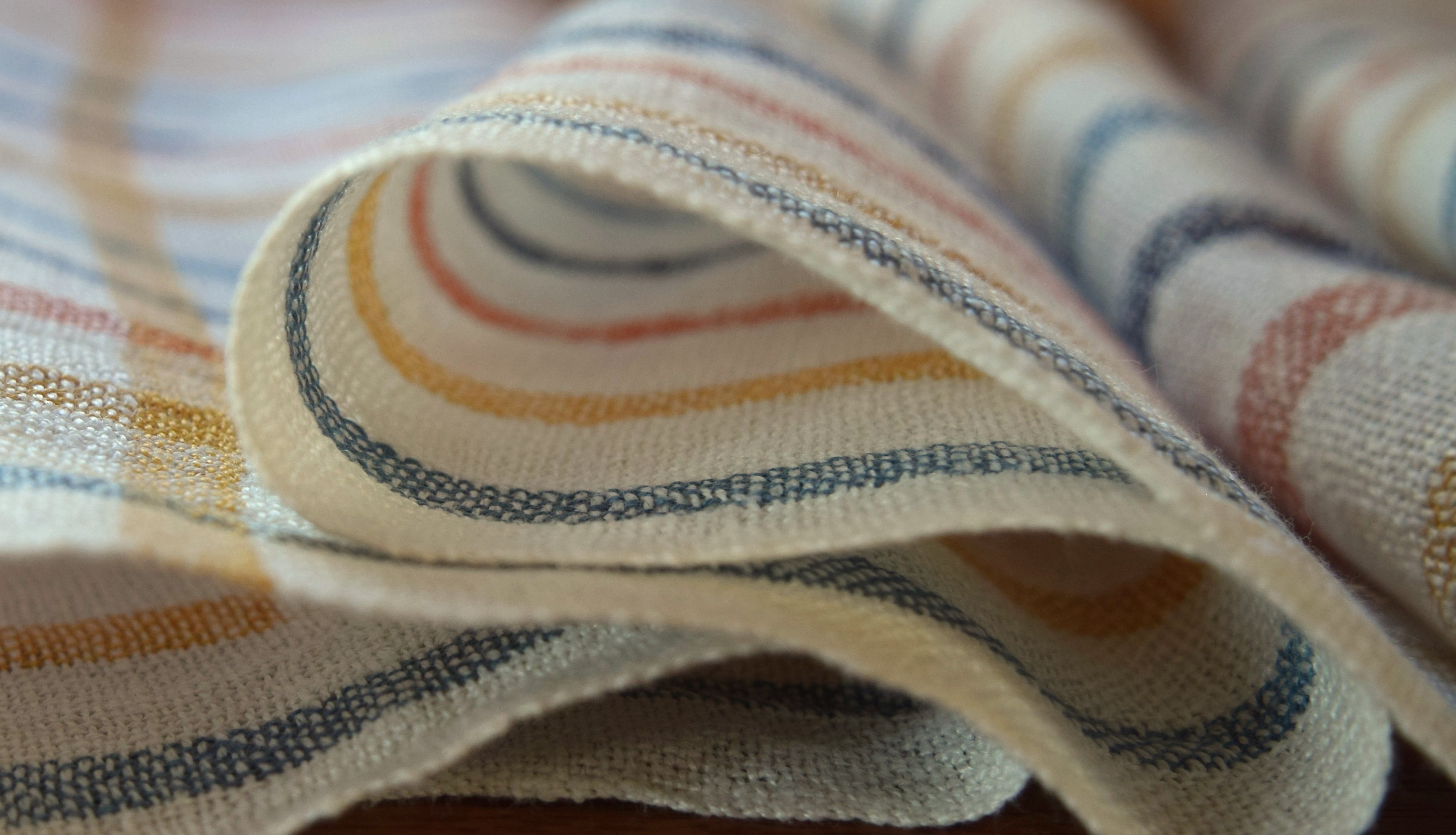
Cloth No.2

Linen is my absolute favorite fabric, more than any other, so I decided to focus on it , as well as cotton, for my cloth series where I learn to weave finer thread counts into utilitarian cloth. Being from California it just seems that linen makes the most sense, and I’ll confess, most of my clothes are made of linen, and so the very reason I am ambitious to learn how to weave it. I’m not considering the traditional floor loom for weaving it, where tensions can get crazy, but on a modest little table loom, where tension seems more manageable, and the whole narrower warp within arms’ reach from the front of the loom. I think I’ll be able to make it work fine on a smaller scale, downsized.

I had just set up yet another small table loom, an Ashford 16″ 8-shaft, and it came with 320 heddles over 8 shafts, pretty sparsely distributed but nonetheless I wanted to get started and not have to wait for more expensive heddles to be ordered. It came with a 10-dent reed so 20epi was to be the bottom line for me, as I prefer to work 2 ends per dent evenly, and although I know that this linen should be woven at least at 24epi, I wanted to discover the limit for loose sett. From this starting point, on this loom, in the future I’ll weave with finer epi with 8 shafts easily, as I acquire finer reeds and more texsolve heddles, I am looking forward to weaving 40/2 linen (7000 ypp) at 32epi, or even up to a crisp 40 epi linen cloth, just something I dream of doing.

There were problems in the warp, as there always are, but I have come to love the mistakes, as they all give the feel that the cloth is handmade and definitely not commercial. Oh, the usual, I missed some heddles, some of the stripes and intervals are narrower, and also, as I was advancing the warp for the last 10″ of weaving, the back warp apron ties came undone and put an end to the weaving (my knots were not done right) so I had to cut it off the loom and forfeit the last bit of length, making the piece 62″ instead of 72″. It was both narrower and shorter than I planned, but that is fine as it is only a sample piece.

♣   Weaving Notes  ♣

I had experimented with threading the heddles first while pulling the threads to the peg for direct warping, and was going to sley the reed last — I can’t remember why I decided to do this, and struggled getting the wound warp to widen enough to feed through the reed, and learned that valuable lesson to sley the reed and heddles both at the same time — even if I have to re-sley the reed to get set up, which is how I have been doing it in my own direct warp method. I didn’t fill the width reed, and I forgot the floating selvedges I planned on doing, so only 15″ in the reed, and shrank quite a bit to 13.5″ after finishing with a hot machine wash & dry to shrink. I have a hunch that since it was an open weave, that the shrinkage was more than it would be with a denser warp. Next time when I weave 7000ypp 40/2 linen will be denser and will fill the entire reed, plus floating selvedges , that shrinkage will be less.

  • Yarn: 40/2 linen from Valley Yarns (249 g cone/ 3300yds) in Half Bleached (HB) (or possibly it was 20/2, I couldn’t be sure and the cone was unmarked)–and– 40/2 linen from Jane Stafford Textiles (100 g cones /1,540yds= 7000ypp) in Ginger (G), Topaz (T), Denim (D), and Indigo (I).
  • Loom: Ashford 16″ 8-shaft Table Loom, straight draw threading for plain weave, lifting pairs of odds & evens (1, 3, 5 &7, and 2, 4, 6 & 8)
  • Warping method:  Direct warp method, back to front; double threading from back apron rod through heddles to peg. Wound on to back beam and finally sleyed through reed and tied off on to front for weaving.
  • Number of warp ends: I didn’t count, and made mistakes, although there were supposed to be 320, there ended up fewer.
  • Reed: 10 dent
  • Width in reed: approx. 15″, I forgot to measure.
  • Sett on loom: 20epi
  • Selvedges: No reinforcement in the selvedges. Used a temple to keep width in reed.
  • Sett after finishing: Warp 22 epi, and weft 22 ppi.
  • Color Pattern Warp:  [16 (ends) HB, 4 G, 4 T, 16 HB, 4 D, 4 I ] repeat across, end with 16 HB.
  • Pattern Weft: Twice repeated the warp stripes in the ginger, topaz and denim, otherwise no pattern, just one color, HB, used shuttle.
  • Finished: 1/4 inch turned hem, then washed and dried in machine, then steam pressed, measuring 62″ long and 13.5” wide, and weighs 115g. 
  • Yardage:  Total yardage used for finished piece = approx 2310y, figured from weight of finished piece and not including loom waste.

Cloth No.1

This morning early, I was impatient for the light to come, giving the muse a rest, and the loom too. Nothing is distorted or broken in the weave, after-all. It went through wash and dry, and a ritual of steam pressing — it is more than fine, it survived my incessant nervous worry as I wove through the last many days, and my misunderstanding of the warp is now an embarrassment, but essential part of the lesson, because really, in the end there is no sacrifice, it is a perfect piece of cloth.

Warp and weft together leave their home, are cut off the loom as if saying goodbye to their birthplace, for a marriage in a journey together for the life of the cloth. Purifying their bond in the water, for wet finishing is when the fibers bloom, the tension evens out, the blatant flaws heal and become only subtle scars. The loom is silent for a short while, and the cloth is folded and stashed away, along with its own potential, as it was meant to be.

♣   Weaving Notes  ♣

  • Yarn: 20/2 mercerized perle cotton, 8400yds / 1 lb, Maurice Brassard, in colors Beige (P-2), Natural (P-100), Turquoise (P-401), Rose (P-145), and Flax (P-5104).
  • Loom: Ashford Brooklyn 4-shaft Table Loom, straight draw threading for plain weave, lifting pairs of odds & evens (1&3, and 2&4)
  • Warping method:  Tested an easy direct warp method, back to front; double threading from back apron rod through heddles and reed, then to peg. Wound on to back beam and finally tied off on to front for weaving.
  • Number of warp ends: Warped in couplets of 20/2, each couplet counts as 1 end. 380 plus 2 extra at each selvedge = 384 ends
  • Reed: 16 dent reed, 2 ends in each dent and 2 ends in each heddle.
  • Width in reed: forgot to measure.
  • Sett on loom: 20epi
  • Selvedges: 4 extra ends at each selvedge and used a temple to keep width in reed.
  • Sett after finishing: Warp 24 epi, and weft 12 ppi.
  • Color Pattern Warp: { 8 ends beige, [4 ends turquoise, 16 ends beige]x8, 4 ends turquoise, 16 ends rose}, 4 ends Flax, mirror reverse { … }.
  • Pattern Weft: No pattern, just one color, Natural (P-100), used shuttle.
  • Finished: 1/4 inch turned hem, then washed and dried in machine, then steam pressed, measuring 80″ long and 14″ wide, and weighs 128g. 
  • Yardage:  Total yardage used for finished piece = 2370y, figured from weight of finished piece and not including loom waste.

Four Shafts

I have been craving weaving yards and yards of narrow width, fine cloth, on just a simple little table loom like this, my new Brooklyn four-shaft loom. Using the finest weight cotton and linen threads that I can find, higher epi (ends per inch) should not be so overwhelming with only 16 inches weaving width, shoulder width, therefore it is very ergonomic and a great way to weave longer pieces. I like to stand while I weave, so I have set up the Brooklyn on my loft table which is also my desk, sharing space with everything else, and I can take breaks often to weave a few inches here and there. Just having it there with a long warp waiting, is so inviting. I started weaving my first project, with a hybrid direct warp method, using only the number of heddles for 20epi that the loom comes with, and next time I will add heddles and weave 40 epi. Even though the inexpensive Brooklyn comes unfinished, I waxed all of the pieces before assembling, and I don’t even mind that the sides are plywood, I wanted a little loom just like this one on which to learn to weave ultra fine — at my own pace.

Another Nine Days (Shawl No.2)

It is just another one of those striking coincidences, that the days it took me to warp, weave, finish, and photograph Shawl No.2 is precisely the same number of days as Shawl No.1. Despite my best efforts to relax and enjoy the process, I began to focus on speeding up my technique, spending less time fussing at the selvedges, and worked at a frantic pace , and now my whole body is sore, and my arm feels like it is going to fall out of its socket. Abelene models the shawl in a most regal way and was compassionate and quiet today, although she did tell me what great work the wind did for the photos!

♣   Weaving Notes  ♣

I wanted to try big blocks of color this time, decided to weave the full length of the warp, not trying to enforce full repeats, so there is a little strip of gold at the end, giving beautiful asymmetry, and a unique folksy touch.

  • Yarn: Knit Picks Alpaca Cloud lace weight, 440 y = 50g, in Lydia (rust red), Zadie (gold), Willoughby (warm light grey), and Arabella (dark green).
  • Loom: Ashford 32″ rigid heddle loom
  • Warping method:  Easy direct warp method for rigid heddle, 1 end in hole and 1 end in slot.
  • Number of warp ends: 472
  • Reed: 15 dent rigid heddle reed.
  • Width in reed: 30.5″
  • Selvedges: I added 4 extra ends to each of the selvedges, as they tend to get pulled in, and I used a temple.
  • Sett after finishing: Warp 16 epi, and weft 16 ppi.
  • Color Pattern Warp: 118 ends each of Lydia, Zadie, Willoughby, and Arabella, approx 7.5″ blocks.
  • Color Pattern Weft: Same sequence as warp, weaving each color in blocks, but ended in a little strip bit of gold for a folksy touch.
  • Finished: 3″ hand-twisted fringe, then washed and air-dried hanging, and lightly steam pressed. Measures 96″ long (not including fringe) and 29″ wide, and weighs 275g — approx 68g of each color.
  • Yardage:  Total yardage used for finished piece = 2422y, figured from weight of finished piece and not including loom waste.

Auld Lang Syne (Scarf No.15)

A lot of the time I don’t realize the coincidences at play as I bring something to finish. For instance, the Scottish phrase “Auld Lang Syne” evoking the sentiment of “for old times’ sake” and “days gone by” . . . and my attempt at weaving to mimic an “auld Scottish tartan” design that my dear old friend and I planned the minute I got my first loom a couple of years ago (the very loom on which it is photographed) . Posted yesterday drying on the line, today here it is, fulfilling all those sentiments as it will be draped artfully over the shoulder of an old wingback chair which sits facing an old woodstove, in a very, very old cabin. For old times’ sake indeed, not to mention it is New Year’s Eve — happy 2026 everyone!

♣   Weaving Notes  ♣

This weight of alpaca is truly perfect for the rigid heddle looms, using a 15 dent reed, because the drape is spectacular and there is enough room for the alpaca to bloom in the simple plain weave. Oh, and about the missing information in the notes; I wrote everything down on a piece of paper as I was calculating the design, then later lost the piece of paper, so it was accidentally thrown away.
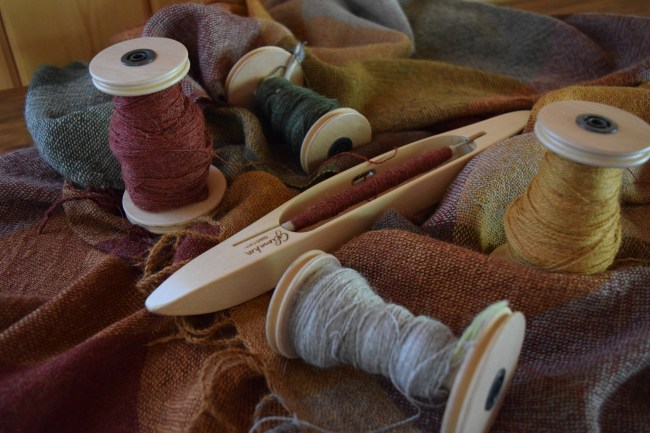
  • Yarn: Knit Picks Alpaca Cloud lace weight, in Carson (dark grey), Alfred (medium grey), Arabella (dark green), Elizabeth (red), and Zadie (gold). 440 y = 50g
  • Loom: Ashford 20″ Knitters Loom
  • Warping method:  Easy direct warp method for rigid heddle, 1 end in hole and 1 end in slot.
  • Number of warp ends: Not available
  • Reed: 15 dent rigid heddle reed.
  • Width in reed: 18.5″
  • Selvedges: I added 4 extra ends to each of the selvedges, as they tend to get pulled in, and I used a temple.
  • Sett after finishing: Warp 16 epi, and weft 16 ppi.
  • Color Pattern Warp & Weft: Not available
  • Finished: 3″ hand-twisted fringe, then washed and air-dried hanging, and lightly steam pressed. Measures 89″ long (not including fringe) and 18″ wide, and weighs 175g. 
  • Yardage:  Total yardage used for finished piece = 1540y, figured from weight of finished piece and not including loom waste.