Scarf No. 14

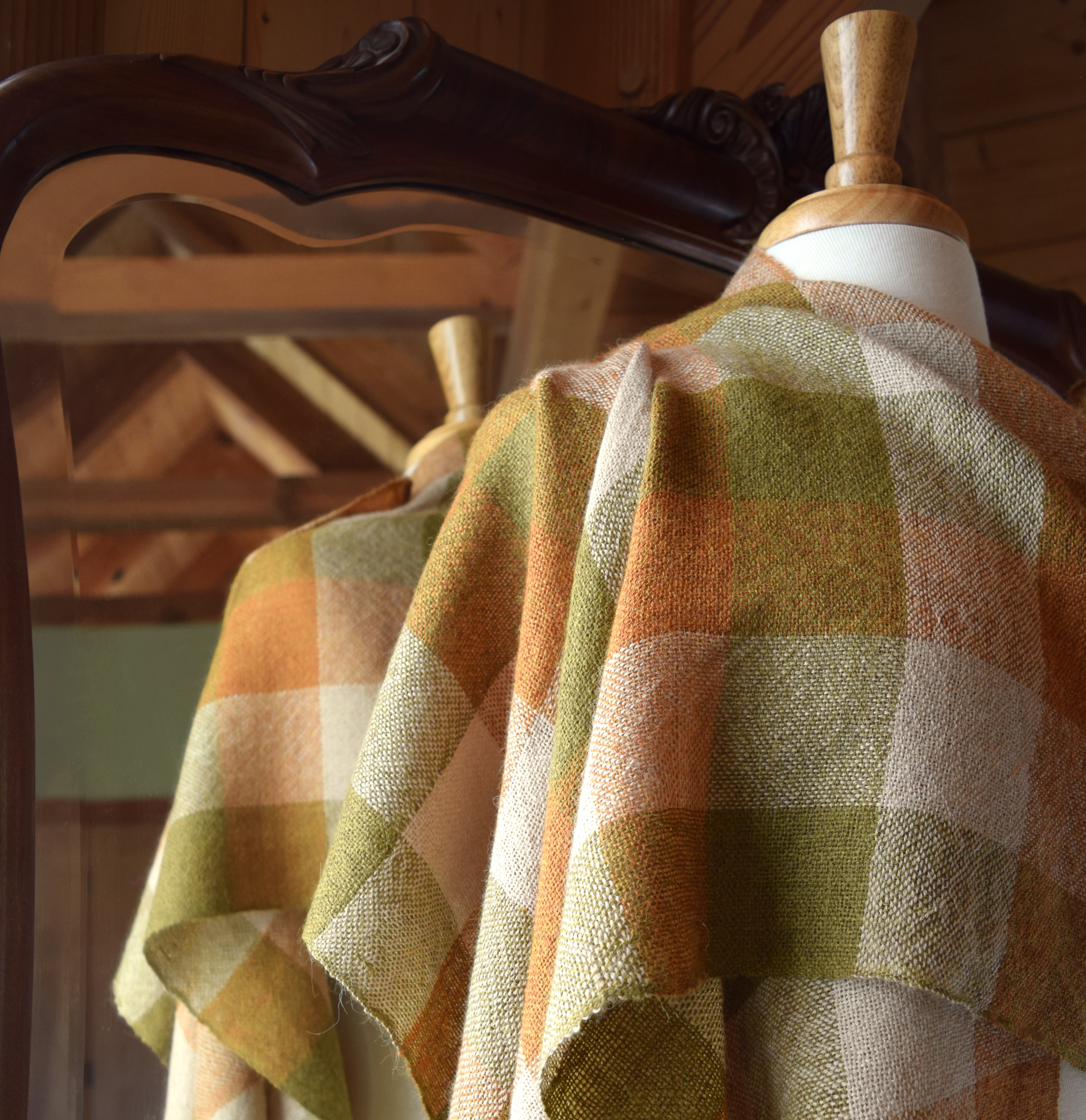
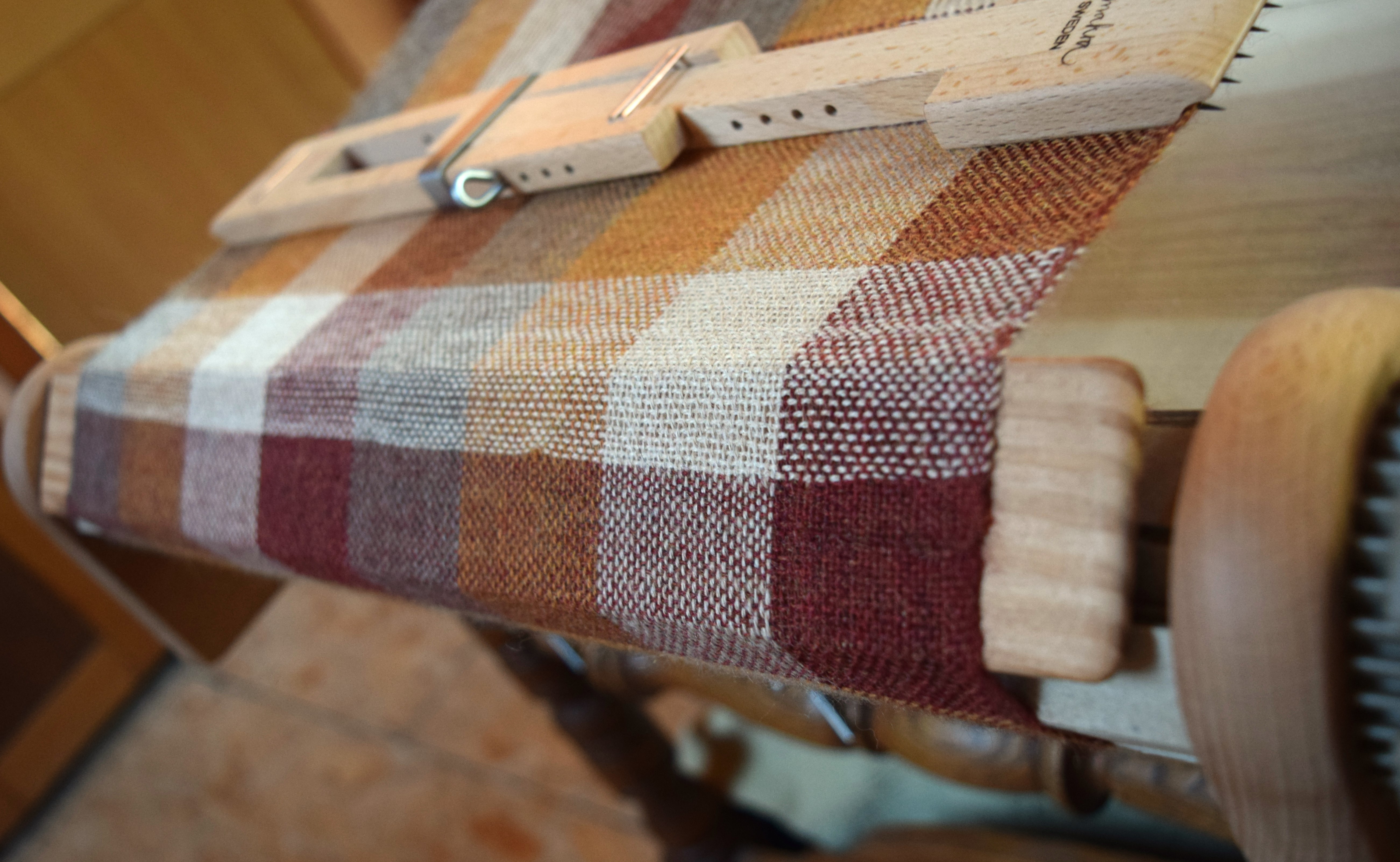
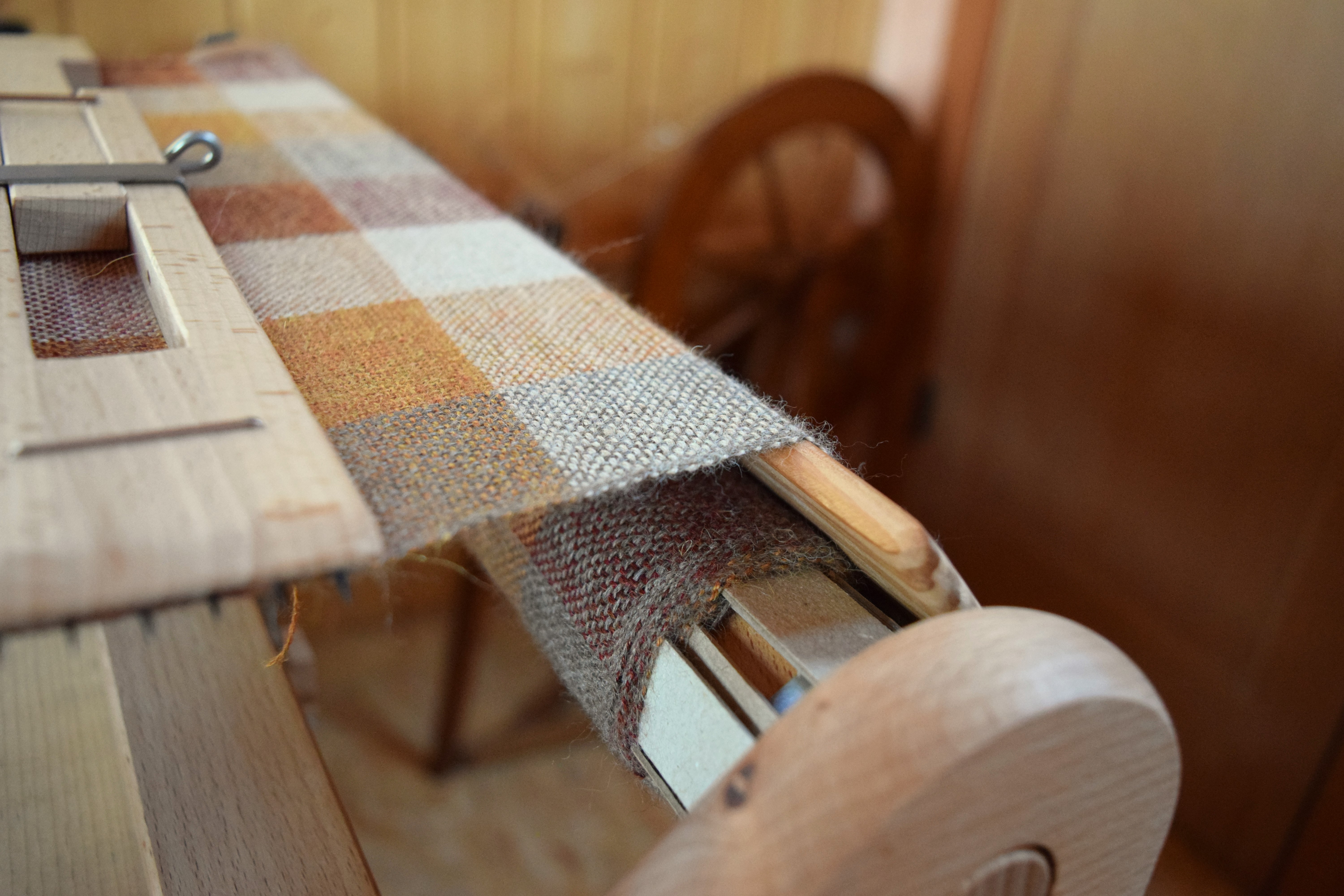
Levi came to visit, and as I was showing him my alpaca scarf series, I could tell that he admired them, and that perhaps he even wanted one, but none of the colors I had woven were appropriate for his blue & grey gentlemen’s style. So, the day before he was to leave I suggested he design one with the alpaca colors I had on hand and that I would weave it for him, and so he did, and by the time he was leaving back to Canada, I had already woven one repeat to show him. Then this last week was a determined effort to getting it done, and now it is finished and ready to send in the post. As usual, my technical weaving notes are listed below.

♣   Weaving Notes  ♣

  • Yarn: Knit Picks Alpaca Cloud lace weight, in Carson (dark grey), Alfred (medium grey), Eleanor (light grey), and Bernard (blue). 440 y = 50g
  • Loom: Ashford 16″ rigid heddle loom
  • Warping method:  Easy direct warp method for rigid heddle, 1 end in hole and 1 end in slot.
  • Number of warp ends: 228
  • Reed: 15 dent rigid heddle reed.
  • Width in reed: 14″
  • Selvedges: I added 4 extra ends to each of the selvedges, as they tend to get pulled in, and I used a temple.
  • Sett after finishing: Warp 16 epi, and weft 16 ppi.
  • Color Pattern Warp: 20 ends each of *Carson, Eleanor, Bernard, Eleanor, Carson, Alfred, Carson, Eleanor, Bernard, Eleanor*, Carson.
  • Color Pattern Weft: Same sequence as for warp *thru*, and ending in Carson.
  • Finished: 2″ hand-twisted fringe, then washed and air-dried hanging, and lightly steam pressed. Measures 76″ long (not including fringe) and 13.5″ wide, and weighs 118g. 
  • Yardage:  Total yardage used for finished piece = 1040y, figured from weight of finished piece and not including loom waste.

An Auspicious Autumn (Scarf No. 13)

Hi, its me Abelene,

Jen did not weave on her scarves at all this summer, and now suddenly another alpaca scarf to show for a very auspicious occasion of the beginning of Autumn. Jen rattled through this scarf in the very last days of summer, having left it on the loom since Spring, while frenzied all summer long with other creative textile pursuits, as designing tweed blends, formulating dye recipes, ikat resist patterning and backstrap warp-faced weaving. We (the crew of inanimate objects) came out of the closet for this finishing event, and Señor Mirando and I have come to the conclusion that Jen has got something up her sleeve, finishing this scarf for the Equinox.

Happy Autumn, from Abelene & The Crew

♣   Weaving Notes  ♣

Note from Jen: With this scarf and every scarf I have woven on the 16″ rigid heddle loom, I have been using this simple tensioning tool, and if you would like to see the technical information about it, I give more detail in the post Scarf No.12

  • Yarn: Knit Picks Alpaca Cloud lace weight, in Amos (green), Zadie (deep gold), and Molesley (beige), 440 y = 50g
  • Loom: Ashford 16″ rigid heddle loom
  • Warping method:  Easy direct warp method for rigid heddle, 1 end in hole and 1 end in slot.
  • Number of warp ends: 240
  • Reed: 15 dent rigid heddle reed.
  • Width in reed: 15″
  • Selvedges: I did not add extra ends to the selvedges, but did use a temple.
  • Sett after finishing: Warp 16 epi, and weft 16 ppi.
  • Color Pattern Warp: [40 ends Amos, 40 ends Molesley, 40 ends Zadie] x 2
  • Finished: 3″ hand-twisted fringe, then washed and air-dried hanging, and lightly steam pressed. Measures 82″ long and 14.5″ wide, and weighs 133g. 
  • Yardage:  Total yardage used for finished piece = 1170y, figured from weight of finished piece and not including loom waste.
  • Note to self, recipient was Eleanor

Watery

Watery is now finished, the Guatemalan backstrap loom taken apart and rolled inside the weaving, with the maguey back strap and lasso resting on top. It was a real challenge in backstrap weaving as well as in ikat preparation, and a monster of a learning curve for a beginner like me, but I am a firm believer in the best teacher being experience. Even though I did make a proper sample “gauge swatch” and posted it in Watery Sample, I had no way to know how a larger variation would weave. I made mistakes, and had to figure out how to fix them as I progressed; the heddles had to be redone, tension problems were endless, at first I could not work the shed changes correctly, nor did I beat the weft evenly, and honestly, I was not sure even how to operate the loom. But I wove a 15.5″ x 46.5″ piece of canvas weight warp-faced fabric, and to me that is astonishing and amazing! Toward the end of my much-longer warp, as room was getting tight to lift the heddle rod, I thought I’d cleverly rearrange the shed rod, and wouldn’t you know it, I accidentally rendered it un-weavable from there forward, but I only lost about 12″ of weaving length left I figure, before I couldn’t weave anymore on it. Not bad for an ardent attempt to do a large piece!

Oh, and about the llama wandering about outside the tiny house? It is a member of a grazing herd which came down from the vineyard above us to sample the greenery, perhaps to participate in the Andean inspired backstrap weaving scene?

Here is how I warped for Watery . . .

  1. I wound 10/2 mercerized weaving cotton, in a figure 8, around 2 warping pegs placed each end of the table at 72″ apart; 40 times, which is 80 ends per warp section when the loop around the loom bars is woven into a flat piece. The weave is completely warp-faced, with the weft hidden, and has 56 epi.  — If this were a balanced weave, there would be aprox. 28 epi, and the weaving would be twice as wide, at least 30″ — I did not understand this about backstrap weaving until after I learned balanced weaving!
  2. Five warp sections were tied with ikat resist tape (I did not photograph this part) without measuring, but fully improvised. Six were left untied (except for the skein ties to keep the warp sections from getting tangled in the dye bath) so all 11 warp sections could be dyed together, and be the same color.
  3. Five warp sections were tied with ikat resist tape (I did not photograph this part) without measuring, but fully improvised. Six were left untied (except for the skein ties to keep the warp sections from getting tangled in the dye bath) so all 11 warp sections could be dyed together, and be the same color.
  4. After dyeing them, I transferred the warp sections to the loom bars which I had lashed on to the pegs, alternating five resist tied sections with six solid sections.
  5. I spread out the warp to get ready to make the string heddles, and the sections all came together as one complete warp, tying ends together at the far-end loom bar, and lining up the cross in the middle of the length, ready to make heddles next.
  6. But first, on each of the five tied ikat sections I pulled some of the threads either forward or backward by pinching some threads in the section and giving a little tug; this is called “shifting”,  and the threads moved around the loom bars so that the straight undyed (white) bands skewed a little to create a design. ( I did not influence the apparent stripe of the non-ikat tied warp sections, so they just ended up as soft squiggly lines across.)
  7. I created string heddles with the same 10/2 cotton as the warp, but the warp and heddles were too close and got bound up, so later I reworked the heddles with fine nylon thread. 
  8. In the photos I show how the shifting works; on top warp threads you see the V shape , but on the bottom threads you see the opposite direction as I parted a V shape on the top shed of the warp to reveal below, because the threads change direction when they go around the loom bar. This is most obvious at the two rods which hold the cross, where the bottom half of the warp comes to the top, and the top disappears below.
  9. When at last the bottom and top of the shed is woven together, the interplay makes a lovely random design which looks like reflection of light on the surface of moving water…. thus “watery”.

Credit: I have enjoyed reading Lavern Waddington’s weaving blog Backstrap Weaving for years. Her experience is extensive, and her legacy is truly admirable as she lived for years in the Andes practicing the indigenous methods of backstrap weaving, as well as travelling the world to learn from other backstrap weaving cultures.  It is mostly from her helpful instructional videos which have brought me to this point, all which are easily navigated from her website.

Watery (sample)

I have swept up all the tweed chaos from the last months and put away in baskets, recipes written, documented all the process, and now its time for a fresh start on something new, a weaving tangent revisiting the possibility of backstrap weaving (and remembering first project two years ago). First, I needed to do a sample so I can better plan a larger project, and managed to put together some loom pieces for a small weaving of 10/2 cotton. After winding five figure-eight bundles of 30 ends 22″ long onto warping pegs, two of them with ikat resist tape, and three of them solid, then dyed all of the bundles together. By the way, when weaving, the ends double as they are wound around in a hoop. Anyway, it ended up being a tangled mess, but after I managed to put them on two loom bars lashed to warping pegs to slowly organize and re-tension the warp threads one at a time, I discovered that is what was responsible for the watery effect. The ikat backstrap weaving sample I made was to test the waters for a larger piece, and I love this idea of lashing the loom bars on to warping pegs to prepare the warp before the weaving!

It ended up being an unexpected and random ikat patterning, the resist areas shifting as I adjusted tension; two ikat bundles, and three solid bundles, dyed in a light indigo blue. After woven the fabric weight is a thick canvas, the weight of blue jeans.

When I showed my best friend the photos, she said “I love that watery pattern you made on the blue” and then it occurred to me to name this ikat design series “Watery” (thank you Sorcha!)

Unassailable Spring (Scarf No.12)

Hi, its me Abelene.

It is finally warming up, and all the insects are on the wing, and while the meadow grass grows higher by the hour, the days are rolling on like an enchanted pastoral scene in the mountains. Jen is weaving pensively through the afternoons, and the crew of inanimate objects and I are having our usual philosophical debates in the closet. All is in an easy and unfettered mood, the mood of warmth and days growing longer at long last, a glorious and unassailable Spring!

As for the alpaca scarf, it appears to be a Freudian Slip of weaving, as these colors turned out completely Autumnal, being Jen’s absolute favorite season, none the less, it is exquisite, even to be woven in Springtime.

Abelene & The Crew

Note from Jen: A few months back I made a discovery that I really want to revisit, for it has developed and I want to make sure to bring it to the fore, so that others may benefit from it. The improvised wooden piece that I came up with in the post Ikat No.1 ; I have developed its use in every weaving since, essentially becoming a loom “breast beam” as well as a fine tensioning tool. I wrote —

“When I was more than halfway through the weaving, and the front cloth beam was getting pretty packed with woven fabric and cardboard I found the cloth beam to have a certain amount of “squish”, the selvedges conforming to the curve of the cloth winding on irregularly, and not really producing a perfectly flat weave. This I assume is one of the things about rigid heddle weaving, the cloth beam builds cloth and as it does the woven cloth distorts in shape, as well as effects the stability of the tension.“

I have found several reasons why this simple fine sanded wood slat board has made a difference:

  • It is a fine-tuning for tension I found in rigid heddle weaving very much needed, as the tension changes in the down and up shed of the reed. The board moved forward (toward the weaving) loosens the tension – and moved back (toward the weaver) tightens it. This fine tuning of the tension allows better weaving , but also so that I can position a temple, or add cardboard warp separators, and a pulling back of the board tightens the tension, which helps open the sheds significantly.
  • It offers the crisp edge of a proper breast beam, such that some rigid heddle looms do not have as part of their simplistic design, Ashford being one of them. This is especially necessary if using a temple to stretch the weave the full width of the rigid reed, also I have found is necessary for a well balance weave with neat and tidy selvedges. Without a temple I find the selvedge warp threads get frayed-to-breaking, as the cloth can narrow and the selvedge threads rub against the reed, and it is a disaster when a warp thread breaks, especially the selvedge warp threads.
  • My tensioning board is 1/4″ thick and 2″ wide, it should be as long as the weaving width of the loom, so that it easily can support a maximum width warp. I will be making one of these for all of the rigid heddle looms I have.

♣   Weaving Notes  ♣

  • Yarn: Knit Picks Alpaca Cloud lace weight, in Dashwood (med brown), Zadie (deep gold), Molesley (beige), and Lydia (brick red). 440 y = 50g
  • Loom: Ashford 16″ rigid heddle loom
  • Warping method:  Easy direct warp method for rigid heddle, 1 end in hole and 1 end in slot.
  • Number of warp ends: 240
  • Reed: 15 dent rigid heddle reed.
  • Width in reed: 15″
  • Selvedges: I did not add extra ends to the selvedges, but did use a temple.
  • Sett after finishing: Warp 16 epi, and weft 16 ppi.
  • Color Pattern Warp: [30 ends Dashwood, 30 ends Zadie, 30 ends Molesley, 30 ends Lydia] x 2
  • Pattern Weft: Gold & Red dominant pattern: 2″ squares of [Zadie, Lydia, Dashwood, Zadie, Lydia, Molesley] rep length of warp.
  • Finished: 3″ hand-twisted fringe, then washed and air-dried hanging, and lightly steam pressed. Measures 72″ long and 14.5″ wide, and weighs 120g. 
  • Yardage:  Total yardage used for finished piece = 1056y, figured from weight of finished piece and not including loom waste.