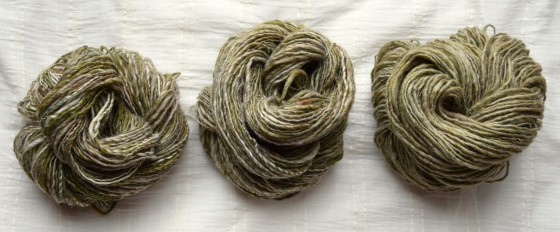
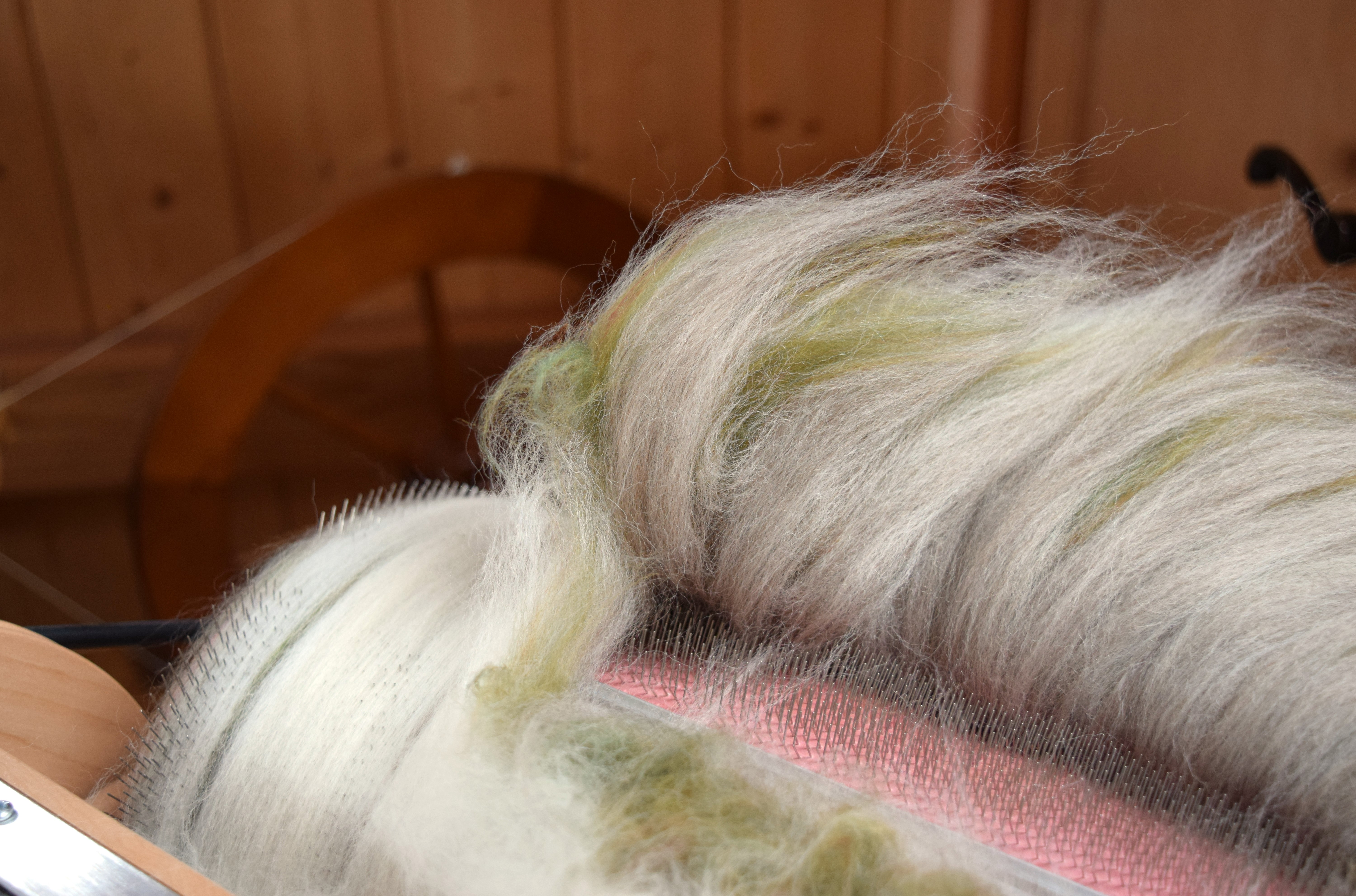
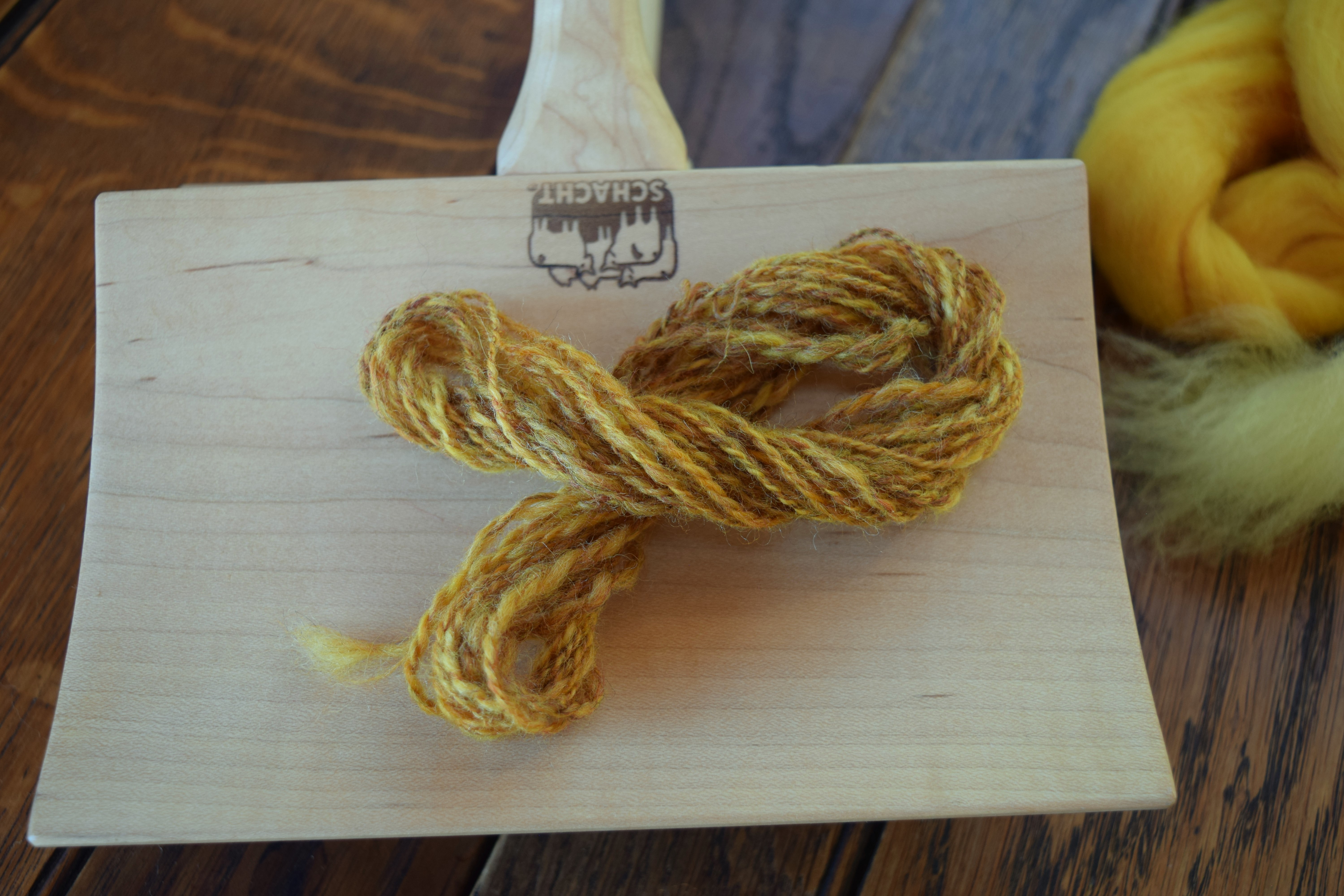
The carded wool from Speed Tweed #1 has been spun and I have some observations. In this experiment I chose the ” layered batt ” for my first speed tweed experiment, as the colors & fibers will be least blended of all, and yet one can at the point of lifting the batt off the carder, begin spinning. These skeins were spun single ply, aran-worsted weight, short draw, soaked in super hot water, and hang dried, completely relaxing the twist. I’m finding that it really doesn’t get much speedier than that!
Above are samples of the first run through the carder (left), the second run through (middle), and the third (right), each time the colors homogenizing more. The most dramatic tweedy splashes of color happen in the first sample . . .
In summary, this fiber preparation was very easy, laying the layers down in one go, no hand-mix, just one trip through the carder. However, I think the process I’ve prepared the wool in Speed Tweed #2 may be the speediest preparation of all, requiring least number of steps, and in one carding its done, ready to spin. Got to spin that up and wrap up the speed tweed series.
I am experimenting on simplifying spinning the carding process as much as possible, so that eventually I may have a recipe, so to speak, to spin in the tweed style much like the Donegal mills spin that I love so much. Since my last big spinning project I have wanted to liberate myself from so many tedious steps, and so speeding up the process is what I’m after in “speed tweed” series.
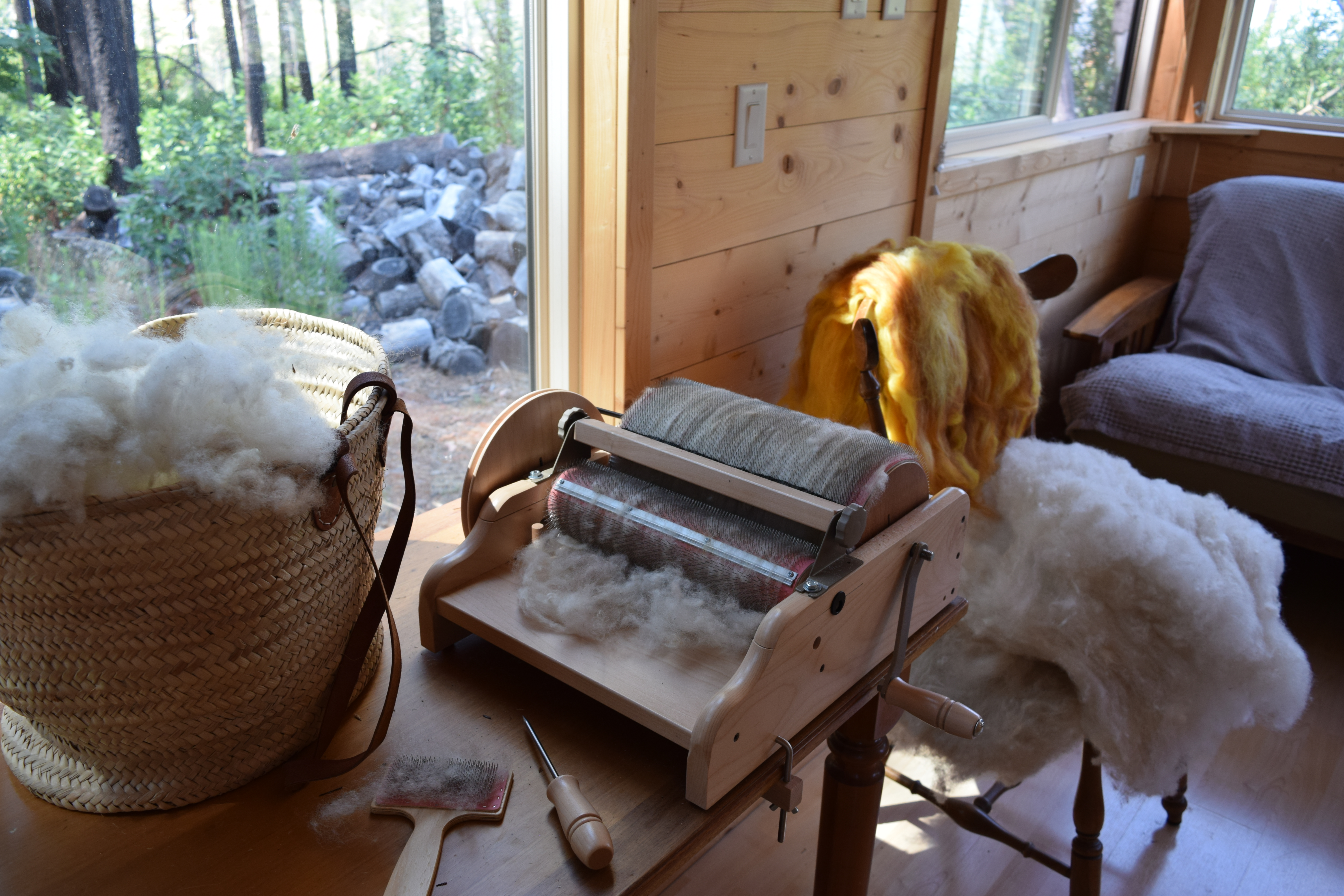
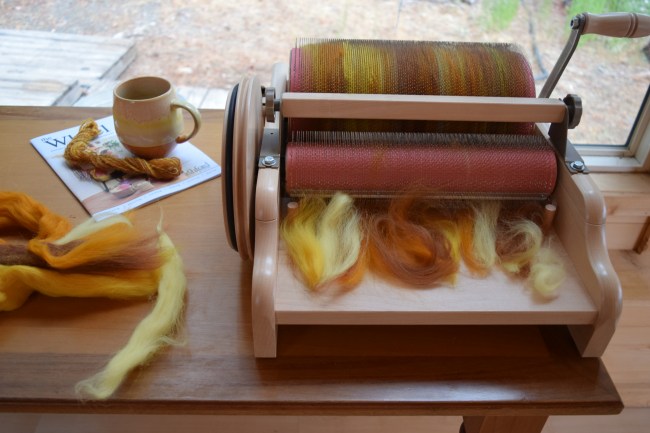
This experiment starts with a very simple layered batt of a colored hand-dyed braid and one or two solids, then spun quickly to an aran weight single ply. I am working on my drum carder this time, however blending boards or even hand carders are going to be the same process, just on a smaller scale. The drum carder of course, now that I have one, offers the most fiber volume with fewer steps, a blending board a few more, and hand carders will take many.
I chose a multi-colored combed top braid from my small collection of indie dyer braids, and I admit, this is the most significant shortcut, for to take advantage of so many beautifully hand-dyed and multi-colored rovings available these days — so many — having the colors already blended is the biggest time-saver, and so very easy to find them too! I usually prefer subdued color, so for this experiment I have sandwiched the colored roving in-between two neutral solids.
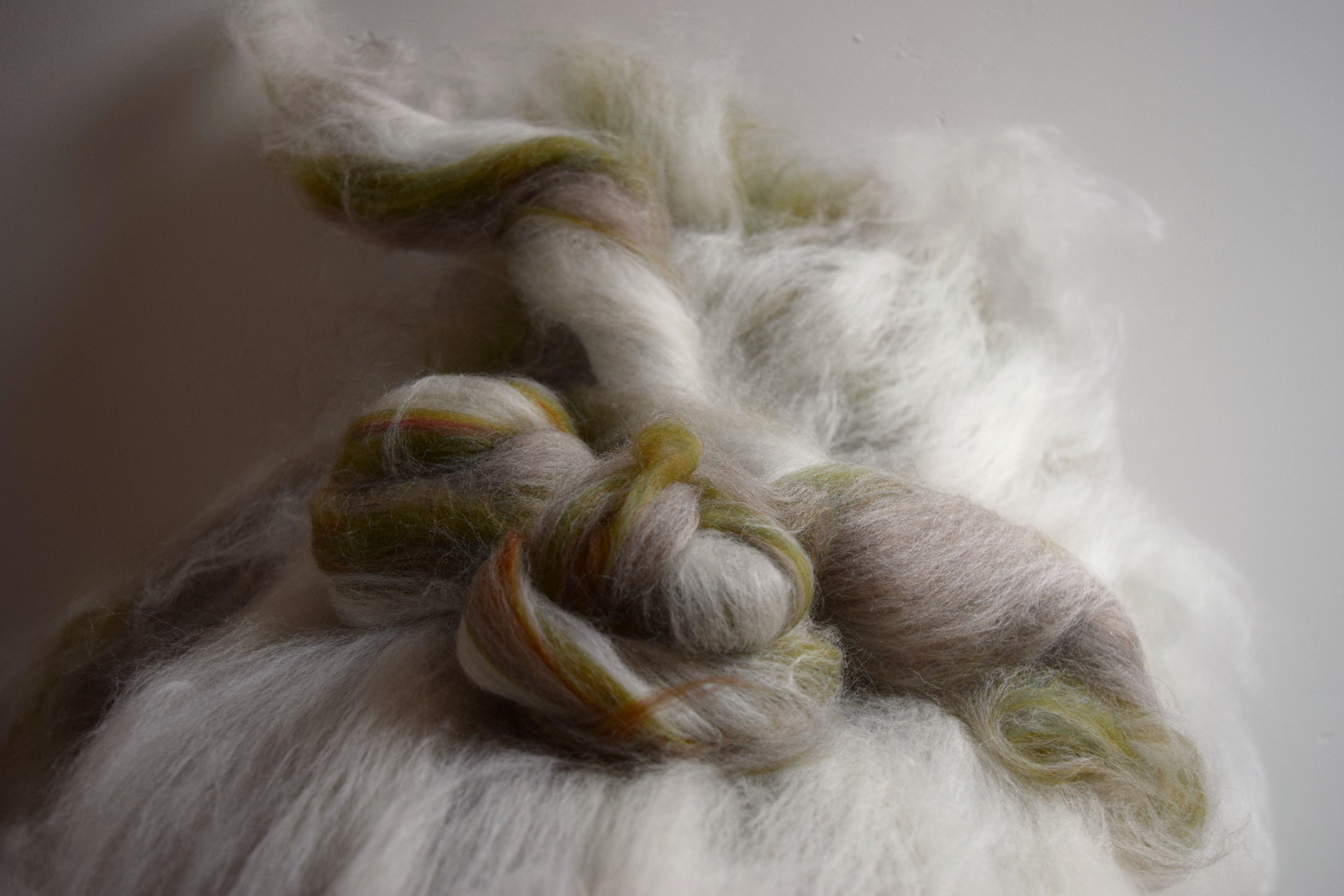
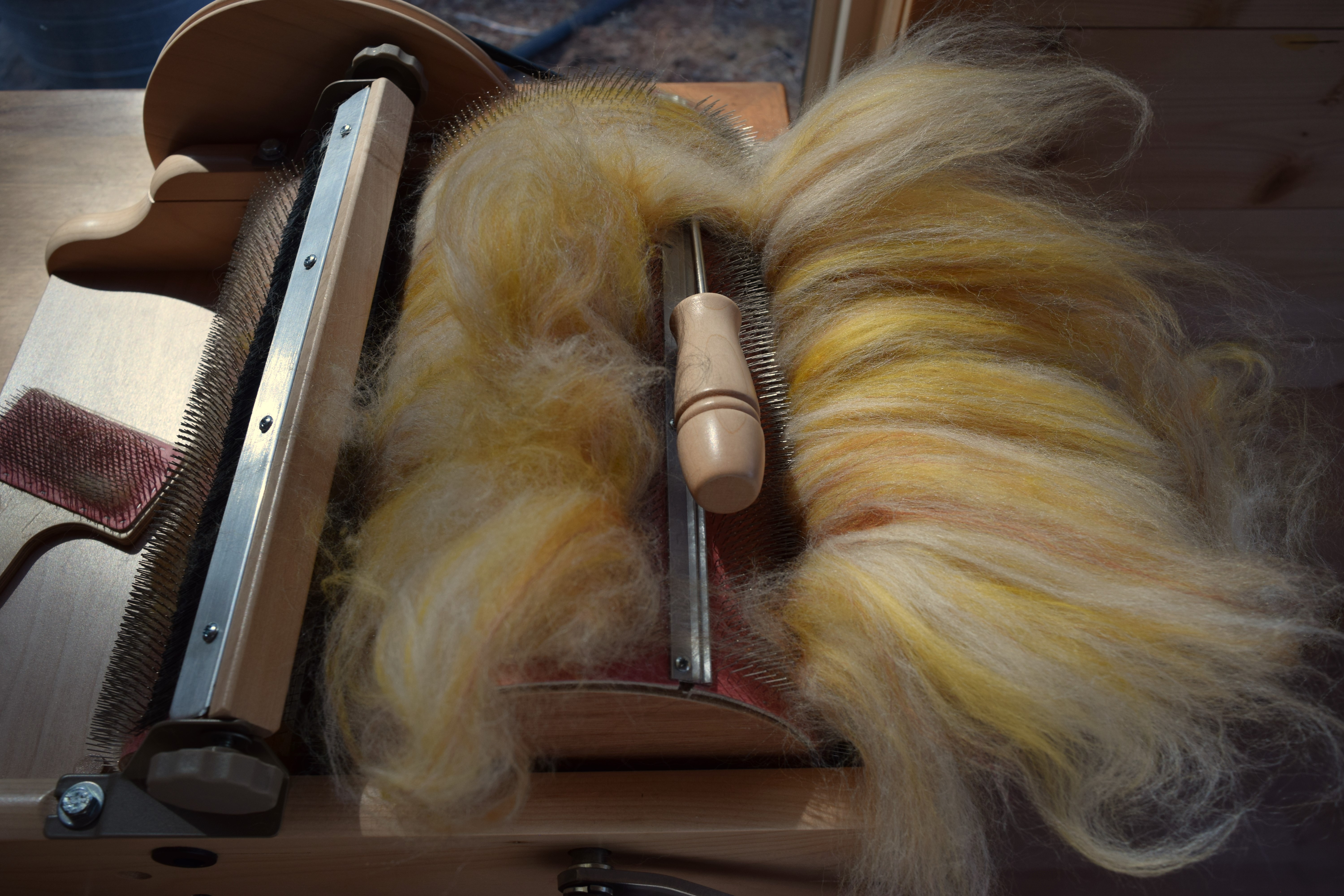
Here is one batt split and coiled into little nests.
Additionally, I plan to spin in a very simple time-saving way, in a short draw worsted technique. That is, working with the combed top, trying to keep the fibers aligned, then keeping the alignment of the wool as much as possible by splitting strips off of the batt — no rolags, no dizzing, no further prep, just loosely put into little nests to photograph them — okay, so now its time to lose myself in some spinning.
♣ ♣ ♣
Techy stuff for Speed Tweed #1:
Fibers . . .
1 part hand-dyed colored roving (100g multi-colored combed top braid from Jakira Farms)
1 part solid roving (100g Wool Of The Andes Roving in Bare )
1 part solid roving (100g Wool Of The Andes Roving in Mink Heather )
I divided each color into thirds (approx 33g each) and layered on the carder as follows:
First layer = 33g layer in mink
Second layer = 33g layer in featured colored braid
Third layer = 33g layer in natural white.
Pull batt off, divide into 6 to 8 strips, and coil strips into little nests to spin. Repeat remaining two thirds.
Approx 300g of wool to spin.
Notes for improvement: As I layered the whole 100g rovings in one layer, I had to run it through the carder again to homogenize enough to my liking. Next time I will apply the wool into the carder differently, refining my speed tweed technique!
See ALL color blending experiments & recipes archived in Tweed Chronicles
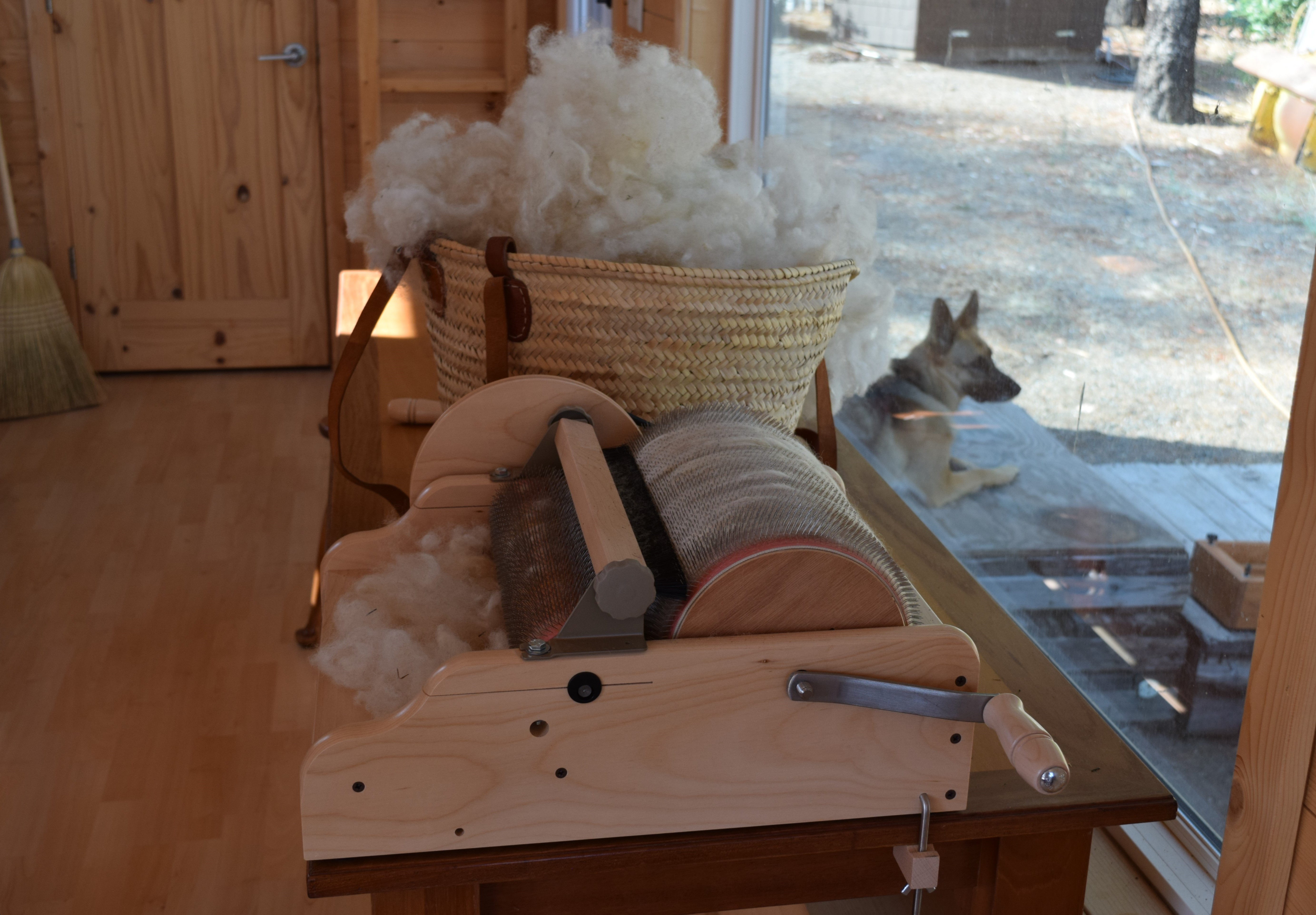
I’ve been busy since the resident carder came earlier this week, down in the tiny (wool) house, raking through the fleece that, after washing it twice, and putting through the box picker twice, I gave up on it as it still had way too many weedy bits, still smelled bad, and was still greasy. The last thing I need is a moth attracting sweater in my wardrobe, so, after cleaning the greasy grime that was fast accumulating on my brand new Ashford carder, I started over blending color with commercial white corriedale/merino top roving I had on hand, and added still more marigold, honey, and dark caramel hues.
However, I made the mistake of pulling off the rolags from the last carding without test-spinning ~~ I am so out of practice ~~ no recipe, just improvising, honing my instincts, and from this point forward it is going to be what it wants to be. I am planning on this first sweater in my wardrobe, to wrap me in the warm memories of golden summer fields all winter long. As I changed course in the middle of carding, I have no idea how much all these rolags weigh, but I’m guessing well over 600g . . . and now for the spinning!
I am busy down at the tiny (wool) house, figuring out methods, weighing carefully, taking notes and taking a leap of faith in color, learning how to use the hand-cranked carder (feeding with left hand, cranking with right) and calculating percentages of mixes.
Back down in the charcoal forest, away from the internet, I am hunkering down . . . with a return to Tweed Chronicles, engaging my creativity with a bit of hard work, and making the effort for the yarn.
This morning I went for a walk with Juno, in the hot . . . dry . . . toasted-in-the-sun wild grass of high summer. I so very much want to capture it and knit it into a sweater! These are moments of this afternoon, as my ideas begin stirring, testing all gold tones together, trying to grasp the emotion I feel about the summer landscape that is elementalto my life on the mountain, and translate it into yarn.