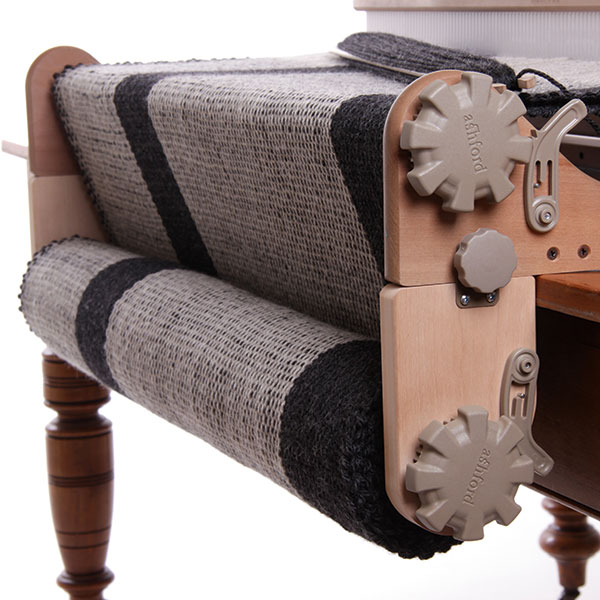
Auld Lang Syne (Scarf No.15)

A lot of the time I don’t realize the coincidences at play as I bring something to finish. For instance, the Scottish phrase “Auld Lang Syne” evoking the sentiment of “for old times’ sake” and “days gone by” . . . and my attempt at weaving to mimic an “auld Scottish tartan” design that my dear old friend and I planned the minute I got my first loom a couple of years ago (the very loom on which it is photographed) . Posted yesterday drying on the line, today here it is, fulfilling all those sentiments as it will be draped artfully over the shoulder of an old wingback chair which sits facing an old woodstove, in a very, very old cabin. For old times’ sake indeed, not to mention it is New Year’s Eve — happy 2026 everyone!

♣   Weaving Notes  ♣

This weight of alpaca is truly perfect for the rigid heddle looms, using a 15 dent reed, because the drape is spectacular and there is enough room for the alpaca to bloom in the simple plain weave. Oh, and about the missing information in the notes; I wrote everything down on a piece of paper as I was calculating the design, then later lost the piece of paper, so it was accidentally thrown away.

  • Yarn: Knit Picks Alpaca Cloud lace weight, in Carson (dark grey), Alfred (medium grey), Arabella (dark green), Elizabeth (red), and Zadie (gold). 440 y = 50g
  • Loom: Ashford 20″ Knitters Loom
  • Warping method:  Easy direct warp method for rigid heddle, 1 end in hole and 1 end in slot.
  • Number of warp ends: Not available
  • Reed: 15 dent rigid heddle reed.
  • Width in reed: 18.5″
  • Selvedges: I added 4 extra ends to each of the selvedges, as they tend to get pulled in, and I used a temple.
  • Sett after finishing: Warp 16 epi, and weft 16 ppi.
  • Color Pattern Warp & Weft: Not available
  • Finished: 3″ hand-twisted fringe, then washed and air-dried hanging, and lightly steam pressed. Measures 89″ long (not including fringe) and 18″ wide, and weighs 175g. 
  • Yardage:  Total yardage used for finished piece = 1540y, figured from weight of finished piece and not including loom waste.

Scarf No. 14

Levi came to visit, and as I was showing him my alpaca scarf series, I could tell that he admired them, and that perhaps he even wanted one, but none of the colors I had woven were appropriate for his blue & grey gentlemen’s style. So, the day before he was to leave I suggested he design one with the alpaca colors I had on hand and that I would weave it for him, and so he did, and by the time he was leaving back to Canada, I had already woven one repeat to show him. Then this last week was a determined effort to getting it done, and now it is finished and ready to send in the post. As usual, my technical weaving notes are listed below.

♣   Weaving Notes  ♣

  • Yarn: Knit Picks Alpaca Cloud lace weight, in Carson (dark grey), Alfred (medium grey), Eleanor (light grey), and Bernard (blue). 440 y = 50g
  • Loom: Ashford 16″ rigid heddle loom
  • Warping method:  Easy direct warp method for rigid heddle, 1 end in hole and 1 end in slot.
  • Number of warp ends: 228
  • Reed: 15 dent rigid heddle reed.
  • Width in reed: 14″
  • Selvedges: I added 4 extra ends to each of the selvedges, as they tend to get pulled in, and I used a temple.
  • Sett after finishing: Warp 16 epi, and weft 16 ppi.
  • Color Pattern Warp: 20 ends each of *Carson, Eleanor, Bernard, Eleanor, Carson, Alfred, Carson, Eleanor, Bernard, Eleanor*, Carson.
  • Color Pattern Weft: Same sequence as for warp *thru*, and ending in Carson.
  • Finished: 2″ hand-twisted fringe, then washed and air-dried hanging, and lightly steam pressed. Measures 76″ long (not including fringe) and 13.5″ wide, and weighs 118g. 
  • Yardage:  Total yardage used for finished piece = 1040y, figured from weight of finished piece and not including loom waste.

Unassailable Spring (Scarf No.12)

Hi, its me Abelene.

It is finally warming up, and all the insects are on the wing, and while the meadow grass grows higher by the hour, the days are rolling on like an enchanted pastoral scene in the mountains. Jen is weaving pensively through the afternoons, and the crew of inanimate objects and I are having our usual philosophical debates in the closet. All is in an easy and unfettered mood, the mood of warmth and days growing longer at long last, a glorious and unassailable Spring!

As for the alpaca scarf, it appears to be a Freudian Slip of weaving, as these colors turned out completely Autumnal, being Jen’s absolute favorite season, none the less, it is exquisite, even to be woven in Springtime.

Abelene & The Crew

Note from Jen: A few months back I made a discovery that I really want to revisit, for it has developed and I want to make sure to bring it to the fore, so that others may benefit from it. The improvised wooden piece that I came up with in the post Ikat No.1 ; I have developed its use in every weaving since, essentially becoming a loom “breast beam” as well as a fine tensioning tool. I wrote —

When I was more than halfway through the weaving, and the front cloth beam was getting pretty packed with woven fabric and cardboard I found the cloth beam to have a certain amount of “squish”, the selvedges conforming to the curve of the cloth winding on irregularly, and not really producing a perfectly flat weave. This I assume is one of the things about rigid heddle weaving, the cloth beam builds cloth and as it does the woven cloth distorts in shape, as well as effects the stability of the tension.

I have found several reasons why this simple fine sanded wood slat board has made a difference:

  • It is a fine-tuning for tension I found in rigid heddle weaving very much needed, as the tension changes in the down and up shed of the reed. The board moved forward (toward the weaving) loosens the tension – and moved back (toward the weaver) tightens it. This fine tuning of the tension allows better weaving , but also so that I can position a temple, or add cardboard warp separators, and a pulling back of the board tightens the tension, which helps open the sheds significantly.
  • It offers the crisp edge of a proper breast beam, such that some rigid heddle looms do not have as part of their simplistic design, Ashford being one of them. This is especially necessary if using a temple to stretch the weave the full width of the rigid reed, also I have found is necessary for a well balance weave with neat and tidy selvedges. Without a temple I find the selvedge warp threads get frayed-to-breaking, as the cloth can narrow and the selvedge threads rub against the reed, and it is a disaster when a warp thread breaks, especially the selvedge warp threads.
  • My tensioning board is 1/4″ thick and 2″ wide, it should be as long as the weaving width of the loom, so that it easily can support a maximum width warp. I will be making one of these for all of the rigid heddle looms I have.

♣   Weaving Notes  ♣

  • Yarn: Knit Picks Alpaca Cloud lace weight, in Dashwood (med brown), Zadie (deep gold), Molesley (beige), and Lydia (brick red). 440 y = 50g
  • Loom: Ashford 16″ rigid heddle loom
  • Warping method:  Easy direct warp method for rigid heddle, 1 end in hole and 1 end in slot.
  • Number of warp ends: 240
  • Reed: 15 dent rigid heddle reed.
  • Width in reed: 15″
  • Selvedges: I did not add extra ends to the selvedges, but did use a temple.
  • Sett after finishing: Warp 16 epi, and weft 16 ppi.
  • Color Pattern Warp: [30 ends Dashwood, 30 ends Zadie, 30 ends Molesley, 30 ends Lydia] x 2
  • Pattern Weft: Gold & Red dominant pattern: 2″ squares of [Zadie, Lydia, Dashwood, Zadie, Lydia, Molesley] rep length of warp.
  • Finished: 3″ hand-twisted fringe, then washed and air-dried hanging, and lightly steam pressed. Measures 72″ long and 14.5″ wide, and weighs 120g. 
  • Yardage:  Total yardage used for finished piece = 1056y, figured from weight of finished piece and not including loom waste.

Inescapable Spring (Scarf No.11)

Hi, its me Abelene.

The Inescapable Spring is upon us, and breaking through the rain clouds are streaming in colors of the most vibrantly rich tones imaginable, the colors of apricots ripening on the tree, the gold sun kissed fruits soon to ripen to perfection before being plucked and bitten into. Señor Mirando and I think the Inescapable Spring weaving is definitely speaking of apricots. March has come in like a lion, and with cool breezy days full of beautiful weather still blowing through, Jen says she is going to warp another in the alpaca scarf series, because the mood is still on!

Abelene & The Crew

♣   Weaving Notes  ♣

Note from Jen: What I love most about this piece is that the colors melt into each other, with low contrast on the grey scale. I want to repeat this , the colors really surprised me in the end, I thought it was going to be too much color, but it all gets toned down in the intersection of the colors. This time I was careful to set the loom up correctly for direct warping, and it was easy, and it was the perfect length. The second alpaca lace-weight I have woven on the 16″ rigid heddle loom, and I just love the balanced plain weave, the sett, the drape, and the light buoyancy to the fabric, I still absolutely am loving weaving this series.

  • Yarn: Knit Picks Alpaca Cloud lace weight, in Zadie (deep gold), Bernice (warm pink to apricot), and Amos (moss green), 440 y = 50g
  • Loom: Ashford 16″ rigid heddle loom
  • Warping method:  Easy direct warp method for rigid heddle, 1 end in hole and 1 end in slot.
  • Number of warp ends: 240
  • Reed: 15 dent rigid heddle reed.
  • Width in reed: 15.5″
  • Selvedges: I did not add extra ends to the selvedges, but did use a temple.
  • Sett after finishing: Warp 16 epi, and weft 16 ppi.
  • Color Pattern Warp: [40 ends Zadie, 40 ends Bernice, 40 ends Amos] x 2
  • Pattern Weft: [2.5″ Zadie, 2.5″ Bernice, 2.5″ Amos] repeated length in sequence.
  • Finished: 3″ hand-twisted fringe, then washed and air-dried hanging, and lightly steam pressed. Measures 76″ long (not including 3″ fringe) and 15″ wide, and weighs 121g. 
  • Yardage:  Total yardage used for finished piece = 1065y, figured from weight of finished piece and not including loom waste.

Scarf No.10

Hi, its me Abelene.

I’m wearing the first finished weave in Jen’s latest series of alpaca scarves; she apparently got a lot of lace-weight alpaca yarn to weave a pile of them, in various colors and patterns, so obviously she’s feeling optimistic for a new adventure. Believe me when I tell you that this weave is so sheer and light and lovely to wear, the alpaca creates a depth of richness that cotton, linen, or even wool, simply cannot, and Jen thinks this is because of the natural luster of the ‘hair’ structure of alpaca, and the color saturation of dyed protein fibers. Hopefully there are still a couple of weeks left of winter in Paris, because that is where this alpaca scarf is heading next, as Jen wants to rush this off to her sister-in-law as soon as she photographs it … on moi!

Ta ta, Abelene

♣   Weaving Notes  ♣

Note from Jen: This time I tried placing pegs around the table, so I didn’t have the warp taking up the whole room, which turned the table into a warping board! I believe I could improvise this way for any amount of warp length within reason. As it was, without having the reference of warping this way before, I accidentally made the warp a little too long … oh well, I’ll do better next time. The very fine lace-weight knitting yarn weaves up into a beautiful light and buoyant draping fabric, I absolutely love it!

  • Yarn: Knit Picks Alpaca Cloud lace weight, in Elizabeth (deep red) and Lydia (brick), 440 y = 50g
  • Loom: Ashford 16″ rigid heddle loom
  • Warping method:  Easy direct warp method for rigid heddle, back to front, double threading from back apron rod through reed, then around pegs on table (a warping board). Wound on to back beam and finally tied off on to front for weaving. Rethreaded to have 1 end in hole and 1 end in slot. I forgot to measure the warp…oops!
  • Number of warp ends: 240
  • Reed: 15 dent rigid heddle reed.
  • Width in reed: 15.5″
  • Selvedges: I did not add extra ends to the selvedges, but did use a temple.
  • Sett after finishing: Warp 16 epi, and weft 16 ppi.
  • Color Pattern Warp: [40 ends red , 40 ends brick] x 3
  • Pattern Weft: 5″ red, 2.5″ of brick, repeated length in sequence.
  • Finished: 3″ hand-twisted fringe, then washed and air dried hanging, and lightly steam pressed. Measures 98″ long and 15″ wide, and weighs 140g. 
  • Yardage:  Total yardage used for finished piece = 1232y, figured from weight of finished piece and not including loom waste.

Rug No.1

My first woven rug came together rather fast, from six old shirts of Jeff’s (one which I made for him years ago, and five LLBean shirts) made custom for a space in our bedroom in front of an old dresser which was given to us by a weaver (hi B!). The rug was woven on my 48″ rigid heddle loom, with the Freedom Roller attached, and I used a temple but kept it back a few inches from the fell so I didn’t whack it with the Schacht weighted beater.

Its been raining steadily for a few days, and I hemmed the rug sitting at the window, in the low light of the afternoon, admiring the Autumn color outside with the black oaks that have completely turned gold.

I am really surprised I could weave an *actual* rug on a rigid heddle loom! The rug is 28×50 inches, and I figure I could have had double the length with the Freedom Roller attachment; I reckon I could warp up to 48″ wide, so in theory, I could make a monster rug of 4×8 feet. After I finished weaving it I hemmed the edges to the under side, and carefully took the labels off and chose one to sew on the hem for a little artful whimsy . . .

Juno was the warping and cutting supervisor!

♣   Weaving Notes  ♣

General Notes: I had to get around the fact that the rug is not made with a proper floor loom, with a heavy swinging beating reed, and so I had to beat hard along each weft with the Schacht weighted beater, but the end result was good enough. I thought of a clever way of cutting long strips; figured since the strips of cut fabric are getting scrunched into the warp anyway, it does not matter if they are on the bias or on the grain, I cut about 2″ wide strips, starting at the bottom, between button bands, following the shape of the shirt tails, zig-zag cutting back and forth, using up as much of the shirt as possible, and very little was cut on the grain. The sleeves were mostly spiral cut. When about 1.5″ from the button band I stopped, then from beneath cut a wide turn back the other direction over of the previous cut, snipping across side seams as they come. I was not particularly neat with the cutting either. I cut all the ends angled, and overlapped the beveled ends instead of sewing edges together, which would be way more work.  I wove one shirt completely before starting the next, in segments rather than stripes, so we could recognize the old beloved shirts in their sequence.

Additionally, the rug is fairly sturdy and thick and the woven “cloth” builds up fast on the cloth beam, so the Freedom Roller (Ashford’s add-on cloth beam for their rigid heddle looms) is absolutely essential in my opinion to weave a rag rug that is thick and substantial, as is the weighted beater. But perhaps the most essential thing that I overlooked (never again!) is the importance of using warping yarn that can withstand the punishment of the hard beating. 

  • Yarn: Maurice Brassard 8/2 cotton, double threaded (2 in hole, and 2 in slot) emulating 8/4 warp yarn. Approx 80″ from apron rod to pegs. Should have bought heavier warp yarn and waited for it to arrive before starting the rug! 
  • Weft: Cotton flannel strips, about 2″ wide, taken from old shirts. Beginning and end 3″ same as warp, woven wide enough to make a turned hem below the rug. 
  • Loom: Ashford 48″ Rigid Heddle Loom (the beast!) with Freedom Roller attachment
  • Number of warp ends: 210, double threaded = 420.
  • Reed: 7.5 dpi (30/10cm) dent rigid heddle reed, about 28″ width in reed.
  • Finished: 1 inch turned hem, sewn against the underside of the rug. No washing/drying. Measurements finished are 28″ x 50″. I planned for 60″ length but made a mistake when measuring warp distance and somehow didn’t factor in the correct amount of loom waste! Gaw!!!  
  • Yardage: Who knows…. 6 shirts using as much as I possibly could. 

Scarf No.9

Hi, its me Abelene.

In the end, it was impossible to photograph, the colors could not be grasped by the camera. Even after trying a hundred shots, in different areas of lighting, only these few worked out. But Jen told me how amazing this one was to be weaving freely with no measured blocks of color, just changing quill bobbins randomly, and she has a lot to say about the whole project in the weaving notes below, so I’ll just smile and wave. I personally think the Marigold Scarf (no.9) is so beautiful, in its deep and rich gold tones, and I wish you could see the colors as they really are, but this photo out of all the many, captures the colors best . . .

♣   Weaving Notes  ♣

Note from Jen: Yes, this project was difficult, and I must confess I am not all that encouraged about dyeing cotton but am gaining perspective in the concept of “slow cloth”. After the many steps of scouring, mordanting, dyeing, then finally washing and rinsing, the actual yarn, and that is before the loom is even warped. I must ask myself is it worth it? I ponder this because I really love weaving, but maybe the added overwhelm from dyeing the cotton yarns first did add a new level of complexity. I have tried indigo, madder, pomegranate and marigold, and in every yarn the results were dull and almost unappealing as the sheen of the undyed mercerized cotton was lost after all the processing through the steps, the luster was gone. I will not give up, I just need a small break, in order to be fresh for learning again. You can see all posts for this project here.

  • Yarn: Yellow , dark gold , green gold overdyed 10/2 yarn (see this post. )
  • Loom: Ashford 16″ rigid heddle loom.
  • Additional tools: I used a temple and the board I rest against the cloth beam to stabilize and lengthen the weaving surface.
  • Warp:  Direct warp set-up, 1 end in every heddle/hole, and 1 in every dent/slot –drawing out from apron rod to peg is approx 110 inches from apron rod to warping peg.
  • Number of warp ends: 239.
  • Reed: 15 dent rigid heddle 15.5″ in reed. (The loom says 16″ weaving width, but there is only the capacity in the reed for 15.5″ .
  • Sett on loom: Warp = 15 epi,  weft = 15 ppi
  • Sett after finishing: Warp 16 epi, and weft 16-18 ppi.
  • Color Pattern: Warp =  random pattern.
  • Finished: 3 inch twisted fringe, then washed and dried in machine, then pressed. Measures 78″ long (not including fringe) and 14″ wide, and weighs 135 g. 
  • Yardage:  Total yardage used is approx 1250 y, figured from weight of finished piece and not including loom waste.
  • Note to self, recipient was eventually Camille, although it was intended for Nina.

Ikat No. 1

This piece is my first attempt at ikat, even though it is only a simple random ikat. I saw a short film on Japanese Kasuri, and wanted to try working with ikat, posted in Knotty. But natural dyeing to me is tricksome, particularly dying cellulose fibers like cotton and linen, and particularly indigo which works in an alkaline solution, which cellulose fibers require. To add, alkalinity is the enemy of wool, which is the only fiber I have significant experience with and possibly the most desire to work colors into. Dying cellulose fibers, such as commercial weaving yarns, involve scouring extremely well, mordanting properly, dying, then neutralizing and rinsing till the cows come home … requiring many chemical ingredients and meticulous measured steps which are very complicated and a lot of work. And if scouring is not done properly a thing happens called “crocking”, where instead of the dye imbedding fully into the yarn, some of it hangs out on the surface ready to rub off on things and ruin them … on to your favorite weaving equipment, on to the clothes worn while weaving, and after being washed the dye gets into the other colors in the weaving itself, which happened to this piece regretfully.

I wish I knew this about the pH issues and limitations before jumping in, and think at this point I need to put the dyes away for while and release myself from self-imposed expectations of dye mastery! I have learned that both commercial dyes and natural dyes have their pros and cons, and I will likely go back to my old favorite reliable powdered Jacquard dye with wools, which are protein fibers, for it needs only a splash of vinegar in the dye bath, a quick scalding, and the dyebath exhausts beautifully if done correctly. Maybe I will again try ikat weaving with wool and Jacquard dyes next.

Going forward, and I have asked myself this: Why spend so much time, money, and resources on the things I am a rank beginner at, while falling behind and not bringing to fruition the things I have a bit of and skill (dare I say talent) with, and really should aspire to become better at? There are a lot of things I want to do, but at this point in my life, I must narrow down the possibilities, eliminating distractions is essential.

♣   Weaving Notes  ♣

There are no technical weaving notes in this post, but I want to document something remarkable I discovered for rigid heddle weaving ! When I was more than halfway through the weaving, and the front cloth beam was getting pretty packed with woven fabric and cardboard I found the cloth beam to have a certain amount of “squish”, the selvedges conforming to the curve of the cloth winding on irregularly, and not really producing a perfectly flat weave. This I assume is one of the things about rigid heddle weaving, the cloth beam builds cloth and as it does the woven cloth distorts in shape, as well as effects the stability of the tension.

I had an idea of propping a piece of wood against the wound cloth on the cloth beam, right at the edge, creating a sort of breast beam setting on top of the wound cloth. I found a piece of board which I had used it for separating the shed wider in backstrap weaving, so I positioned it on the cloth beam so that when I tightened the warp, the tension held it in place, creating a very stabilized and firm straight edge for the weaving, and I found I gained quite a bit of extra space on the weaving too, especially for the temple. The more cloth on the beam, the further back the stabilizing board it sits, creating a longer weaving area in front of the reed! I am going to explore this idea in the future, for I am very excited!

Note to self, recipient was eventually Rosanna.

Scarf No.8

Hi, its me Abelene.

The news around here is that Jen finished scarf no. 8, and not only that, but also she says she is finished the 20/2 ulltra fine cotton series, at least for a while. Time to move on. This project is unique from the others because she used direct warping method on the 8 shaft table loom — do read Jen’s note down in the Weaving Notes explaining things, and see all the photos. We, the crew of inanimate objects; a chatty mannequin, all of the looms, Señor Mirando (mirror), ladder, chairs, old wooden ironing board, little antique folding ruler, et al — we ALL respect that this double threading thing is a big deal to Jen, but she’s losing her mind a bit, attempting to avoid convention. We, the crew, are happy to be able to work together photographing beneath the rafters, with beautiful draping hand weavings, in the afternoon light, but we aren’t sure what Jen intends to do now being finished with “the series”. She has been spending time making dye concoctions with powdered extracts of indigo, madder, and pomegranate rinds, and so we think her next thing might have something to do with that, which no doubt in my mind will result in another beautiful drapey thing!

Ta ta, Abelene & The Crew

♣   Weaving Notes  ♣

Note from Jen: For this piece I tried the easy direct warping double threaded through the heddles on the table loom, so was inventing a method for myself, as so far I have only have done this on the rigid heddle loom with Scarf no.7. Take a look at the photos in the weaving notes below and you’ll see that this is not conventional, and I’m only grateful there are no weaving police around. For the weavers who are reading, I’m sharing my weaving notes and detailed warping photos below . . .

  • Yarn: 20/2 mercerized perle cotton, 8400yds / 1 lb, Maurice Brassard, in colors Natural (P-100), and Flax (P-5104).
  • Loom: Ashford 8shaft Table Loom, straight draw threading for plain weave, lifting pairs of odds & evens (1&3, and 2&4)
  • Warping method:  Tested an easy direct warp method, back to front; double threading from back apron rod through reed and heddles, then to peg. Wound on to back beam and finally tied off on to front for weaving. Warp length is approx 130 inches from apron rod to warping peg.
  • Number of warp ends: 640 max plus 4 extra at each selvedge = 644 ends
  • Reed: 16 dent reed, 2 ends in each dent and 2 ends in each heddle (except for selvedges 4 ends each)
  • Width in reed: forgot to measure.
  • Sett on loom: forgot to measure.
  • Selvedges: I did not add extra ends to the selvedges, but did use a temple.
  • Sett after finishing: Warp 36 epi, and weft 26 ppi.
  • Color Pattern Warp: [32 dents of Natural, 32 of Flax] rep blocks across reed until measures 20″
  • Pattern Weft: Wound on to a 30″ stick shuttle for each color as follows: [30 wraps Natural, 30 wraps Flax] repeating sequence.
  • Finished: 1/4 inch turned hem, then washed and dried in machine, then pressed, measuring 81″ long and 18″ wide, and weighs 150g. 
  • Yardage:  Total yardage used for finished piece = 2780y, figured from weight of finished piece and not including loom waste.
  • What I will do differently next time: Raise up the harnesses to warp, thread and sleigh, I found I had to crouch down unnecessarily before I realized! Also I will group in 1″ bundles, having mistakenly miscalculated 8 groups of 4 harnesses, was actually 2″. EACH GROUP OF 4 harnesses is 1/4″. A group of all 8 harnesses will be 1/2″
  • Recipient: Sorcha

Scarf No.6

Hi, its me Abelene

Here is Jens latest weaving in her ultra fine series! She thinks the attention to drape is really emphasized when the weaving is wrapped around something body-shaped, and not necessarily ladder-shaped, as she had been doing earlier, and so I am the designated weaver’s model, and giddy for the thoughtful attention. Besides, Jen says I’m the new It Girl!

I am trying not to take offense to be calling ” it ” but Jen assured me that an “It Girl” is an attractive and engaging young woman, originating from a 1920’s film all about the British upper-class society. Hey, then I am IT for sure! Mostly because I like to be attractive and engaging. Oh, and Jen thought it best to have a format for these weaving posts, where I get to focus on the dazzling visual affect, then afterward she will explain the boring weaverly aspects in a special note about the project below.

Ta ta, Abelene

Note from Jen: I’ve been exploring weaving in a series of ultra light 20/2 cotton, this being the fourth, and the 20 epi woven on the Ashford Table Loom, set up for weaving straight draw (that means using 4 harnesses threaded 1-2-3-4, which in itself, was a completely new and thoroughly difficult experience, with threads doubled through the reed. Gibberish to my knitting colleagues, but to the weavers who might be reading this, they know this is an absolute basic step to learning weaving on multiple shafts. In fact, the weavers who might be reading this will roll their eyes for the fact that I warped it the same direct method as I do rigid heddle looms – direct warp – drawing the warp from the front apron rod through the reed, and around a peg, and then threaded through the heddles as an in-between step before winding it all on to the back warp beam. I improvised with this and subsequently the warp had mistakes, but not willing to get bogged down with them, I wove the piece instead testing gleefully what seemed closest yet to a perfect balanced weave, with just one light tap of the real swinging beater. This project was first in its own series of multiple shaft fine weaving, and so this very exciting!

♣   Weaving Notes  ♣

  • Yarn: 20/2 mercerized perle cotton, 8400yds / 1 lb, Maurice Brassard, in colors; Galaxy Blue (P-112), Light Beige (P-2), and Blanchi (white) (P-101). 
  • Loom: Ashford Table Loom.
  • Warping Method:  Direct warp, using an extra peg so I could get some extra length in the small space (because honestly , this table loom and stand take up a lot of space in the room. 1-2-3-4 straight draw, and 2 threads in every reed dent. Warp length is approx 110 inches from apron rod to warping peg.
  • Number of warp ends: 360, plus 4 additional each selvedge. 368 ends total. 
  • Reed: 10 dent reed, 2 ends through each dent.
  • Width in reed: approx 18″
  • Selvedges: Doubled for 4 ends each selvedge, and used a temple.
  • Sett after finishing: Warp 22 epi, and weft 20 ppi. Still not perfectly balanced, but could be a situation of beating . I think a closer sett for warp would allow me to beat more consistently and get perfect balance, because with a slightly open weave the measuring overall is more difficult because of variations throughout.
  • Color Pattern:   
    • Warp =  [20 slots with 2 ends each slot (40ends) blue, 20 slots with 2 ends each slot (40ends) light beige, 20 slots with 2 ends each slot (40ends) white] repeat. 20 slots with 2 ends each slot (40ends) blue. 
    • Weft = wound on to a 30″ stick shuttle for each color as follows: [30 wraps blue, 30 wraps light beige, 15 wraps blue, 15 wraps light beige] repeating sequence for the length of the warp.
  • Finished: 1/4 inch turned hem, then washed and dried in machine, then pressed, measuring 76″ long and 17″ wide, and weighs 96g. 
  • Yardage:  Total yardage used for finished piece = 1776y, figured from weight of finished piece and not including loom waste.
  • What I will do different next time:  Warp back-to-front, again direct, but with longer warp needed due to the fact that the table loom has more loom waste than the rigid heddle loom, such as a minimum of 120″ from apron rod to peg for 80″ finished scarf.  Also I need to better organize heddles before attempting to thread, so mistakes don’t happen as easily. I will tie off bundles of 1″ in groups according to epi. 

Scarf No.5

Hi, its me Abelene

Jen has brought me out of the closet where I was suffocating in debate with my new pals, the Ashford 48″ rigid heddle loom and Ashford 32″ table loom, very existential ideas, like about whether or not as inanimate objects, we really exist, and I have been by far the most optimistic among us! Anyway, Jen seems to have forgotten about me, but finally she brought me out to see the spring . . . I am wearing a very light weave that seems to be sticking to my skin all by itself, perhaps from static electricity, as it has been three days of drying wind here.

Jen wants me to say that she had some difficulty weaving this fluffy light sheer cloth, but eventually she found her way and the weaving became better balanced, eventually only a light tap of the reed to keep the structure even and open. This is the 15epi experiment in her series of weaving ultra fine cotton where she is experimenting with different threads per inch. She is super pleased that very light cloth can be woven on a simple little rigid heddle loom with one 15 dent reed, and is hoping to do more just like it. But first to finish her series she wants to weave 20 epi with this same thread, whether threading two rigid heddle reeds together on my pal the big rigid heddle loom, or to warp it up on my other pal, the table loom.  But on the other hand (um, what other hand???) she thinks she might just weave more single reed 15epi samples on the little rigid heddle loom, like this piece was.

So much fun going on here I tell you!

Ta ta, Abelene

ps. Don’t miss out on the technical weaving notes and slideshow below!

♣   Weaving Notes  ♣

  • Yarn: 20/2 mercerized perle cotton, 8400yds / 1 lb, Maurice Brassard, in colors;  Flax (P-5109), Rose Paudreux (P145), Natural (P100), and Blanchi (white) (P-101). 
  • Loom: Ashford Knitters Loom 20″.
  • Warp:   Warp length is approx 110 inches from apron rod to warping peg.  
  • Number of warp ends: 298
  • Reed: 15 dent, warp is 19.5″, full width in reed.
  • Sett on loom: Oops, I forgot to measure.
  • Sett after finishing: Warp 17 epi, and weft 19 ppi.
  • Selvedges: I did not do floating selvedges, but I did warp 3 extra ends per selvedge, which is almost necessary I am finding when using a temple.
  • Color Pattern:   
    • Warp =  [18 ends of rose, 18 of blanchi, 18 of flax, 18 of blanchi ] x 2 . 288 ends plus 3 extra selvedge ends at each side = 294.
    • Weft = wound on to a 30″ stick shuttle ; [20 wraps of rose, 20 wraps flax] repeat the sequence to end of warp.
  • Finished: 1/4 inch turned hem, then washed and dried in machine, then pressed, and weighs 83g. Measuring after finishing 76″ long and 17″ wide (before washing/drying it measured 76″ x 18″).
  • Yardage:  Total yardage used for finished piece = 1536y, figured from weight of finished piece and not including loom waste.
  • General Notes: This weave is open and fairly sheer. I am striving for balanced weave with only a light tap of the reed needed.  If I beat too hard with the reed, even just a slight bit of pressure on the reed, or too many taps, the weft easily becomes compressed and creates horizontal stripes of weft dominant color. For this reason, I had to be very careful, hoping that after a wash and dry in the machine everything would become even, with threads locked together in a firm gauze fabric. The ppi is slightly more than the epi, so not perfectly balanced. I am guessing then that 20 epi will be the magic warp spacing for ease of weaving balanced.

Scarf No.4

This weaving taught me two new things. One is that I further explored color, using a different variation than I have yet; with two colors in the warp, and four in the weft. The color affect of the check is still lively and interesting, but without warping with the two lightest shades (beige and natural) the result gave a more muted and softened color variation, less dramatic with no light blocks. I would like to explore this idea even more!  

I think the most challenging thing about this piece, and anything I’ve woven to date, is that I did a double heddle threading with two different size reeds. It was definitely another long and arduous threading process, and after discovering I miscalculated the spacing the first time, I resolved there really was no way of going around it, that it had to be done right, and be done over.  Of course, in doing it over I discovered a formula for myself, where I was only guessing at first, and so I have written my formula in my weaving notes.

This is going to be the last of the double reed threading for a while, for not only is it a very intensive warping process, but also if a mistake is made in the warp (as there was one, if you’ll notice the long run throughout the whole weaving) it is just not something I know how to fix and it tests my patience.  Such was the case again, some threads misaligned and right off the start, the flaw was blaringly obvious, but this was merely a sample to test the process. The reed sizes I wanted to thread together in this project were 15 dent and 12.5 dent (per inch), but easier calculated in the metric sizes 60/10(cm) and 50/10(cm) , to get a sett of 25 epi. Its all there in the weaving notes, with technical threading photo gallery.

♣   Weaving Notes  ♣

  • Yarn: 20/2 mercerized perle cotton, 8400yds / 1 lb, Maurice Brassard, in colors; Rose Paudreux (P145), Natural (P100), Light Beige (P-2), and Flax (P-5109). 
  • Loom: Ashford Knitters Loom 20″.
  • Warp:  Double threaded 4 ends per dent on first  reed, then through  a second reed using this method  Using a heddle stand is rather necessary, Jeff made the one I use in tech photos below.  I don’t know how to suggest an alternative, but if one has a couple of heavy objects or uses a bit of cleverness, one could rig a reed stand. Now, with the second reed forward, threading it through in a very seemingly complex manner, but it really isn’t.  Warp length is approx 110 inches from apron rod to warping peg.  See formula below.
  • Number of warp ends: 432.
  • Reed: Two rigid heddle reeds, one 15 dent and one 12.5 dent.   I threaded through the 15 dent reed first, skipping 1 slot after every 4 slots threaded, and the second reed I threaded every slot. End result is as two 12.5 dent reeds, with 25 epi.  See formula below. Note: After both reeds were threaded, I held them together with thick rubberbands as shown in photos.
  • Sett on loom: Warp = 25 epi (ends/threads per inch),  weft =  25 ppi.
  • Sett after finishing: Warp 28 epi, and weft 28 ppi.
  • Selvedges: I did not do floating selvedges, nor did I bother to double up and reinforce the selvedges, mostly because there was so much going on with threading through TWO reeds. I did use a temple.
  • Color Pattern:   
    • Warp =  [18 slots with 4 ends each slot (72 ends) flax, 18 slots with 4 ends each slot (72 ends) rose] REPEAT for a total of 3 pattern reps, and 432 ends.
    • Weft = wound on to a 30″ stick shuttle; [30 wraps of flax, 50 wraps of light beige, 30 wraps of rose, 50 wraps of natural] repeat the sequence to end of warp.
  • Finished: 1/4 inch turned hem, then washed and dried in machine, then pressed, measuring 80″ long and 15.5″ wide, and weighs 105g. 
  • Yardage:  Total yardage used for finished piece = 1943y, figured from weight of finished piece and not including loom waste.

My formula for threading two graduating sized heddles together: All of the reed sizes for the Ashford rigid heddle looms, which many rigid heddle weavers have a size graduation of reeds:

2.5 dpi (10/10cm)
5 dpi (20/10cm)
7.5 dpi (30/10cm)
10 dpi (40/10cm)
12.5 dpi (50/10cm)
15 dpi (60/10cm)

I have most of the reed sizes for my Knitters Loom, but for the sake of very fine cloth weaving with my rigid heddle looms, I am writing down my formula for threading two reeds of graduating larger sizes together so that I can achieve epi’s greater than the finest single reed available for this loom, which is a 15 dent (60/10). I’ll add that It is far easier to use a single reed than to thread two together, so in the case of coupling the lower-dent reeds — I recommend just buying the single 15 dent reed, instead of double threading 40/10 with 30/10 (or two 30/10) reeds to get 15 epi, but for the sake of example I listed all the rigid heddle reed pairings in sequence, in the situation that it applies.

The reed that has fewer dents should be in front of the other, facing forward toward the weaving, where every slot and hole is threaded. The reed with more dents should be behind it, and when threading, skip 1 slot/hole as needed to align to the front reed.  Off of the warp beam there will be spaces in the threading, but the reed facing the weaving is even with no empty slots/holes. Here are my calculations for a balanced threading across the warp . . .

  • 60/10 & 50/10, thread as two 50/10 (thread 5, skip1) same as two 12.5/in= 25epi
  • 50/10 & 40/10, thread as two 40/10 (thread 4, skip1), same as two 10/in = 20epi
  • 40/10 & 30/10, thread as two 30/10 (thread 3, skip1), same as two 7.5/in = 15epi
  • 30/10 & 20/10, thread as two 20/10 (thread 2, skip1), same as two 5/in = 10epi
  • 20/10 and 10/10, thread as two 10/10 (thread 1, skip1), same as two 2.5/in = 5epi

Click 1st photo to go to slideshow…

Scarf No.3

This ultra fine cloth finished has 32 threads per inch in the warp, and was woven on my 20″ Ashford Knitters (rigid heddle) Loom, which is a fabulous sample loom for all the fine weight threads I have been so curious to try. This particular project is extremely fine cotton, was threaded through two 15 dent reeds, and I have no desire to go finer, this is the limit. Famous last words, eh?

One must look and wonder how all these gazillion threads in the warp can be kept track of, and I for one, can not.  I thought all the threads were there, but as I begin to weave, there’s empty slots where warp threads are suppose to be, maybe one or two were mis-threaded, or broke, and I missed them, but as I weave further, more threads have disappeared, likely in not catching them when I was threading the reeds. I just can’t pull my hair out over it, these are sample weavings, total leaps of faith and hoping for the best, I can’t take it too seriously.

The most impressive thing to me about this piece is that it was threaded through two rigid heddle reeds; double threading is a mind bend at first, but then after my first try using these instructions the process gelled and suddenly I felt like I was born knowing how to do it. So I’m weaving on in spite of the mysteriously thinning warp, it is a thrill to be weaving such ultra fine fabric on a simple, nearly primitive loom, even though weaving 30 epi on the rigid heddle loom means I am having to do the extra work of using a stick shuttle for both passing the weft and beating down to try for a balanced weave, and still it is not. Weaving on the rigid heddle in this way slows weaving down a great deal, and there is a lot to pay attention to.

Once I am finished with this piece I may try another similar double threading sample with a different reed combination, coupling a 15 and a 12 dent together, achieving a 24 epi, and maybe then I can beat with only a tap of the rigid heddle reed instead of having to beat it down with the stick shuttle. I strive to find the sweet spot where weaving is truly balanced, not forced, and ultimately what I want to achieve with plain weave.

A bit about the design; I crave bold block design in a subtle contrast, so developing my elongated big check blocks with or without a stripe, and selecting the two very low contrast neutral colors for the background check, for this piece was an attempt to get a “barely there” colorway, yet it is still bold enough, and I really love it!

♣   Weaving Notes  ♣

  • Yarn: 20/2 mercerized perle cotton, 8400yds / 1 lb, Maurice Brassard, in colors; Natural (P100), Light Beige (P-2), and Flax (P-5109). 
  • Loom: Ashford Knitters Loom 20″.
  • Warp:  Double threaded 4 ends per dent on first  reed, then through  a second reed using this method. Using a heddle stand is rather necessary, Jeff made the one I use in tech photos below.  I don’t know how to suggest an alternative, but if one has a couple of heavy objects or uses a bit of cleverness, one could rig a reed stand. Now, with the second reed forward, threading it through in a very seemingly complex manner, but it really isn’t.  Warp length is approx 110 inches from apron rod to warping peg.
  • Number of warp ends: 600 , or there about, as I lost some along the way. 
  • Reed: Two 15 dent rigid heddle reeds, about 19.5″ width in reed.
  • Sett on loom: Warp = 30 epi (ends/threads per inch),  weft =  ?? (forgot to measure).
  • Selvedges: I did not do floating selvedges, nor did I bother to double up and reinforce the selvedges, mostly because there was so much going on with threading through TWO reeds , but  a real positive thing about such a tight weave and having to beat with the stick shuttle to get the weft in place, there seems to be no draw-in on the edges. After about 12″ of weaving I noticed a little draw-in, so I started using the temple.
  • Sett after finishing: Warp 32 epi, and weft 24 ppi.
  • Color Pattern:   
    • Warp =  [12 slots with 4 ends each slot (48ends) light beige , 1 slot with 4 ends (4 ends) flax,  12 slots with 4 ends each slot (48ends) light beige.  12 slots with 4 ends each slot (48ends) natural, 1 slot with 4 ends (4 ends) flax,  12 slots with 4 ends each slot (48ends) natural, 12 slots with 4 ends each slot (48ends) natural. ] REPEAT for a total of 3 pattern reps, and 600 ends.
    • Weft = wound 60 full wraps on to a 30″ stick shuttle for each color, in repeating sequence natural and light beige. 
  • Finished: 1/4 inch turned hem, then washed and dried in machine, then pressed, measuring 81″ long and 18″ wide, and weighs 130g. 
  • Yardage:  Total yardage used for finished piece = 2405y, figured from weight of finished piece and not including loom waste.
  • What I will do differently next time:
    • Again, I ran out of room on the reed(s) while threading, and had to sacrifice the left 12 threads, but its so fine, that is like a quarter inch I am guessing. Second is I didn’t catch it, but there’s a few threads missing in the slots, and that is okay with me.
    • Glimakra slim boat shuttle actually fit in the shed!  I am so anxious to finally use it, I found I had to use the stick shuttle as a beater anyway, why not refine the movements and wind the stick shuttle with thread and omit the boat shuttle this time… but next time, with 24 epi , using 12 and 15 dent reeds double threaded, maybe it will be balanced.  

(( click 1st image to go to slideshow ))