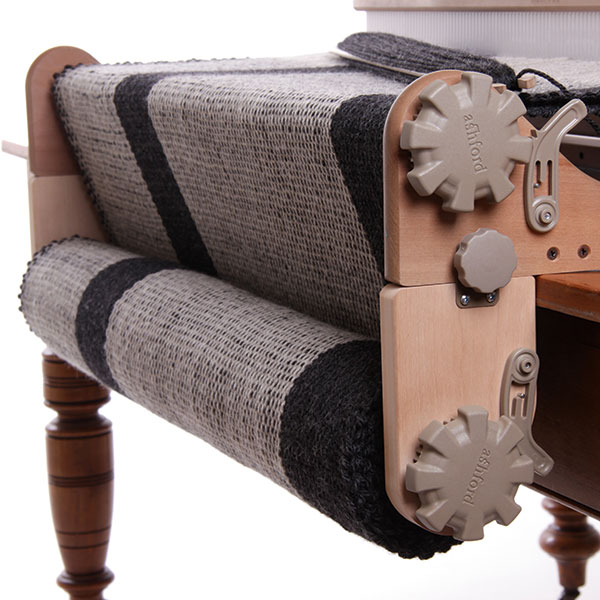
Rug No.1

My first woven rug came together rather fast, from six old shirts of Jeff’s (one which I made for him years ago, and five LLBean shirts) made custom for a space in our bedroom in front of an old dresser which was given to us by a weaver (hi B!). The rug was woven on my 48″ rigid heddle loom, with the Freedom Roller attached, and I used a temple but kept it back a few inches from the fell so I didn’t whack it with the Schacht weighted beater.

Its been raining steadily for a few days, and I hemmed the rug sitting at the window, in the low light of the afternoon, admiring the Autumn color outside with the black oaks that have completely turned gold.

I am really surprised I could weave an *actual* rug on a rigid heddle loom! The rug is 28×50 inches, and I figure I could have had double the length with the Freedom Roller attachment; I reckon I could warp up to 48″ wide, so in theory, I could make a monster rug of 4×8 feet. After I finished weaving it I hemmed the edges to the under side, and carefully took the labels off and chose one to sew on the hem for a little artful whimsy . . .

Juno was the warping and cutting supervisor!

♣   Weaving Notes  ♣

General Notes: I had to get around the fact that the rug is not made with a proper floor loom, with a heavy swinging beating reed, and so I had to beat hard along each weft with the Schacht weighted beater, but the end result was good enough. I thought of a clever way of cutting long strips; figured since the strips of cut fabric are getting scrunched into the warp anyway, it does not matter if they are on the bias or on the grain, I cut about 2″ wide strips, starting at the bottom, between button bands, following the shape of the shirt tails, zig-zag cutting back and forth, using up as much of the shirt as possible, and very little was cut on the grain. The sleeves were mostly spiral cut. When about 1.5″ from the button band I stopped, then from beneath cut a wide turn back the other direction over of the previous cut, snipping across side seams as they come. I was not particularly neat with the cutting either. I cut all the ends angled, and overlapped the beveled ends instead of sewing edges together, which would be way more work.  I wove one shirt completely before starting the next, in segments rather than stripes, so we could recognize the old beloved shirts in their sequence.

Additionally, the rug is fairly sturdy and thick and the woven “cloth” builds up fast on the cloth beam, so the Freedom Roller (Ashford’s add-on cloth beam for their rigid heddle looms) is absolutely essential in my opinion to weave a rag rug that is thick and substantial, as is the weighted beater. But perhaps the most essential thing that I overlooked (never again!) is the importance of using warping yarn that can withstand the punishment of the hard beating. 

  • Yarn: Maurice Brassard 8/2 cotton, double threaded (2 in hole, and 2 in slot) emulating 8/4 warp yarn. Approx 80″ from apron rod to pegs. Should have bought heavier warp yarn and waited for it to arrive before starting the rug! 
  • Weft: Cotton flannel strips, about 2″ wide, taken from old shirts. Beginning and end 3″ same as warp, woven wide enough to make a turned hem below the rug. 
  • Loom: Ashford 48″ Rigid Heddle Loom (the beast!) with Freedom Roller attachment
  • Number of warp ends: 210, double threaded = 420.
  • Reed: 7.5 dpi (30/10cm) dent rigid heddle reed, about 28″ width in reed.
  • Finished: 1 inch turned hem, sewn against the underside of the rug. No washing/drying. Measurements finished are 28″ x 50″. I planned for 60″ length but made a mistake when measuring warp distance and somehow didn’t factor in the correct amount of loom waste! Gaw!!!  
  • Yardage: Who knows…. 6 shirts using as much as I possibly could. 

Ikat No. 1

This piece is my first attempt at ikat, even though it is only a simple random ikat. I saw a short film on Japanese Kasuri, and wanted to try working with ikat, posted in Knotty. But natural dyeing to me is tricksome, particularly dying cellulose fibers like cotton and linen, and particularly indigo which works in an alkaline solution, which cellulose fibers require. To add, alkalinity is the enemy of wool, which is the only fiber I have significant experience with and possibly the most desire to work colors into. Dying cellulose fibers, such as commercial weaving yarns, involve scouring extremely well, mordanting properly, dying, then neutralizing and rinsing till the cows come home … requiring many chemical ingredients and meticulous measured steps which are very complicated and a lot of work. And if scouring is not done properly a thing happens called “crocking”, where instead of the dye imbedding fully into the yarn, some of it hangs out on the surface ready to rub off on things and ruin them … on to your favorite weaving equipment, on to the clothes worn while weaving, and after being washed the dye gets into the other colors in the weaving itself, which happened to this piece regretfully.

I wish I knew this about the pH issues and limitations before jumping in, and think at this point I need to put the dyes away for while and release myself from self-imposed expectations of dye mastery! I have learned that both commercial dyes and natural dyes have their pros and cons, and I will likely go back to my old favorite reliable powdered Jacquard dye with wools, which are protein fibers, for it needs only a splash of vinegar in the dye bath, a quick scalding, and the dyebath exhausts beautifully if done correctly. Maybe I will again try ikat weaving with wool and Jacquard dyes next.

Going forward, and I have asked myself this: Why spend so much time, money, and resources on the things I am a rank beginner at, while falling behind and not bringing to fruition the things I have a bit of and skill (dare I say talent) with, and really should aspire to become better at? There are a lot of things I want to do, but at this point in my life, I must narrow down the possibilities, eliminating distractions is essential.

♣   Weaving Notes  ♣

There are no technical weaving notes in this post, but I want to document something remarkable I discovered for rigid heddle weaving ! When I was more than halfway through the weaving, and the front cloth beam was getting pretty packed with woven fabric and cardboard I found the cloth beam to have a certain amount of “squish”, the selvedges conforming to the curve of the cloth winding on irregularly, and not really producing a perfectly flat weave. This I assume is one of the things about rigid heddle weaving, the cloth beam builds cloth and as it does the woven cloth distorts in shape, as well as effects the stability of the tension.

I had an idea of propping a piece of wood against the wound cloth on the cloth beam, right at the edge, creating a sort of breast beam setting on top of the wound cloth. I found a piece of board which I had used it for separating the shed wider in backstrap weaving, so I positioned it on the cloth beam so that when I tightened the warp, the tension held it in place, creating a very stabilized and firm straight edge for the weaving, and I found I gained quite a bit of extra space on the weaving too, especially for the temple. The more cloth on the beam, the further back the stabilizing board it sits, creating a longer weaving area in front of the reed! I am going to explore this idea in the future, for I am very excited!

Note to self, recipient was eventually Rosanna.

Scarf No.2

Another simple check with three big blocks of color shows so well how shades interact and colors multiply, intersections creating new colors and keeps the interest going through the arduous task of managing even edges. Something so basic as three colors can give a lot of gratification when first learning the basics of weaving. I am still a massive fan of check!

In my recent weavings I’ve been reinforcing the selvedges with extra threads and using a temple, which at this early stage of becoming a weaver, I have already come to rely upon. I think every once in a while weaving something without extra selvedge threads or temple, would give me practice keeping the selvedges from drawing inward by keeping the tension even but not too tight, and the weavers’ angle generous. There are many weaving notes and photos left below, in the event that anybody might find them useful, and I am happy to talk about the details further in the comments as well.

♣   Weaving Notes  ♣

  • Yarn:  10/2 cotton, 4200yds / 1 lb, Valley Yarns Mercerized in colors; Golden Ochre (7129), Moss Tone (5997), and Mediterranean Blue (2448). This is the first time I used mercerized cotton, having no idea how much I would like it, I really do! 
  • Loom: Ashford Knitters Loom 20″.
  • Warping method:  Direct warp set-up, 1 end in every heddle/hole, and 1 in every dent/slot –drawing out from apron rod through each dent to peg is 2 ends = each color 30 dents = 60 ends.  Approx 100 inches from apron rod to warping peg.
  • Number of warp ends: 240
  • Reed: 15 dent rigid heddle 20″ reed, and width in reed = 15.5″.
  • Sett on loom: Warp = 15 epi (threads or “ends” per inch),  weft = 15 ppi (passes or “picks” per inch).
  • Sett after finishing: Warp 16 epi, and weft 16 ppi.
  • Color Pattern: Warp =  60 ends gold, 60 ends green, 60 ends blue, 60 ends gold.  Weft = wound 60 full wraps on to the stick shuttle for each color, in repeating sequence gold, green, and blue. 
  • Finished: 1/4 inch turned hem, then washed and dried in machine, then pressed, measuring 68″ long and 14″ wide, and weighs 117g. 
  • Yardage:  Total yardage used = 1083 y, figured from weight of finished piece and not including loom waste.

A new adventure and humble beginnings.

It was inevitable, and I gave into it. For years I have longed to be weaving. I have visualized the varied movements, pondering the most ergonomic way my arms and body would move almost mechanically to work warp and weft, and I have craved to move to this rhythm of weaving. There was just no point in waiting, or putting it out of my mind any longer, but one thing was for sure, I needed to start small. So, these are my first weavings, on a tiny little little loom, the Ashford Inklette.

This thing is addictive, and I think this little loom is a good first step to take to understand how warp sheds work, how to manage tidiness in the selvedges, learn warp-faced weave — how to manipulate the threads and yarns, before I move on to the backstrap loom & beyond.

I’m all about the little baby steps now, I am taking one small step and getting a bang out of it! I managed to finish this in a few hours, and now enjoying a celebratory cup of kahve . . .

An Irish Woolen Mill

Sometime ago I posted this excellent Hands Series of a Dublin Wool Mill, but it seemed to have been taken off of youtube so couldn’t be viewed. Now almost three years later, I have found it again, a superbly artful wool spinning mill & weavers from the late 1970’s. Watch and find out what happens when colors layered in to wool sandwiches are fed to the “fear-not machine”, the “scribbler machine”, and old style mill spinning with a “mule”,  then various weaving of the cloth and processing into the Irish Tweed that is world renowned. This episode is absolutely loaded with all sorts of tweedy goodness ~~~ enjoy!

In another life . . .

In another life I am a weaver. Perhaps I’ll grow up as a child of the earth, tending the plants and bringing water, then later as a young woman I would bear the tension of the backstrap, squaring weft against warp, sweating through long tedious hours of work so honorable, and insulated from the worries and the wars of the world. Or really, just any kind of weaver, anywhere! (( You can see the very same mosi weaving master filmed a little earlier in her life back in this post which is quite a bit more extensive in the technique of making the warp)). But then, it really would take a lifetime to do this, why would I want to be a rank beginner now? Instead, from time to time I’ll just post great weaving films that I find.

See all weaving videos. . .

frothy

A little frothy tasty treat, and so serene, theses little Nantucket Looms weaving videos popped up when I searched youtube for ‘ weaving on a flying shuttle floor loom ‘. Not that I’m going shopping for a floor loom anytime soon, but while I knit I find so very much pleasure and inspiration in watching short films about mills and weaving in general. The relationship between the fiber and the wood, loom creaking, swishing, clacking, sighing, wheezing into action. Any form of it, industrial or indigenous, slick linen or fuzzy mohair, I could watch for hours and forever the yards of warp inch forward, shifting on the heddles and the weft unwinding in the flying shuttles, interlocking in finality, growing and then winding up again, as purposeful useful thing… it just tickles a spot for me. I’m a dream weaver for sure.

Fish a little, croft a little, weave a yard or two (2)

I am revisiting a very personal ambition of blending signature colors from local landscape and spinning into yarn, as is always the genius of Harris Tweed, and it all began for me in this post a few years ago.  Soon my own color blending experiments were born, and became a literal obsession with me, and I created Tweed Chronicles on this blog. But also it is about my intrigue of the life of a weaver, particularly the tweed weavers of the the Hebrides, their tradition and industry that has held on through the test of time.   Whenever I find an old film about textiles, or mills, I am sure to post it here, and I do look often for the most wonderful ones, and it appears that I have dug one up out of the vast archives of the internet.  The film opens with the weavers working their fields, cutting peat, doing the work of island life, but soon gets in to some great footage of the Harris Tweed company making warp bundles to deliver out to the resident weavers of the island, then once in the hands of the weavers, warp is set up on their looms, weft shuttles loaded, and then the shuttles fly.  I love how when the cloth is finished, its left out on the roadside to be picked up by the Harris Tweed people.  I know you’ll love this little gem as much as I do!

The Textiles of Cusco 2

OLYMPUS DIGITAL CAMERA

I am very much enjoying learning about Nilda Callañaupa Alvarez and her life’s work establishing the Center of Traditional Textiles of Cusco , and keeping part of the past alive.  She has fought an important battle bringing  back the straying generation which nearly put an end to the skilled weavers of the Cusco region, and result has established institution and industry in Cusco,  while  bringing next generations back into the nest of tradition.    Nilda, you go girl!

I am deeply inspired by the imagery of the Andes mountains,  and of industry in spinning, weaving, and knitting  from the Cusco region.  It is obvious that I romanticize their more provincial lifestyle, although I do consider myself very lucky that I can set my feet into a degree of provincialism while at the same time choosing what I like from convenience of the modern world.  I know from my own that it is hard work refining a life in craft has nearly in itself become a novelty in the modern world.   A work ethic in craft is to me all consuming, as I savor and enjoy growing the goodness of making.

Here are a few short interview films about Nilda and her work…

I have found and purchased out one of Nilda’s  books and am looking forward to it arriving by mail, and of sharing it here forthcoming .  I am fascinated in  weaving, and the colors create from natural dyes (as well as natural un-dyed yarns) , but as I am committed to knitting, I hope the muse touches me and brings more ideas into the knit  design that I do.  More to come about my views of the richly exotic textile traditions in the nest of the Andes, so watch this space!

Read more about Nilda Callañaupa Alvarez…

 Nilda’s Wikipedia
Nilda’s books on Amazon
Interview with Cloth & Clay
Interview with World Strides
Smithsonian Folk Life Festival

The Textiles of Cusco

What do you get when you bring together a remote and rugged high mountain range, herds of soft downy llamas, alpacas, sheep, and an indigenous people who’s thirst for artfulness is apparent in all they do?   You get beautiful textiles steeped in ancient traditional, as in the Cusco region of Peru!

I’ve been watching this video over and over, fascinated in the weavings of the Cusco region, and life’s work of Nilda Callañaup Alvarez ,  while I knit and think about All Things Peruvian.  So much that I’m feeling a deep inward shift in this direction. But that is all for now, more to come later.

♥    ♥    ♥

I have a few designs which were influenced directly from Andean culture . . .

Sol Inca

Camino Inca Chullo

Camino Inca Ponchito

♥    ♥    ♥

News: I am happy to say that we got the quote from the building contractors, and we’ll manage to build our house again!  We will have to do some of the finish work ourselves, like flooring, and who knows what else, but that is nothing like when we built the whole house before. The timeline of starting date is still unknown, as is an estimated time of finish,  and I suppose everything is getting queued up for a fast and furious build sometime this upcoming spring.  I find it so difficult to blindly wait without knowing when I will go back home.   Anyway, the  very best-case scenario, if everything goes well, and which I am visualizing for dear life,  is that we could very possibly be moving back into our rebuilt house this …  coming …  Autumn … ?

(not so) Grey Days

jenjoycedesign© Oakville-grocery2

Knitting while enjoying some amazing coffee, at the Oakville Grocery , once a very small-town grocery just a blink along Highway 29,  and now a roaring tourist stop with coffee bar & deli for those on their way upvalley.   For me it is just off the Oakville Grade, when I come down off the mountain, one of my ‘going out’ places,  and usually by myself.   Lots of being by myself lately, as my days are in limbo and I prefer to sit alone on one of the outside tables like this to knit and ponder with yarn and a coffee connoisseur’s cuppa.

Oh, but about the knitting.   I am in the midst of knitting a pile of prototypes, some made with Isager Tweed (previously posted in yarn tasting) , and some with other wonderful tweedy yarns, and I can only hope that I will surface with some evidence soon, nearer to the point when my pattern is ready.  I am in no rush and presently can not set a lot of expectations upon myself.  I am a snail in the race against nothing.

jenjoycedesign© tweed socks

tweed sock

I just felt like checking in, and  mention that it’s been like spring around here, and while I am under the impression that it is   suppose to be winter,   these oppressive blue skies and warm afternoons since late January are rather frightful.   I only  want nourishing rain  and dark grey skies.

Bring it on rain clouds …

♣     ♣     ♣

Most of you know that I have a deep intrigue in films about old mills, and traditions of textile crafts, and especially traditions of weaving.  Here is one I found that shows traditional Korean Ramie weaving.  It seems so like linen but processed completely different. I am so in awe of the older more simplistic methods. It seems the more simple, the more elegant the cloth …

Tweed Chronicles

jenjoycedesign© spinning tweed

I can’t stay away from the blending board…

jenjoycedesign© colors to blend

 nor can I stop testing my instincts about color,

and layering them ever so finer … and finer …. and even finer…

jenjoycedesign© 1st batt

1st batt, 1st carding

 just to see how the colors will work together.

jenjoycedesign© tweedy 3

Because perhaps I am just ridiculous!

jenjoycedesign© detail

rolags from 2nd batt, second carding, and wonderfully oceanic!

So I have decided to make a new category  ~~  Tweed Chronicles ~~ wherein I can post my tweed yarn making refinements, as I explore both predictable as well as the unpredictable color combinations (maybe especially the unpredictable),  my learned improvements of technique, and so on.

jenjoycedesign© tweed 9

Techy stuff 

  •  20g of white undyed roving I acquired decades ago, the tweedy “nepps” from the slubby roving are excellent for tweed, 20g of mixed Shetland I over-dyed with color peacock, 10g of Corriedale  aqua, and 10g of Corriedale dark denim.
  • Layered very thinly … I mean really a lot of thin layers… using technique: Blending for tweed simplified. 
  • Lifted batt, layered again a second time.
  • Drew off rolags.
  • Total of only two “cardings”.

♣   ♣   ♣   ♣   ♣

I have found another gem in the “Hands” series I’ve been watching countless times over the last month, while I learn the technique of long-draw tweed spinning on my little wheel, and learn the art of color in fiber.  And because I have always been so deeply inspired from nostalgia, this one is my new favorite.  Enjoy!