Sun has gone into Libra, and now it is the Autumn equinox. This photo has become my tradition for years now, capturing the most magical time of day on the most magical day of the year, when the sinking sun throws light up against the rafters, and the beams reflect a glow, yet each year it is a little different. A time of transition into soothing cooler days with rain on its way, it marks a happy time of excitement. Wishing a happy equinox to all!
The news around here is that Jen finished scarf no. 8, and not only that, but also she says she is finished the 20/2 ulltra fine cotton series, at least for a while. Time to move on. This project is unique from the others because she used direct warping method on the 8 shaft table loom — do read Jen’s note down in the Weaving Notes explaining things, and see all the photos. We, the crew of inanimate objects; a chatty mannequin, all of the looms, Señor Mirando (mirror), ladder, chairs, old wooden ironing board, little antique folding ruler, et al — we ALL respect that this double threading thing is a big deal to Jen, but she’s losing her mind a bit, attempting to avoid convention. We, the crew, are happy to be able to work together photographing beneath the rafters, with beautiful draping hand weavings, in the afternoon light, but we aren’t sure what Jen intends to do now being finished with “the series”. She has been spending time making dye concoctions with powdered extracts of indigo, madder, and pomegranate rinds, and so we think her next thing might have something to do with that, which no doubt in my mind will result in another beautiful drapey thing!
Ta ta, Abelene & The Crew
♣ Weaving Notes ♣
Note from Jen: For this piece I tried the easy direct warping double threaded through the heddles on the table loom, so was inventing a method for myself, as so far I have only have done this on the rigid heddle loom with Scarf no.7. Take a look at the photos in the weaving notes below and you’ll see that this is not conventional, and I’m only grateful there are no weaving police around. For the weavers who are reading, I’m sharing my weaving notes and detailed warping photos below . . .
Yarn: 20/2 mercerized perle cotton, 8400yds / 1 lb, Maurice Brassard, in colors Natural (P-100), and Flax (P-5104).
Loom: Ashford 8shaft Table Loom, straight draw threading for plain weave, lifting pairs of odds & evens (1&3, and 2&4)
Warping method: Tested an easy direct warp method, back to front; double threading from back apron rod through reed and heddles, then to peg. Wound on to back beam and finally tied off on to front for weaving. Warp length is approx 130 inches from apron rod to warping peg.
Number of warp ends: 640 max plus 4 extra at each selvedge = 644 ends
Reed: 16 dent reed, 2 ends in each dent and 2 ends in each heddle (except for selvedges 4 ends each)
Width in reed: forgot to measure.
Sett on loom: forgot to measure.
Selvedges: I did not add extra ends to the selvedges, but did use a temple.
Sett after finishing: Warp 36 epi, and weft 26 ppi.
Color Pattern Warp: [32 dents of Natural, 32 of Flax] rep blocks across reed until measures 20″
Pattern Weft: Wound on to a 30″ stick shuttle for each color as follows: [30 wraps Natural, 30 wraps Flax] repeating sequence.
Finished: 1/4 inch turned hem, then washed and dried in machine, then pressed, measuring 81″ long and 18″ wide, and weighs 150g.
Yardage: Total yardage used for finished piece = 2780y, figured from weight of finished piece and not including loom waste.
What I will do differently next time: Raise up the harnesses to warp, thread and sleigh, I found I had to crouch down unnecessarily before I realized! Also I will group in 1″ bundles, having mistakenly miscalculated 8 groups of 4 harnesses, was actually 2″. EACH GROUP OF 4 harnesses is 1/4″. A group of all 8 harnesses will be 1/2″
Today is the 1st of Step-tember, and a daily walking routine, so Juno and I walked to the top of the mountain, she running in circles around me. Phone photos don’t do justice to the scenery (so lazy these days, I didn’t bring my camera) but they document the event, so it’s all good. Steptember and Walktober are the months about walking-into-autumn, making up for the lazy days of summer I spent indoors out of the heat. Now, counting down the days to the Autumnal Equinox, three weeks from today!
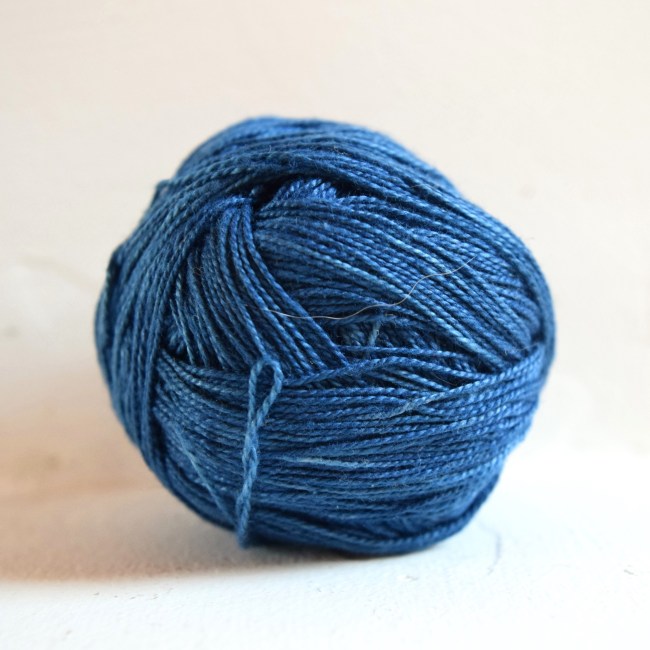
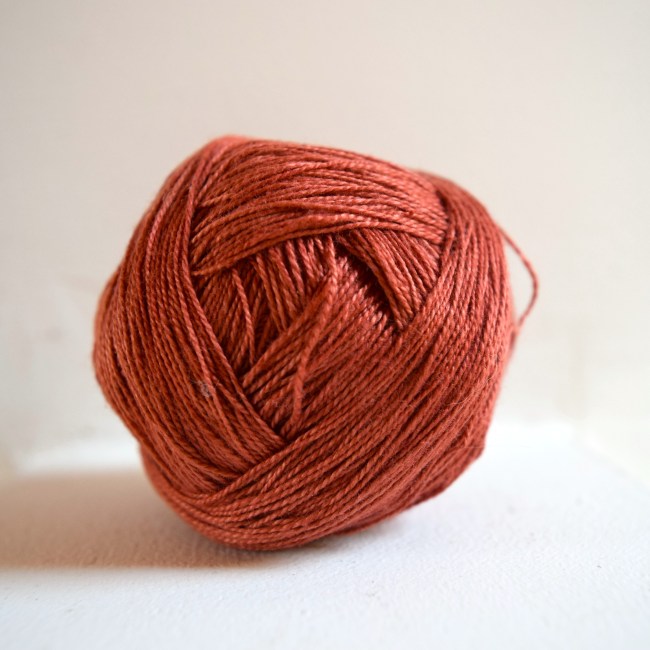
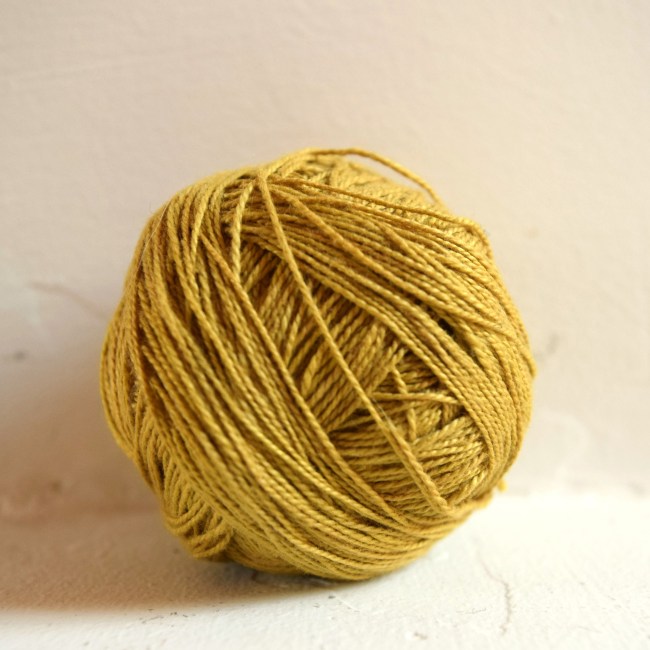
I’ve been trying out some natural dyes from my new natural dye kit, and decided to start a dye diary — a DYERY — on my blog, to keep track of successes, failures need not be mentioned. On the summer solstice I bought myself the EarthhuesColor Collection Kit which promises to be completely safe and I love the motto on the instruction booklet “What comes from the earth shall not harm the earth” ~~ I’m on board! The kit includes everything needed for one or two indigo vats as well as a dozen other color dye extracts, and mordants, plus color shifters, for both protein fibers as well as cellulose fibers, really quite a value when you open the box and it is packed with pouches and jars and a booklet too. I want to have my basic primary natural colors which is indigo, madder, and weld, but wanted to explore with some neutral and golden tones too, so these were my first two experiments all using 10/2 mercerized cotton for weaving …
Indigo: The dye used indigo extract powder, lye powder to make the vat alkaline and thiourea dioxide to reduce the oxygen in the bath — very fast — but the chemicals did not smell at all pleasant. I think next indigo dye vat I will try the well-known “1-2-3 fructose vat” which uses powdered food-grade lime (calcium hydroxide) to make the vat alkaline and fructose powder to reduce the oxygen. The color striations are from when I tied some warps for ikat that I posted in Knotty after being very inspired by the Japanese ikat video. I hope to try my first ikat weaving very soon, but that will be a different post. As I tied off the ikat warps 5 inches center-to-center, I figured I could go ahead and wind into a ball and align the ikat patterning on the loom when I weave.
Madder, Weld, Pomegranite, and mix of Wattle & Quebracho: Four at once, after scouring and then mordanting the cotton fiber with aluminum acetate solution. The four dyes simmered in separate pint jars in a huge electric 12 quart instant pot that I got just for dying, scouring, and mordanting with, and can set different sized jars inside of the heating water, which makes a very clean and flexible heat source. I don’t know which dye jars were the pomegranite and waddle/quebracho as I didn’t label the dye jars, a bad oversight out of inexperience to run up to the house and get pen to mark the jars with writing on rubberbands ~ next time for sure!
♣ Dye Notes ♣
Indigo: No need to mordant, and I forgot to scour. I didn’t weigh the parts, just used the vat recipe in the booklet which was in tsp/tbsp/cup measures — it really is magic, the blue is a beautiful earthy warm blue, truly a gorgeous blue light, medium, or dark shades.
Madder (15% wof “weight of fiber”): Came out exactly how I predicted, a beautiful warm brick red. In future if I want it darker, I think I’ll just overdye a grey or brown yarn or wool, and that should be perfect.
Weld (15% wof): Came out neon bright yellow, and ended up borrowing little bits of dye out of the other jars to tone it down. In future, I’ll only use weld in combo with other dyes or overdye another color like grey or brown, should be lovely.
Pomegranite (15% wof): What I suspect was the lovely gold, bottom left, but I can’t be sure. Once I find out for sure, I will repeat this percentage of wof because its a perfect gold.
Wattle & Quebracho (12% & 3% wof): What I suspect is the rosy beige the booklet recipe listed.
It was a long labor of love, and after a year, it returned to the source. My golden fields sweater project is finished, astonishingly on the anniversary of starting it, brought back to the inspiration, the golden landscape of summer that I love so much.
One year ago almost to the day, I was on a walk with Juno and we stopped at this very same rusty fence post. I took a photo of her in the wild grass, and posted it in High Summer. The place, and the photo somehow deeply inspired me, I craved to capture the connection I felt to the golden fields in August. When I got home I started blending all kinds of colors and spinning samples, striving to grasp the emotion and the colors of the sun toasted grass in high summer, and then committed to knitting a sweater from yarn I began to create yarn to color match it.
I am very pleased that the colors of the sweater seem to touch the spirit of the golden fields, and at one point the breeze blew the sweater off of a little branch I had hung it on to photograph, and it landed on its back in the grasses full of stickers and thistle stuff . . . it received of kiss of approval from the actual field!
I woke early this morning and realized if I worked fast that I could finish it, and take it up to photograph on this anniversary. So early I did the minimal finish work of grafting the underarms, weaving in the ends, sewing on the buttons, and decided rather than wash & block it, which would give it the smooth appearance of a new sweater not yet worn (and what I always recommend), instead I decided it would suffice to just steam it lightly, and keep its rustic appeal. Really though, it was because I let impatience win over! And before the sun got too high, I put on my walking boots, took the sweater, hanger, and camera, and walked up to the open space near my home where I often take photographs of the landscape.
This rustic cardigan was a lot of work and you can see all the process in posts from beginning to end in My Summer Fields Project, scrolling down through the posts about blending of wools on the drum carder, spinning the yarn, and finally the knitting from my own pattern Calidez Cardigan. I’ve even made a gallery of the best photos of the making of this project…