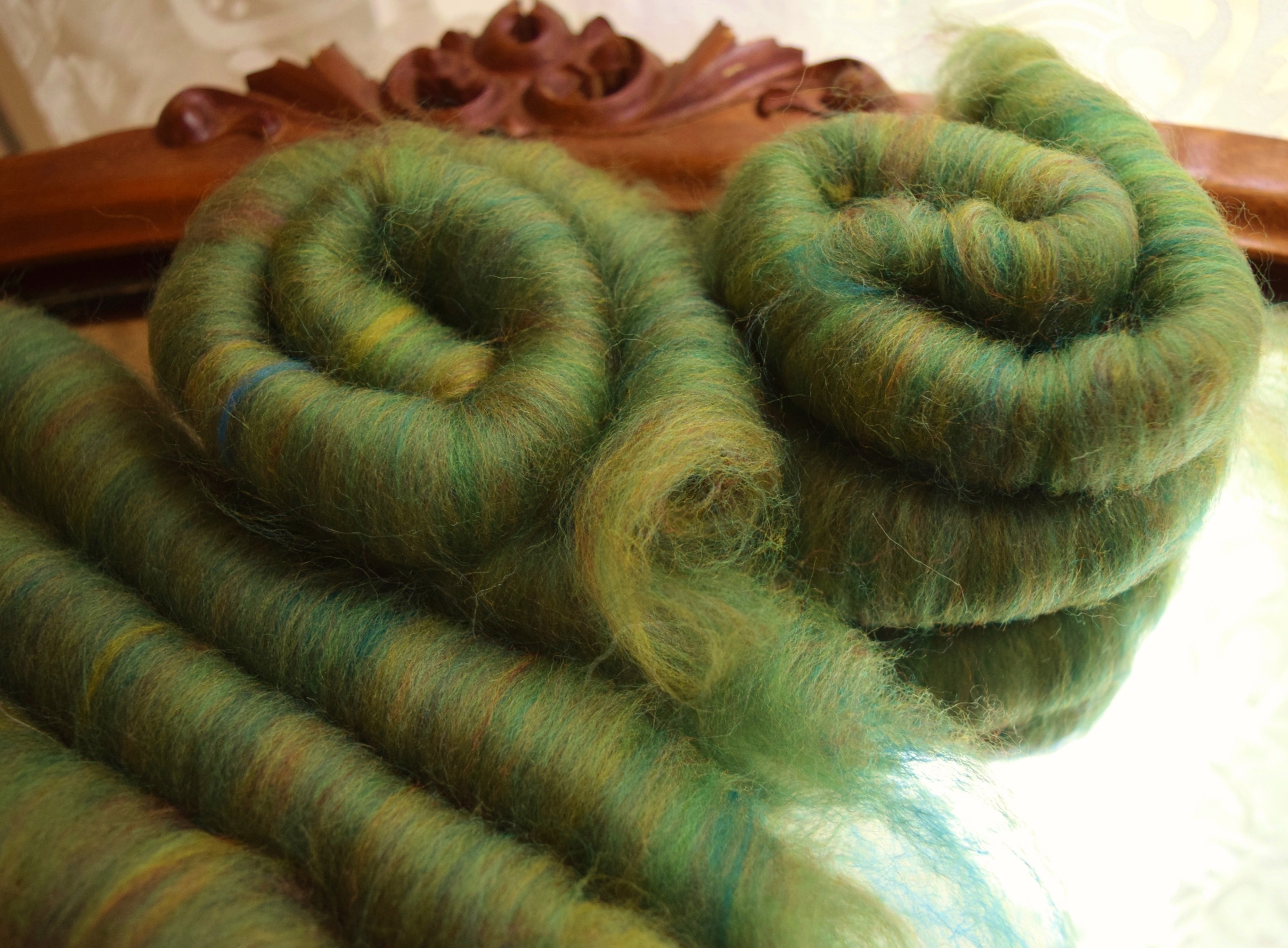
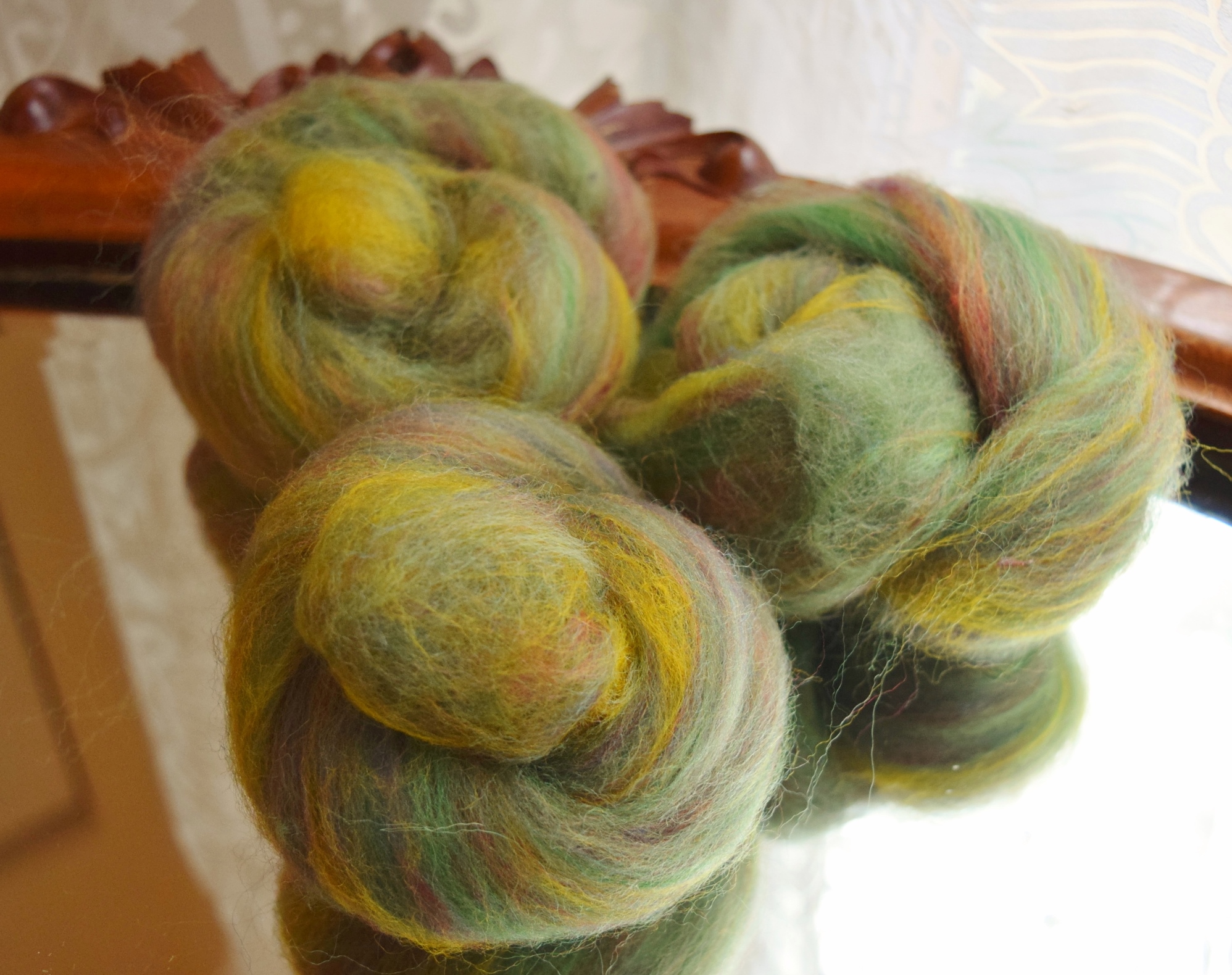
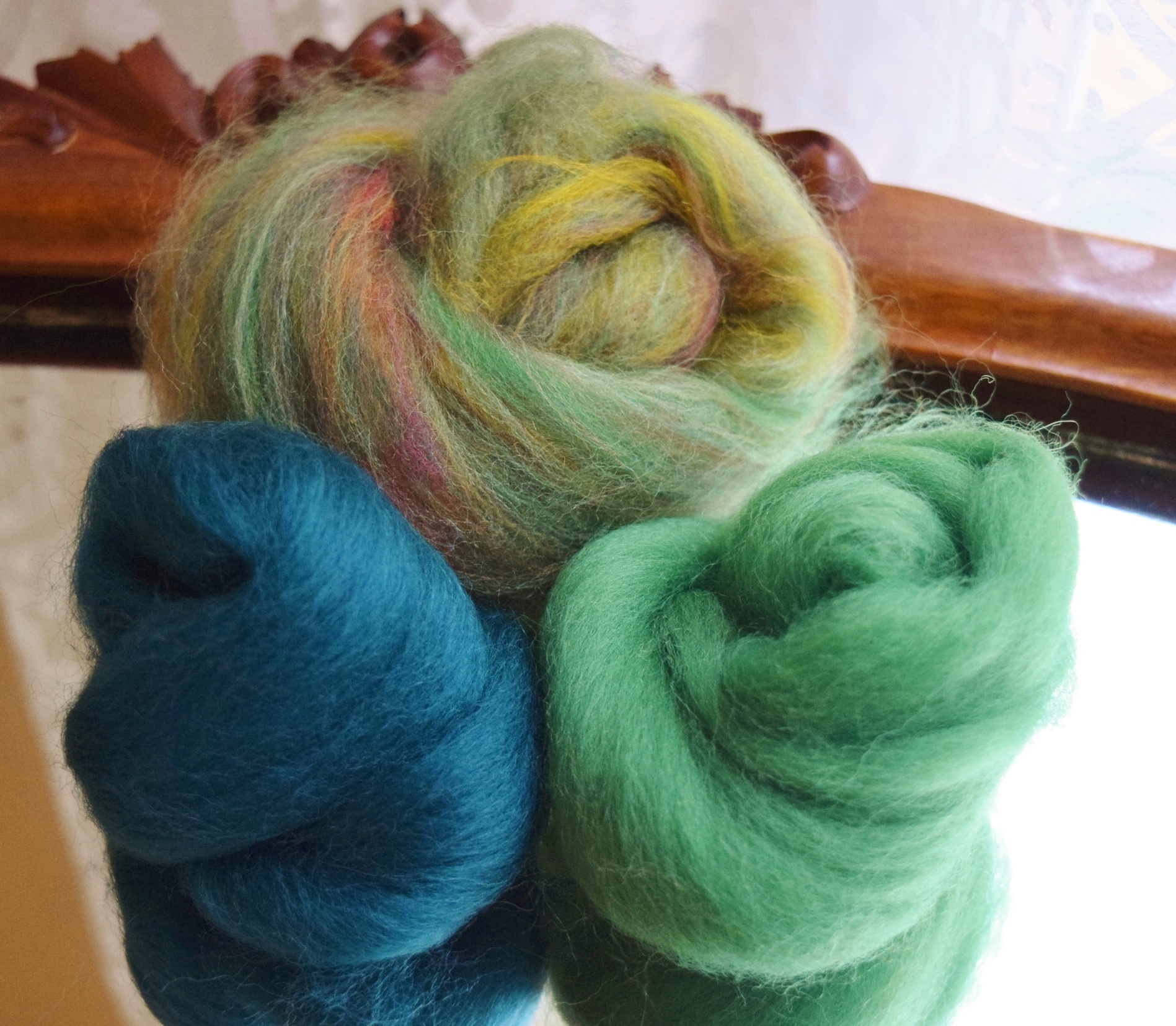
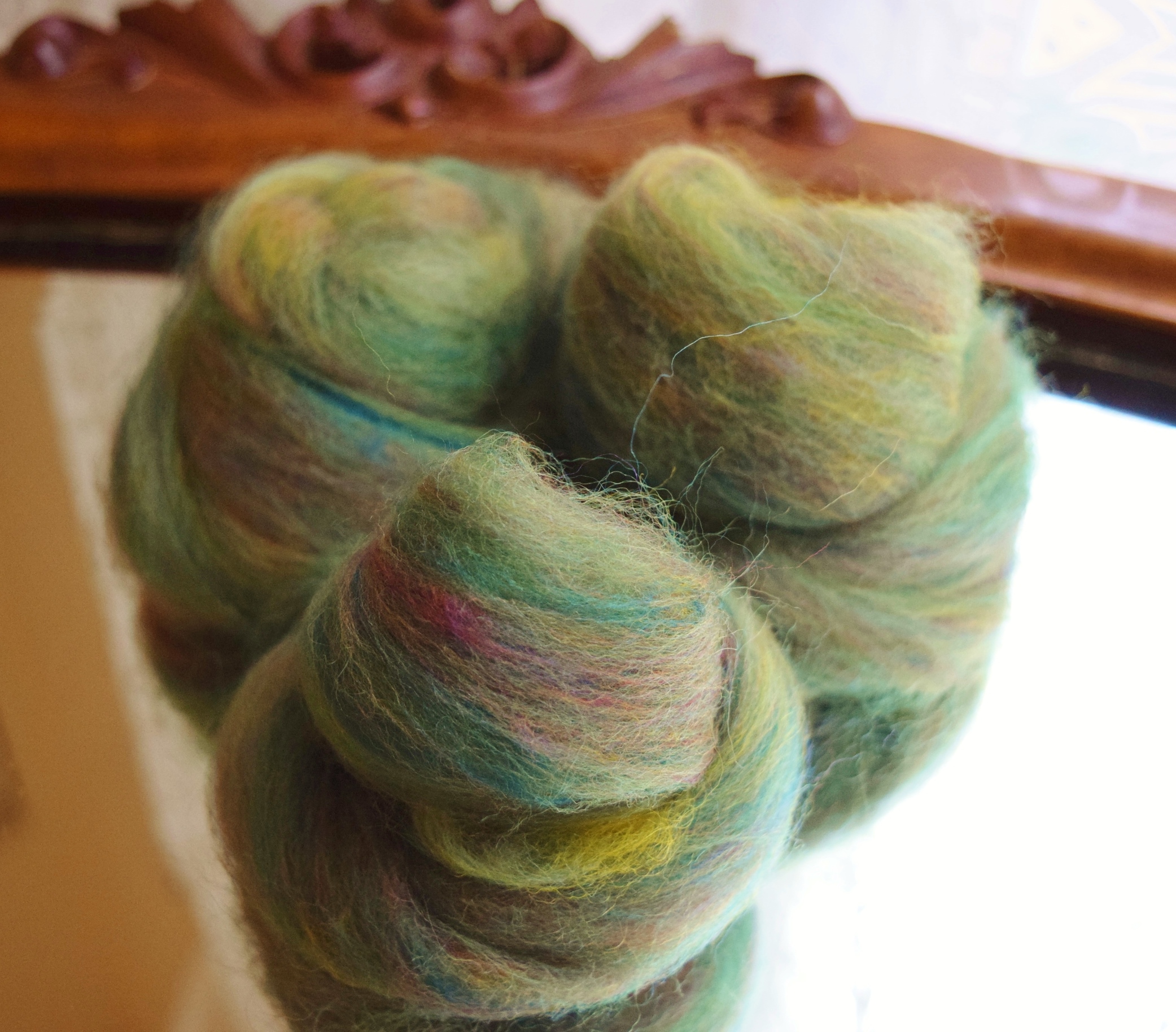
Moss is the most complicated color in nature that I can think of. Here in the mountains of Northern California, it is dormant through the dry season (most of the year if not half) during which it shrivels and turns an olive green to brown color. When the rains come, it is fat full of water, it glistens with nearly neon golden tips and has every shade of green present, plus a few other colors in there too …
I could never really quite figure out if real moss in nature is a warm or cool green, so I figure I’d just layer and layer and layer the colors until it seemed right, improvising as I went along …
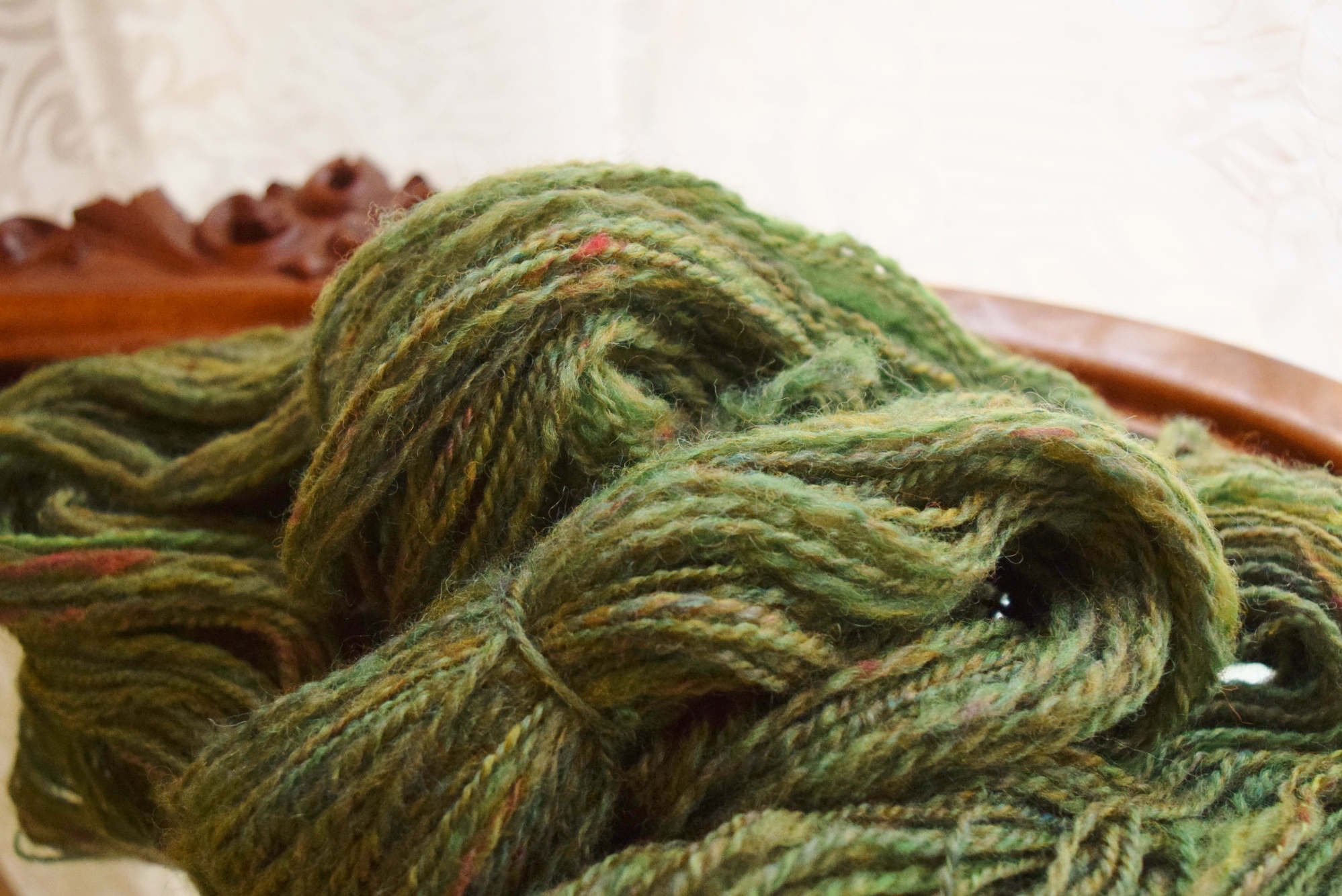
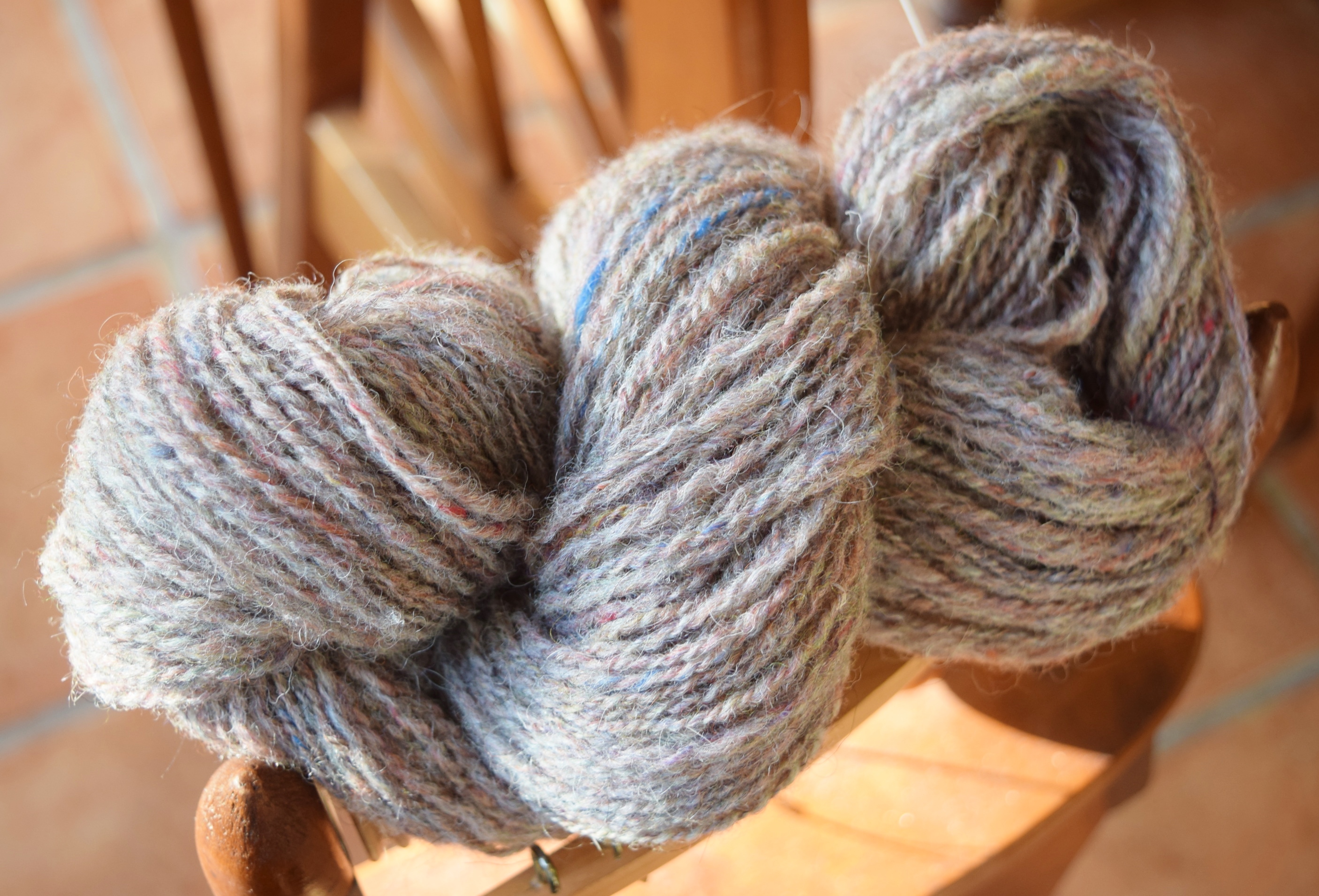
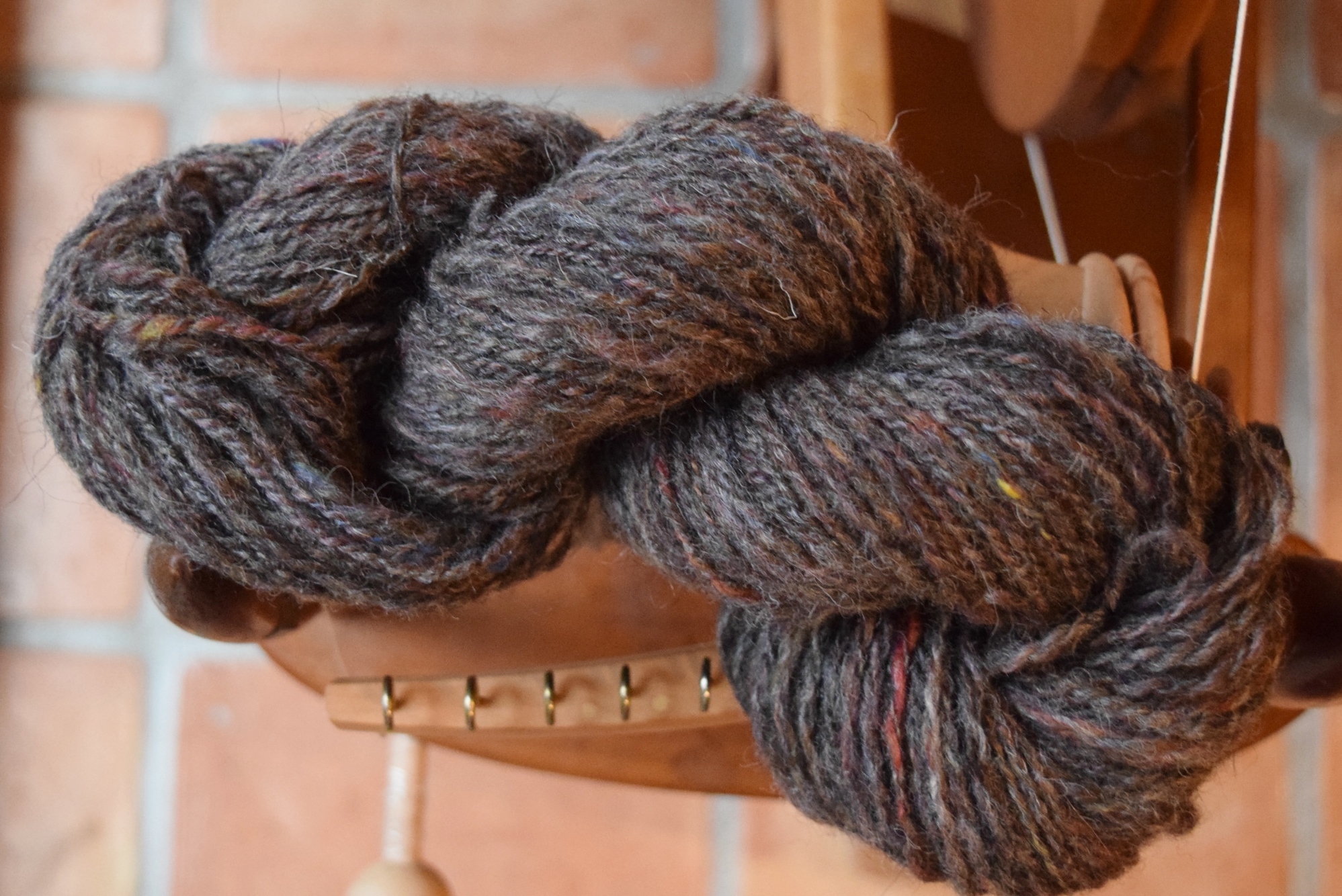
which spun up to be as complex of a green in yarn form as I thought it should be …
but I do think in hindsight I should have added more dark green, which I didn’t have any of, so if I did, I would have added in the greens.
Anyway, this is how I did my ” moss “…
♣ ♣ ♣
Techy stuff for Moss…
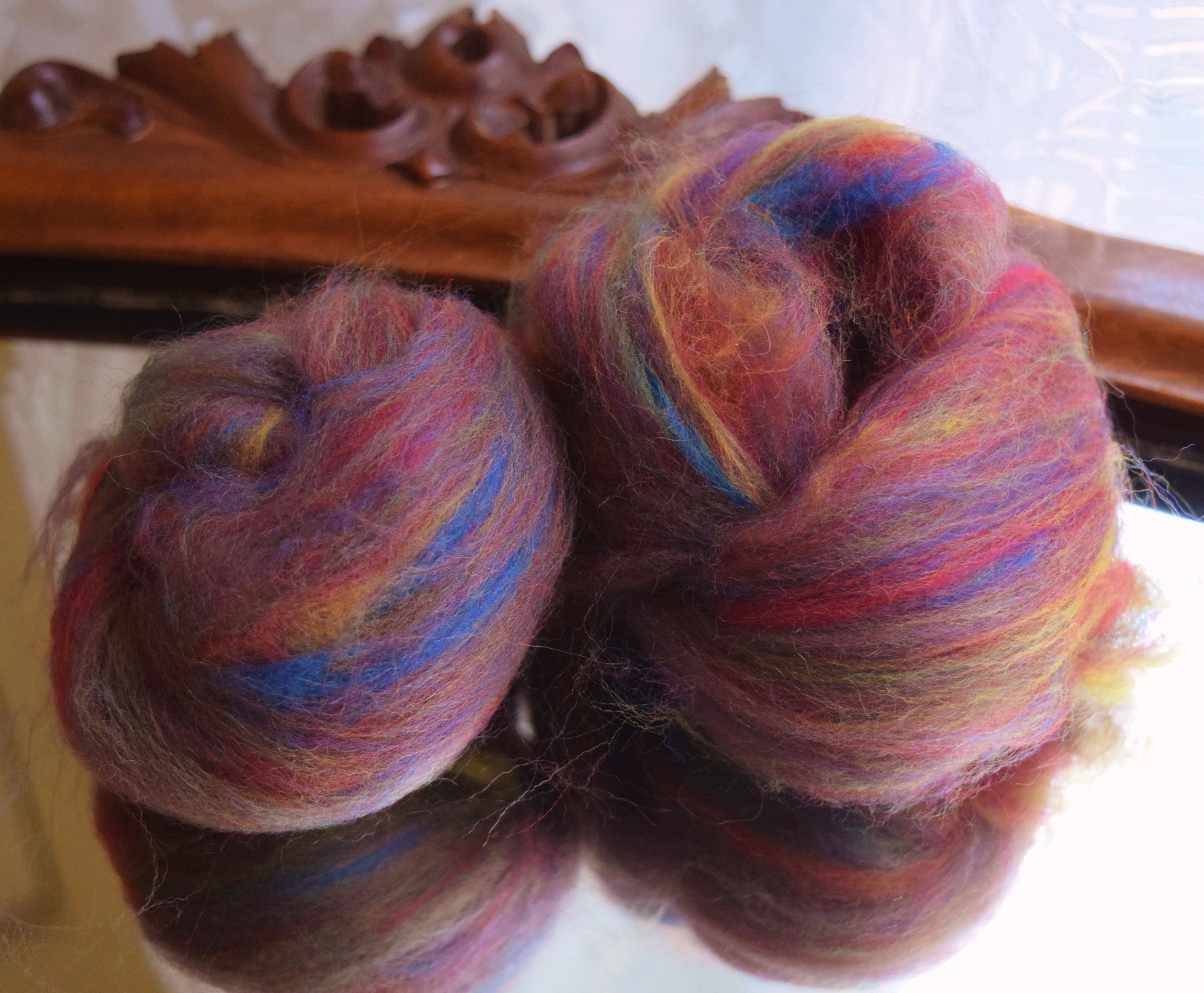
Began with Primary & Secondary Neutral recipe using approx 2.5g each of green, purple, and orange, blue, red, and yellow, (or alternately 5g each of primary or secondary triad colors) blended thoroughly on blending board (see Blending For Tweed Simplified)
Lift color saturated neutral batt, layer alternately with 5g each of grass green, leaf green, and olive green.
Lift batt, layer alternately again with 5g each of grass green and mustard yellow.
Lift batt, layer alternately again with 5g each of grass green and mallard teal. (I think next time I will blend in more Mallard teal, perhaps along with the yellow in previous step).
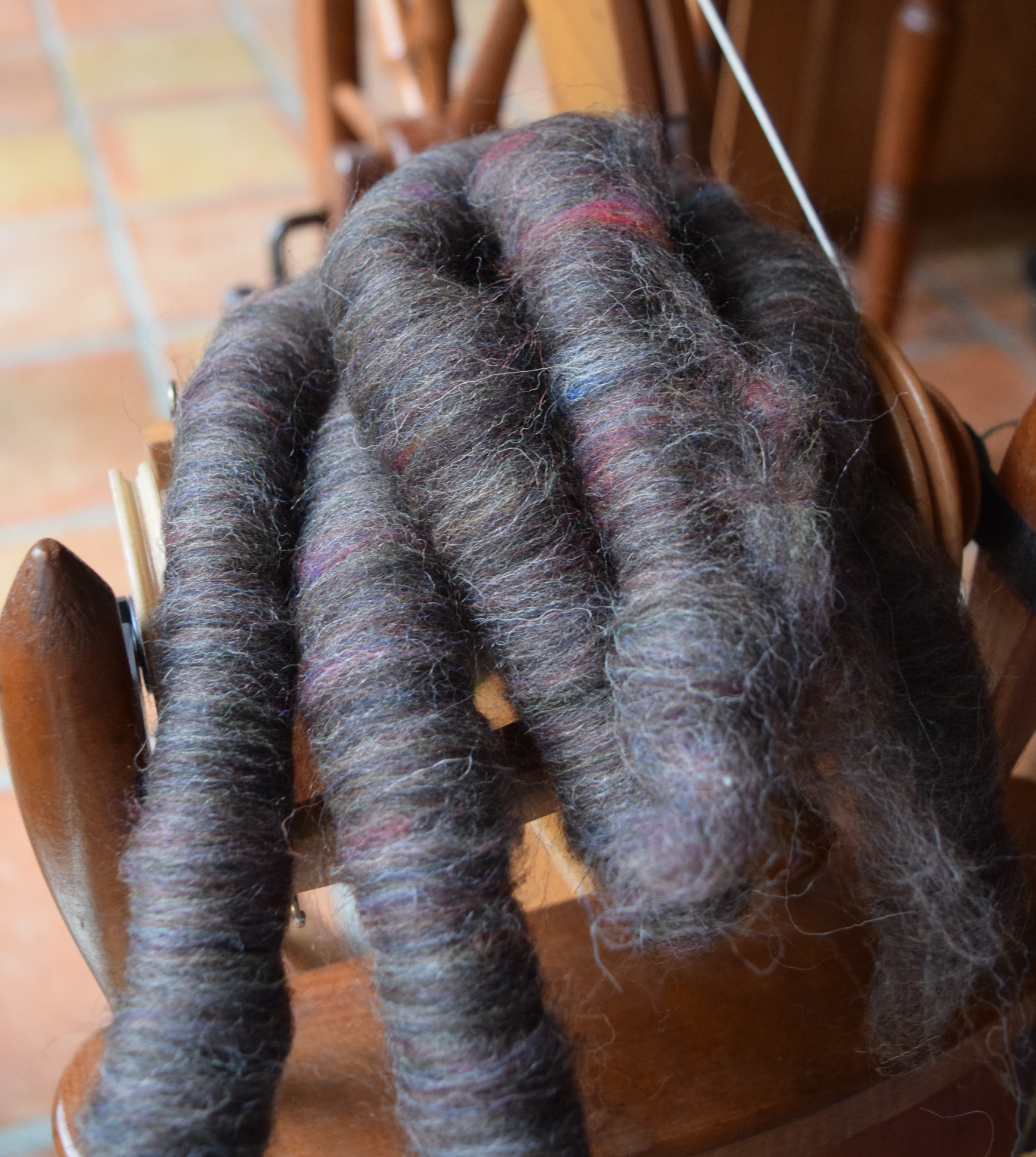
Layer again on blending board and draw off rolags.
Improvement for next time: Add more mallard (teal) with yellow, as well as a dark green.
Colorway blend: ” Moss” .
See ALL color blending experiments & recipes archived in Tweed Chronicles
Last and lightest color in my geological series is the ash layer from volcanic eruptions, and which show up a couple of feet down, seen mostly where there is water erosion in the ditches along side of some of the vineyard roads next door …
It is a stripey design of very light grey to medium grey, depending whether it is wet or dry, so “Ash” perfectly names the light grey color in my Geological colorways.
The bulk of the color is silver — natural grey and natural white fleece — so the range from a warm silver to a cool medium grey is up to the mood, and a thing which invites a lot of personal touch.
In my three geological colors of dark Shale, medium Sandstone, and now light Ash, either natural grey or natural brown can be blended with natural white for the rock tones, because the distinguishing difference is dark-to-light variation more than it is color hue.
The other distinguishing feature of geological colors is that I’m using undyed natural colors for the all-over color, with a splash of the color-saturated neutral showing …
… which by the way, the “color saturated neutral” (primary and/or secondary triad mix) is the unifying element of ALL of my tweedy colorways !
Next time I will use less ratio of the color-saturated neutral, because when one is blending a light wool , like paint, the proportion of pigment actually is very little. Also next time I will use more white in the mix to make the all-over color a lighter silver (noted below). But for the sake of documenting my experiment, here’s what I did…
♣ ♣ ♣
Techy stuff for Ash…
Began with Primary & Secondary Neutral recipe using approx 2.5g each of green, purple, and orange AND blue, red, and yellow, (or alternately 5g each of primary or secondary triad colors) blended thoroughly on blending board (see Blending For Tweed Simplified) , lift batt, set aside.
Layer 15g natural white with 15g natural grey, lift batt. (Note: For lighter grey, blend more white, less grey)
Layer color-saturated neutral batt with white/grey batt alternately.
Lift batt, and for lighter grey layer again with 15g more white.
draw off rolags.
Colorway blend: ” Ash” .
See ALL color blending experiments & recipes archived in Tweed Chronicles
In previous geological post I created a woolly colorway of Sandstone. Second in my geological series of the mountain, and underfoot quite a lot, is shale. A refresher of a quote from a reliable local vintners’ source, they who take the geology of this appellation very seriously…
Mount Veeder is primarily an island of ancient seabed, pushed up in the mountain’s formation five million years ago. This is the only Napa Valley appellation that can claim this unique geologic phenomenon. While the rest of Napa Valley was covered in volcanic ash 1 million years ago during the eruption of Mount Saint Helena to the north, Mount Veeder received just a sprinkling. Within the marine soils lies a complex tapestry of fractured shale, sandstone, volcanic (ash) dust, and other various constituents. — From Mt Veeder Appellation
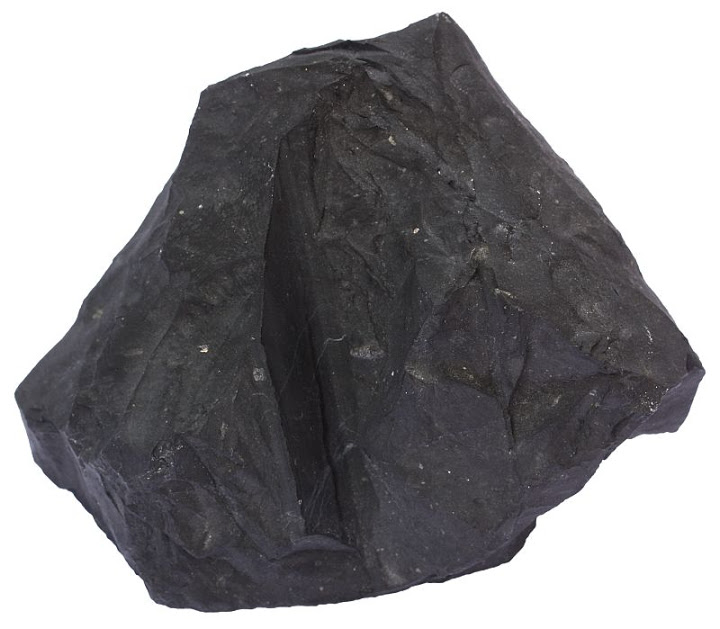
This rock I have seen in some places mounded up into nearly hill-sized formations which I suspect to be left behind by an ancient volcanic upheaval. Hard and a bit brittle, this broken shale is generally dark charcoal grey, although sometimes a medium grey.
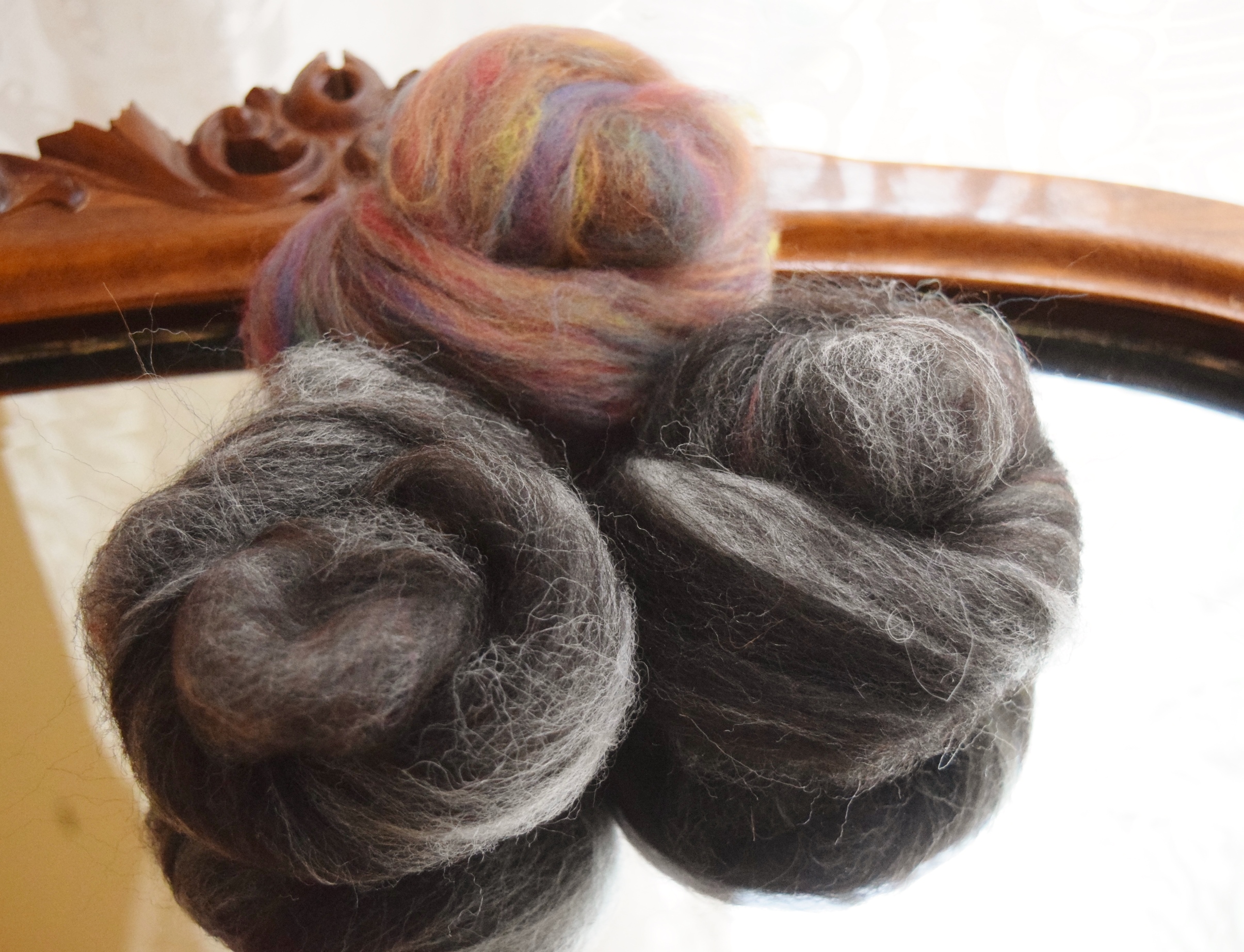
To achieve this color I use colors from the color-saturated neutral, blended with undyed wool shades of natural black and natural grey.
And as natural black and brown fleeces are amazingly varied in breed and color, so can be this shale colorway, ranging from medium grey to almost black, just as the rock is.
Stay tuned for geologcial 3, which will be a woolly colorway of yet another geological composite. Very pleased with the charcoal/black in my tweedy palette, I give you the recipe I have written for “Shale” …
♣ ♣ ♣
Techy stuff for Shale…
Began with Primary & Secondary Neutral recipe using approx 2.5g each of green, purple, and orange AND blue, red, and yellow, (or alternately 5g each of primary or secondary triad colors) blended thoroughly on blending board (see Blending For Tweed Simplified) ,lift batt, set aside.
Layer 15g natural black with 15g natural grey, lift batt.
Note: This blend is 50/50 black and grey. For darker color blend more black and less grey, and for lighter blend more grey, and less black.
Layer color-saturated neutral batt with black/grey batt alternately.
Lift batt, layer again. Layer once more for a more homogenized result, or go on to next step.
draw off rolags.
Colorway blend: ” Shale” .
See ALL color blending experiments & recipes archived in Tweed Chronicles
Inspired by the rock forms of the mountain, I have created three more colors in my palette, introduced in three parts. But first, let me borrow a quote from a reliable local vintners’ source, they who take the geology of this appellation very seriously…
Mount Veeder is primarily an island of ancient seabed, pushed up in the mountain’s formation five million years ago. This is the only Napa Valley appellation that can claim this unique geologic phenomenon. While the rest of Napa Valley was covered in volcanic ash 1 million years ago during the eruption of Mount Saint Helena to the north, Mount Veeder received just a sprinkling. Within the marine soils lies a complex tapestry of fractured shale, sandstone, volcanic (ash) dust, and other various constituents. — From Mt Veeder Appellation
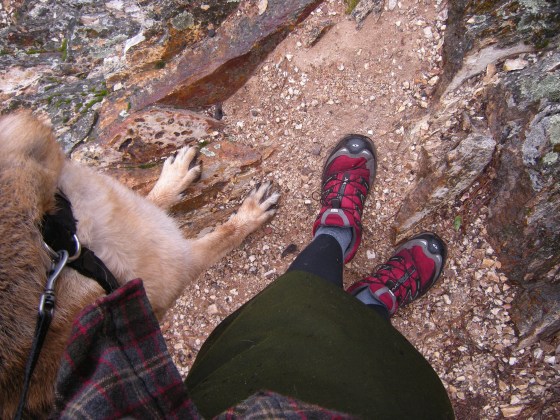
In my observation the most prevalent of these three mentioned geological rock forms must be sandstone, ranging from a dull tan, to a rusty brown and sometimes sparkles with colors, sandstone is the color of everywhere …Especially at the summit of the mountain these rocks are of rather large proportion, and an outstanding geological feature. Sandstone, with color-saturated neutral base, so like the true rock form created from a composite of many grains of colorful sand, blended with natural white and natural brown wool …
The nice thing is, using natural brown fleece, there is quite a variation of color, and as I blended with natural white, even more of variation of natural values & hues can be accomplished. Just as the rock itself is so varied in color, the Sandstone colorway is too…
Next , in Geological 2, I will produce a woolly colorway of another popular rockform, but as yet, I am waiting for my wool to come in the mail! Until then, here’s how I made “Sandstone” …
♣ ♣ ♣
Techy stuff for Sandstone…
Began with Primary & Secondary Neutral recipe using approx 2.5g each of green, purple, and orange, blue, red, and yellow, (or alternately 5g each of primary or secondary triad colors) blended thoroughly on blending board (see Blending For Tweed Simplified) Note: for a more dramatic tweed, with gobs of color splashing through, blend only once , then continue.
Lift color-saturated neutral batt, set aside, and blend 7.5g each of natural brown, and natural white.
Combine layer of color neutral with brown…
Lift batt, layer alternately with 7.5g each more of natural brown, and natural white. Note: In second blending, for a browner tone, continue with only brown, omitting the white, and for a creamier beige tone, omit the brown.
Draw off rolags.
Colorway blend: ” Sandstone” .
See ALL color blending experiments & recipes archived in Tweed Chronicles





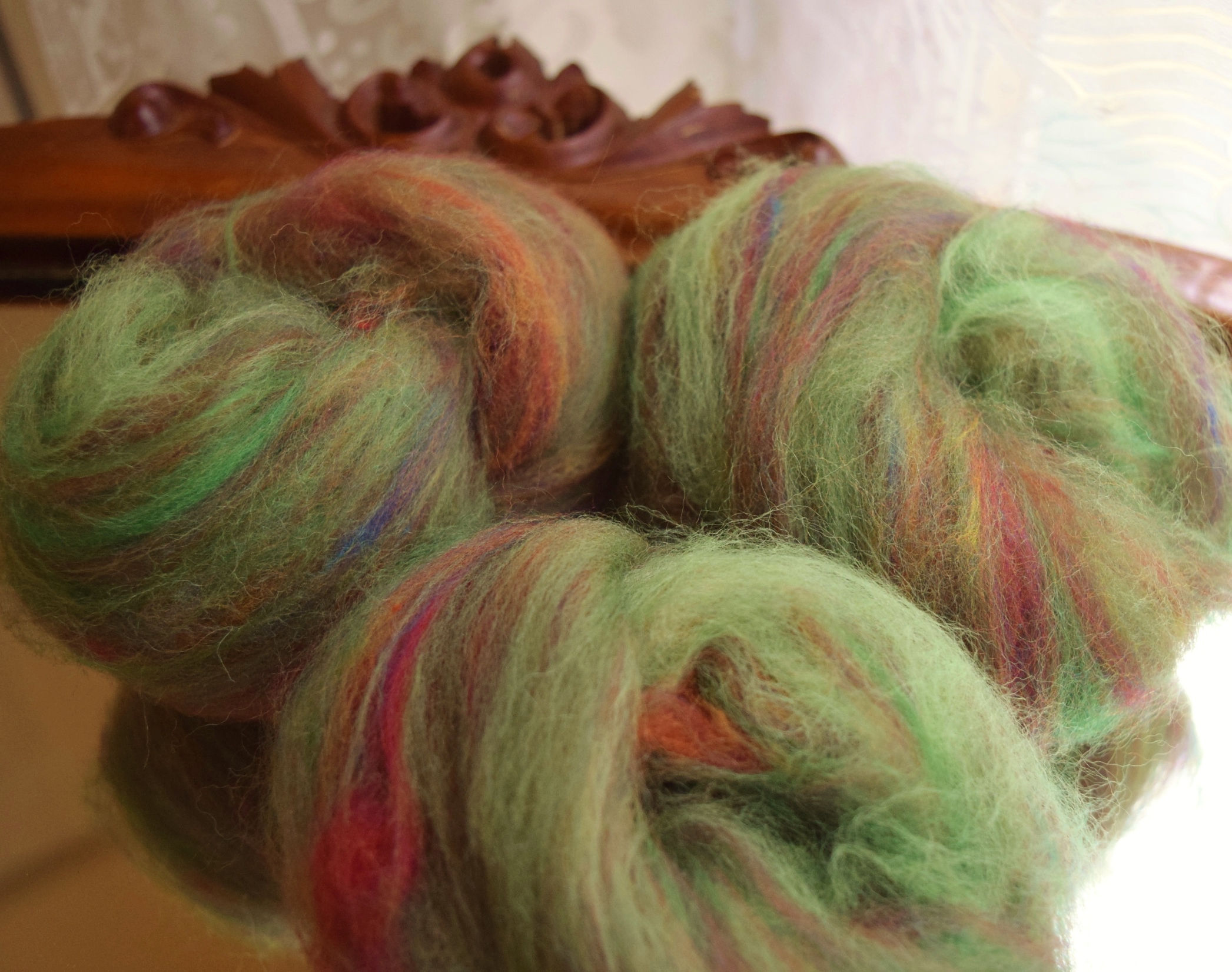
 Layer 15g natural white with 5g each of amber and mustard, lift batt.











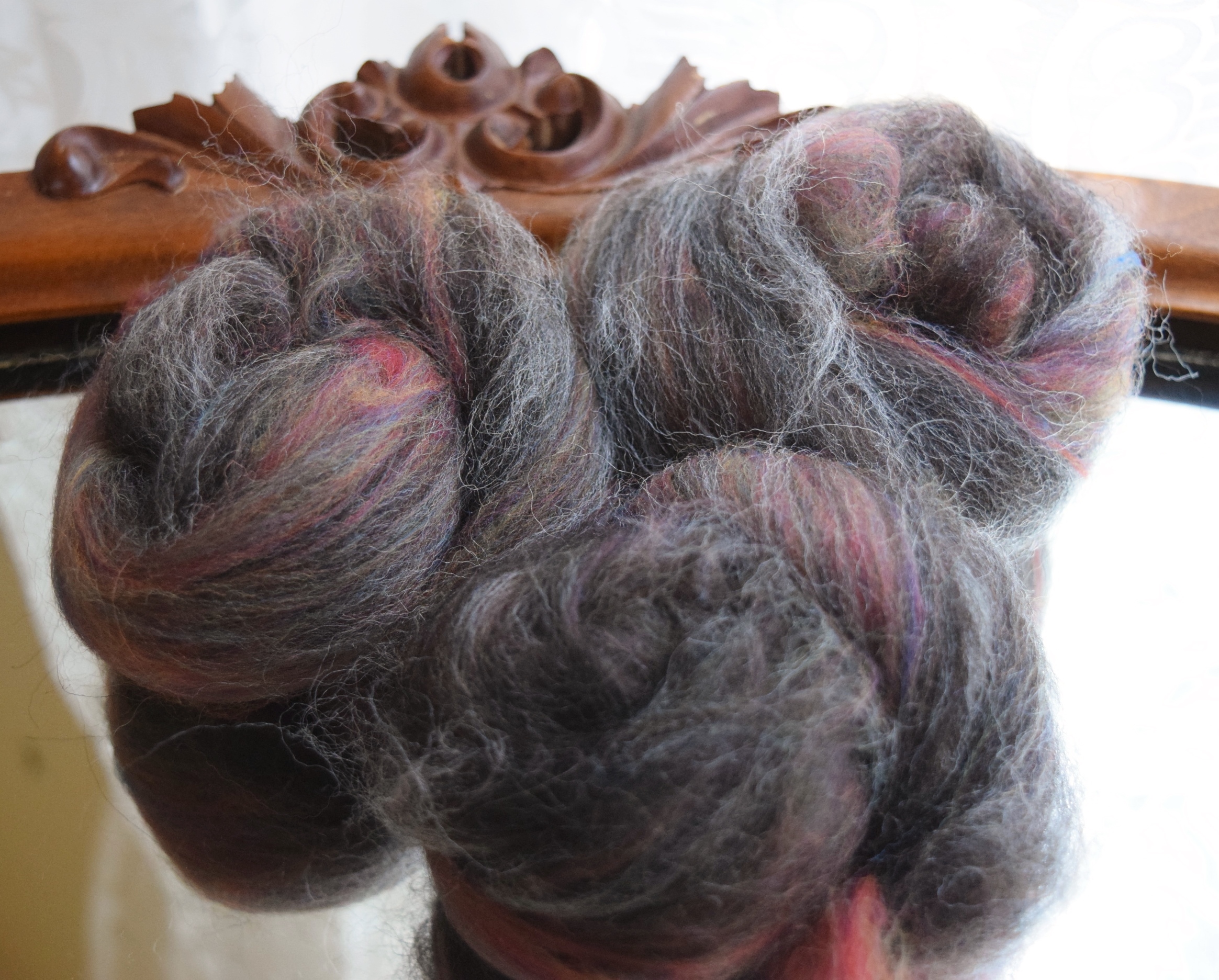
 Especially at the summit of the mountain these rocks are of rather large proportion, and an outstanding geological feature. Sandstone, with color-saturated neutral base, so like the true rock form created from a composite of many grains of colorful sand, blended with natural white and natural brown wool …


